
He killed his parents and stuffed their bodies into the fridge…
The Icebox Murders (1965)

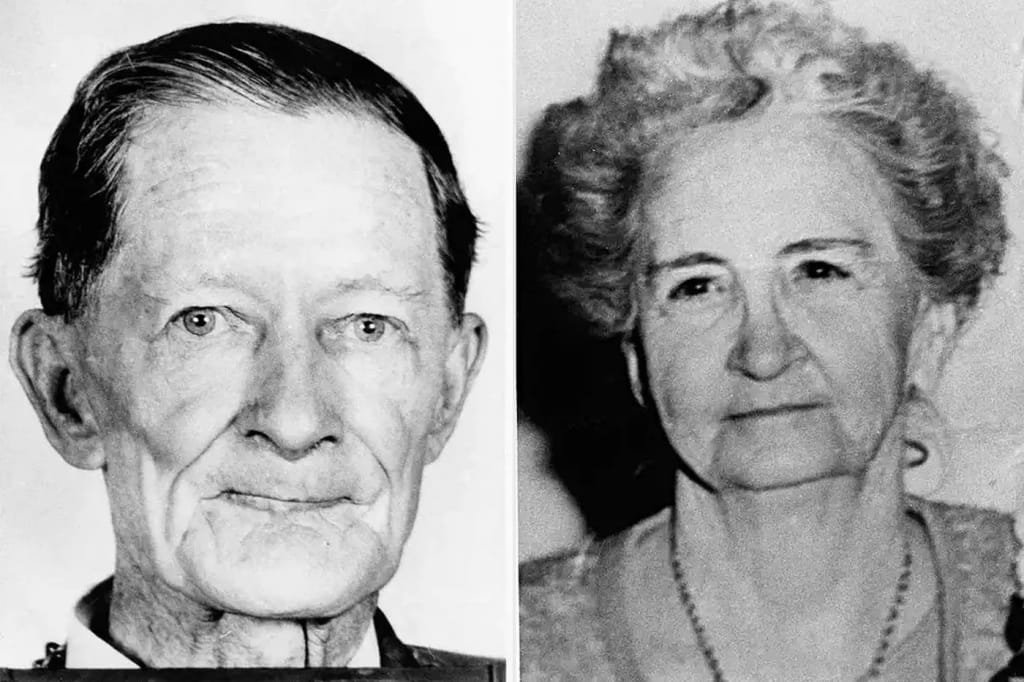
On a sweltering summer day in 1965, Houston police officers stepped into what seemed like an ordinary suburban home. What they found inside was anything but ordinary. The house was eerily quiet, yet the smell of something rotting lingered in the air. It was coming from the kitchen.
Opening the refrigerator, officers discovered a gruesome scene — severed body parts neatly wrapped in newspaper, stacked among the shelves like leftovers. The remains belonged to Fred and Edwina Rogers, an elderly couple who had been brutally murdered and dismembered. But the most disturbing part of the case? Their son, Charles Rogers, was nowhere to be found.
The Discovery
The Rogers family lived in a small house at 1815 Driscoll Street, a modest neighborhood in Houston’s Montrose area. Fred, 81, and Edwina, 72, were known to keep to themselves. Their son, Charles, a 43-year-old recluse, also lived in the home, but barely anyone ever saw him.
Days passed without anyone hearing from the elderly couple. Concerned, a relative called the police on June 23, 1965, asking them to check on the Rogers. Officers arrived and knocked on the door. No answer. After forcing their way inside, they searched the house — until one officer opened the refrigerator and stumbled upon a nightmare.
Inside, wrapped in bloody newspaper, were human body parts. Some were stored in the crisper drawers. Others were on the shelves. But something was missing — two things, actually. Fred and Edwina’s heads were nowhere to be found.
When officers examined the kitchen further, they discovered something even more horrifying. The couple’s missing organs had been flushed down the toilet, and their severed heads were later found in the backyard sewer. It was as if the killer had taken their time, carefully butchering them as if they were nothing more than meat from the butcher shop.
The Prime Suspect
Investigators soon realized there was only one person who could have done this: Charles Rogers. But there was a problem — he was missing.
Charles had always been an enigma. Despite living in the same house as his parents, he barely interacted with them. He would enter and exit the house through a back door, avoiding neighbors and even his own family. Friends described him as intelligent but deeply private. A former Navy pilot, Charles had studied physics and geophysics, working for Shell Oil before abruptly quitting his job in 1957. From then on, no one knew exactly what he did for a living. Some believed he was involved in secret intelligence work. Others thought he was just a reclusive oddball.
But after the murders, Charles completely vanished. There was no sign of a struggle in his bedroom. His car was missing. It was as if he had disappeared off the face of the Earth.
What Really Happened?
An autopsy revealed that Edwina had been beaten and shot execution-style, while Fred had been bludgeoned to death with a hammer. The extent of the dismemberment suggested that the killer had experience with anatomy — perhaps medical knowledge or even a background in butchery.
Authorities searched for Charles, issuing a warrant for his arrest, but he was never found. Over the years, theories about his disappearance grew wilder. Some believed he fled the country, possibly to Mexico or South America. Others suspected he had been involved in government intelligence work and was protected by powerful connections.
One of the most compelling theories came from The Icebox Murders, a book written in 1992 by Hugh and Martha Gardenier. The authors claimed that Charles had endured years of psychological and even physical abuse from his controlling mother and passive father. They suggested that he finally snapped, killing them in a fit of rage before meticulously disposing of their bodies and vanishing. The book even speculated that Charles may have had ties to the CIA and could have been involved in the assassination of President John F. Kennedy. While these claims remain unproven, they only added to the mystery.
The Lingering Mystery
Decades later, the house on Driscoll Street is gone, replaced by a new development. But the story of the Icebox Murders still haunts true crime enthusiasts. How does a man completely disappear after committing such a brutal crime? Was Charles Rogers an abused son who finally broke, or was there something more sinister at play?
To this day, Charles Rogers remains one of America’s most infamous fugitives. He was declared legally dead in 1975, though no trace of him has ever been found. Whether he died shortly after the murders or managed to evade capture for decades is a question that may never be answered.
One thing is certain: The chilling discovery in that Houston refrigerator remains one of the most disturbing murder cases in Texas history.
Thank you for reading!
If you find this piece interesting, please leave a clap, comment, or even subscribe! Your support means a lot to me!
About the Creator
Victoria Velkova
With a passion for words and a love of storytelling.
Keep reading
More stories from Victoria Velkova and writers in Criminal and other communities.
Robert Hansen: The Butcher Baker Who Hunted Women for Sport
Alaska is known for its breathtaking landscapes, towering mountains, and endless wilderness. But in the 1970s and 1980s, those vast, desolate spaces became the hunting grounds of one of America’s most terrifying serial killers — Robert Hansen, the so-called “Butcher Baker.”
By Victoria Velkova12 months ago in Criminal
Story of Larry Hoover
Larry Hoover Legacy in Reform and Pop Culture For more than half a century, the name Larry Hoover has carried a weight that echoes through Chicago’s history and American urban culture. Often discussed in connection with crime, controversy, or organized street life, Hoover’s identity became a symbol far larger than the man himself. But beyond the headlines, beyond the mythology, and beyond the notoriety, there exists a lesser‑known story: the story of a human being who evolved, reflected, transformed, and worked to redirect others from the path he once walked. It is this story — the one buried beneath decades of public narrative — that reveals the depth of Larry Hoover’s transformation.
By Organic Products about 13 hours ago in Criminal



Comments (1)
Gruesome story ✍️📕😜 please support me too have a read of my writing s 🙏