
George
There's work to be done, and there's work to be finished.

George T. Allen was seventy years young when he finally decided to buy the farm.
Not that he left on his own accord. In fact, it was something of a mandatory exit. A coup d’état. An involuntary overthrow and in George's mind a prototypical stealing of the reigns. You see, for a farmer, 'retirement' is a fluid term. It's a rather singular perspective. There’s work to be done, and there’s work that’s been finished.
Nothing more.
Nothing less.
You do your job.
Then you go home.
Rinse and repeat.
Unfortunately for George, the job was never, ever finished.
He was a constant silhouette on the horizon of this small town. A solitary spectre who tried his best to keep to himself. He didn't need much. He had family. He had friends. He was kind to everybody and for the most part, everybody was kind to him. While he'd never admit it, he was a bit of a workaholic. Years passed with George missing birthdays, first communions, piano recitals and funerals.
When he turned sixty-five, George said that he was calling it quits.
By sixty-six he reneged on that deal.
At sixty-seven he was complaining about his hips and by sixty eight he'd had the right one replaced.
He had trouble getting into the cab of the tractor at sixty-nine and so here was where we found ourselves, on the eve of George's seventieth birthday reading him his last rights at the edge of the headlands at the Southernmost tip of the Sixth Line Farm.
'Heavens to Betsy!' he swore, 'This whole godforsaken town is going to have to carry me kicking and screaming across my own darned land if you bunch of knuckleheads expect me to give up the ghost!'
Well, it was quite the sight to behold when the whole godforsaken town did exactly that. The entire community came together. They planned a parade and sent him off with a ceremony that was fit for a king. His own children - all mothers and fathers in their own respective rights - carried Old George over the fields, pallbearer-style with the rest of the Municipality in tow. Starting at the edge of the green beans, the whole procession travelled past the tomato plants, beyond the edge of the easternmost tree line and right through George's favorite row of corn.
He gave up one hell of a fight, but in the end, his weary old body fell limp in their arms - the grand culmination of years of sacrifice and complete and utter exhaustion. The deed was done, and the next day, George found himself in unfamiliar territory.
Officially and irreversibly retired.
He had been working the land since he was sixteen years old. His father had taught him the value of a hard day's work and so, from his very first shift, George had taken a single dollar bill and started a stack that he kept at the side of his nightstand. By the end of the year he had three hundred and sixty five dollars. After two, the total climbed over seven hundred and by the third year, George had soared past a thousand with no signs of stopping.
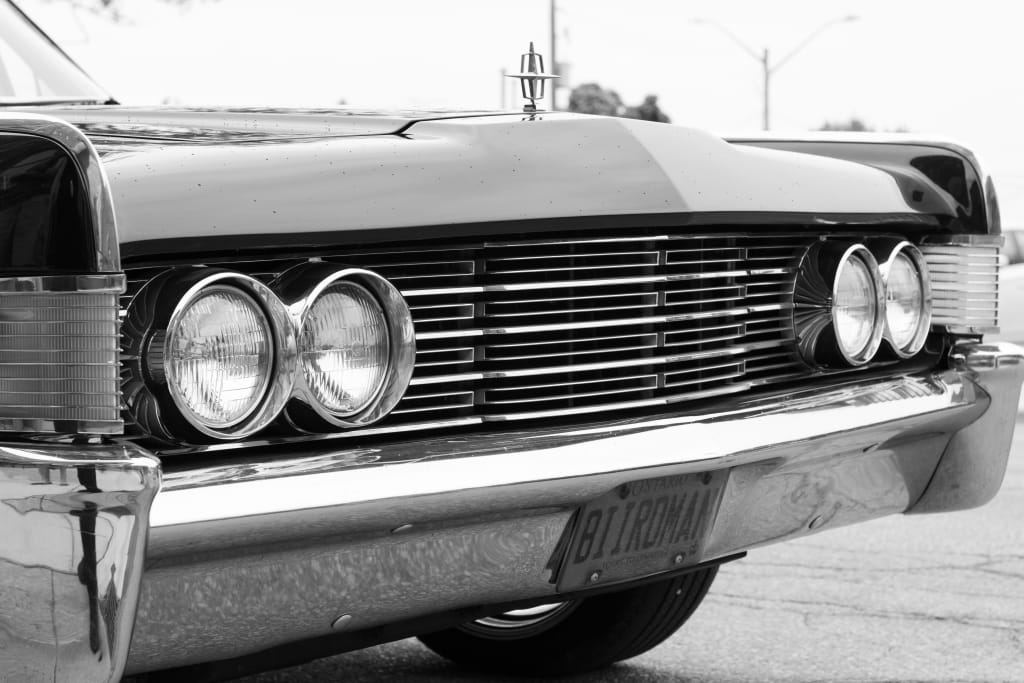
He had dreams of owning an all-black 1965 Lincoln Continental.
Each night, the tower would grow, but eventually, the whole thing became a bit of a ritual. George was working so much that the process became more important than the product. He truly did enjoy the repetitive nature of the task. George was the kind of man who preferred the finer forms of communication. He wrote with a small rectangular carpenter’s pencil. He loved the smell of cedar and took great pleasure in the almost religious act of slowly sharpening the tip with a short, stubby pocketknife. He had a penchant for handwritten letters. Rotary telephones. Community radio, and a knock at the door when a friend was in need.
Well, sometimes.
George had a crippling fear of 5G cell towers and so, in order to stay connected, he kept a contact list of all of the important people in his life in his front breast pocket. The archive was maintained in a small black notebook and the important sections marked by a thin black band. The last few pages contained the ledger for his money. It was the only visual evidence of the savings he'd collected, and it also provided the combination to the lock on the front of his toolbox.
He never did get the chance buy that car.
He drove a beat up old runner and in due course, came to appreciate it's predictable nature. When he received his driver's license, George transferred the stash to the bed of the pickup truck, meticulously adding to the stack and binding the bunches at both one hundred and one thousand dollar intervals. As you might imagine, after years and years of tending to his habit, a small fortune had been amassed.
On his seventieth birthday, George had accumulated a grand total of $20,000.
You'd would be surprised at just how little space such a large amount of money takes up. Turns out - enough to fill a toolbox.
You see, George was a trusting kind of fellow. A big believer in the kindness of strangers and the loyalty of his friends. He never locked his doors and always hung his keys behind the sun visor on the passenger side of the cab. Everyone knew that.
I knew that.
It was all out in the open. That’s the way he lived his life. Naked as a baby bird. No one hated George.
I never hated George.
George was great. He was sweet, and kind, and mild-mannered and was always willing to help. He gave me my first job and took me under his wing. He showed me the ropes and made sure to point out my mistakes so that I could do better. The life of a farmhand doesn't come with much vertical flexibility. No climbing of the economical ladder here.
There's just an expectation that you follow the rules. No recognition of personal circumstances. No empathy for issues that might be beyond your control. Frankly, there was never any perspective that some people don't come from the same kind of decorated pedigree as good old George.
Just for the record - I asked for a raise.
I reached out to George. I explained my situation. I told George that we were struggling. That we needed money and that we had no lifeline. George knew full well what we were dealing with at home. The medical bills. The lack of insurance. The short term loans and the long term consequences. And George?
Well George didn't listen.
George just continued on doing what was best for George, because that's the way it goes around here.
George, George, George, George, George.
So.
Yeah, when the opportunity presented itself, I grabbed that little black book.
I stole those keys. I unlocked that toolbox and I took every last bill out.
And you know what?
He didn't even notice.
George was retired. Remember?
Nothing to do. Nowhere to go. George hadn't even driven that truck in over a month!
Oh, it was so very hard to locate.
Sixth Line Farm. Right outside the main barn. Back of the building. Beside the lean-to. Exactly where it always was. Not exactly rocket science.
George never needed the money he'd been saving up his entire life.
Everyone was so worried that George wouldn't be able to handle the transition toward this new phase of his life, but if you ask me, he's handled it like a champ.
In some ways, George was exactly like that Lincoln Continental that he held in high regard. Stuck in the past. Incapable of change. Ornery as all get out and a pain in the neck to work with.
In George's world, there’s always work to be done, and there’s always work that’s been finished.
Nothing more.
Nothing less.
You do your job.
Then you go home.
Rinse and repeat.
About the Creator
Colin Pattison
Father. Teacher. Writer.
Molder of Minds.
Teller of stories.
Occasional observer of people, places and things.
Keep reading
More stories from Colin Pattison and writers in Criminal and other communities.


Comments
There are no comments for this story
Be the first to respond and start the conversation.