
Female Victorian Murderesses
"There is a horrible fascination attached to capital crimes"


Today we see so much on the news that, unfortunately, we are rarely shocked when we hear of a murder, unless it is particularly ‘graphic’. Communication in this Century surpasses any other Century and we can see or read the news of (almost) any country with the click of a button or the tap on a phone.
In the Victorian Era, we can only “imagine” the shock a murder caused throughout the country. The newspapers were well established but how many could actually read them? The photograph had just been invented and the telephone was invented in 1878, when Alexander Graham Bell demonstrated it to Queen Victoria. We tend to think of the days described in a Charles Dickens novel, when on one side of the ‘street’ there was squalor and on the other side of the ‘street’ the rich. Very few even think that there was much crime at that time — except when the name Jack the Ripper comes up.
At a time when women were not even allowed to study to become a doctor, it is hard to imagine, or even believe, that there were women who were cunning enough to murder. Kate Webster, Marie Manning and Mary Ann Cotton were three such murderesses.
Katherine Lawler was born in 1849 to respectable but poor parents, who lived in Killane, County Wexford, Ireland. As a young child, she was caught stealing on many occasions, which gave her the reputation of being dishonest. Once she was in her early teens, Kate stole quite a lot of money and used it to sail to Liverpool. Kate was fed up with the constant arrests and nagging lectures from the local priest. Once in Liverpool, she lived by her wits and by what she could steal. At 18, Kate was caught picking pockets and spent 4 years in prison.
Once released from prison, Kate travelled to London and managed to get a job as a charwoman, adding to her income with prostitution. Before long, Kate became pregnant and gave birth to a son. This, however, did not change her character and Kate was soon back to stealing from boarding houses this time. She would take a room, sell everything she possibly could from the room, and disappear with the money. Kate got caught time and again, being arrested several times, receiving short prison sentences. In 1875, Kate spent time in Wandsworth prison and when she was released in 1877, it didn’t take long for her to go back in again.
In 1879, Kate moved to Richmond, leaving her son with Mrs. Crease, a woman she had become quite attached to, and Kate got a job as a maid for a wealthy lady, Mrs. Julia Martha Thomas, who lived at 2, Vine Cottage, Park Road, Richmond. At the beginning, Kate seemed to work well but she soon fell back into her old habits by spending more time in the local pubs than working. After working as a maid for only one month, Mrs. Thomas sacked Kate on Sunday 2nd March (1879), and then went off to church.
Angry because she had been sacked, Kate waited for Mrs. Thomas to return from church and followed the old woman up to her bedroom. As soon as Mrs. Thomas had removed her hat, Kate burst into the room with an axe and struck the old lady. Managing to crawl onto the landing, Kate pushed the old lady down the stairs and smashed Mrs. Thomas over the head with the axe, killing the wealthy old lady. Dragging the body into the kitchen, Kate chopped it up and started to boil the remains. The stench was terrible, so Kate ‘took a break’ and went to the local pub. Returning to finish the job, Kate also scrubbed the house to destroy any evidence, burning the bones in the fireplace.
Kate Webster was so greedy that she sold the old lady’s gold bridgework. Throwing the remains into a box, she threw the box into the River Thames, thinking that she had committed the perfect crime and would never be caught. Kate was so certain of this that she started to sell Mrs. Thomas’s furniture, telling ‘new acquaintances’ that she had inherited it from an aunt. However, the box she had thrown into the Thames was found by fishermen, with the remains still inside.
A neighbour called the police when she saw Mrs. Thomas’s furniture going out of the house without Mrs. Thomas or a maid supervising. The police went to the house and Kate Webster fled back to Ireland. The authorities now realized that Mrs. Thomas had been murdered and followed Kate to Ireland, where they arrested her. She was still wearing Mrs. Thomas’s dress and rings.
Kate did not go quietly and ‘identified’ several others for doing the murder, but their alibies were proved true, proving Kate’s guilt. Now back in London, the trial began and the newspapers were sensational in covering the murder, which shocked the whole country. The death sentence was given but Kate “pled her belly”, pretending to be pregnant. An examination by a doctor soon proved her a liar.
The night before the execution, Kate Webster admitted to the prison chaplain and the warden that she had committed the murder, and on 29th July, 1879, Kate Webster was executed by hanging at Wandsworth prison.
The next murderess was the inspiration for one of the characters in Bleak House by Charles Dickens. She was born Marie de Roux in Lausanne, Switzerland, coming to England and entering domestic service. Marie’s first job was maid to Lady Palk of Haldon House, Devon, and then she moved on to Lady Blantyre at Stafford House in 1846.
Marie started to court an Irish custom house officer called Patrick O’Connor, who ‘paraded’ himself as financially successful, although he had in fact bribed his way into his position. Marie also met Frederick George Manning who was a railway guard and who also wanted to court her. Marie made her choice and married Manning because O’Connor liked his drink too much. Manning enticed Marie with some kind of inheritance that he would get once his mother died. Over time, Marie realized that this was not true, and so took up her ‘friendship’ with O’Connor again.
O’Connor encouraged Marie to take up lodgings at Minever Place, London, saying that he would become a boarder. O’Connor had lied and so the Mannings took in a medical student, named Massey, to help with the finances. It’s generally thought that O’Connor and Marie had started an affair by now. Her husband seemed to be blind to the affair, mainly because he was drinking quite heavily by now.
O’Connor had become a wealthy man and on 9th August, 1849, dined with the Mannings. During the evening, the couple carried out their plan and murdered O’Connor by shotting him in the back of the skull. They buried the body under the flagstones in the kitchen. A week later, a police officer noticed a damp corner stone on the floor and found O’Connor’s remains. In the meantime, Marie had gone to where O’Connor was lodging and stole his railway shares and money.
Realizing that the police were onto them, the couple fled, double-crossing each other. Marie was arrested in Edinburgh and her husband was arrested on the island of Jersey.Both were tried at the Old Bailey on 25th and 26 October, 1849. Mr and Mrs Manning were executed by hanging on 13th November, (1849). For the execution, Marie wore a black satin dress, Satin being the most fashionable fabric at that time. Herman Melville, who paid half a crown for a spot on a roof overlooking the execution, wrote: “The man & wife were hung side by side — still unreconciled to each other — what a change from the time they stood up to be married, together!”
Mary Ann Robson was born at Low Moorsley, County Durham, on 31st October, 1832. The family moved to the village of Murton where Mary Ann was described as: “a most exemplary and regular attender” by the Sunday School superintendent, “a girl of innocent disposition and average intelligence”, and “distinguished for her particularly clean and tidy appearance”. Her father died in a mining accident in February, 1842, and her mother married George Stott in 1843. At 16 years of age, Mary Ann moved to the nearby village of South Hetton, to become a nurse in the home of Edward Potter. Once all of the children she was caring for left for boarding school, Mary Ann returned home and trained as a dressmaker.
At 20 years of age (1852), Mary Ann married William Mowbray, a colliery laborer, and the couple moved to South West England. They had several children, some dying of gastric fever, and her husband died of an intestinal disorder in January, 1865. William and the children were insured by the British and Prudential Insurance office, and Mary Ann collected £35 (£3,421 today) on her husband’s death and £2 5s for one of the sons' deaths.
Soon after her first husband’s death, Mary Ann met and married George Ward (1862). Mary Ann was working at the Sunderland Infirmary, House of Recovery for the Cure of Contagious Fever, Dispensary and Humane Society. George was one of the patients. George continued to suffer bad health and he died in 1866 after a long illness of paralysis and intestinal problems. Mary Ann again collected the insurance money on her second husband’s death.
In November, 1866, Mary Ann became housekeeper to the recently widowed James Robinson (in Sunderland). The two quickly became close and Mary Ann became pregnant. At this time, her mother became ill with hepatitis and Mary Ann went to care for her mother, who died just nine days after her daughter’s arrival. The mother complained of stomach pains.
Going back to her ‘position’, two of Robinson’s children died and Mary Ann’s daughter, Isabella. The children were buried the last week of April and the first week of May, 1867. Mary Ann collected insurance money on her daughter’s death. Robinson married Mary Ann on 11th August, 1867, but soon became suspicious when she kept nagging him to insure his life. He also found out that she had run up debts up to £60 (which was a lot of money in those days, £7,147 today). When he found out that his new wife had been forcing his older children to pawn household valuables, Robinson threw Mary Ann out of the house.
Penniless and on the streets, Mary Ann now received help from Margaret Cotton, who introduced her to Frederick, Margaret’s brother. Frederick was a widower with children and Margaret had been helping her brother to look after the children. In March, 1870, Margaret died of an undetermined stomach ailment and Mary Ann took over looking after the children. Very soon she became pregnant with her twelfth child and Cotton married her (bigamously) on 17th September, 1870. Their son, Robert, was born in early 1871.
Mary Ann found out that her former lover, Joseph Nattrass, was living about 30 miles away, and she persuaded her fourth husband to move to the village of West Auckland (where Nattrass was living). They soon became lovers again and Frederick Cotton died from gastric fever that same year. Her lover now became her lodger. Mary Ann gained employment as a nurse to an excise officer who was recovering from smallpox. The two became lovers and she became pregnant with child number thirteen. Two of her baby sons died and Nattrass became ill with gastric fever, dying after he had changed his will to favor Mary Ann.
It was at this time that Mary Ann got caught! The Parish official, Thomas Riley, asked Mary Ann to help with the nursing of a woman with smallpox. Mary Ann complained about Charles Edward Cotton, the last surviving Cotton boy, because he was getting in the way of her life. Mary Ann told Riley: “I won’t be troubled long. He’ll go like all the rest of the Cotton’s”. Five days later the boy was dead and Riley went straight to the police. Mary Ann collected the insurance money from the little boy’s death.
The local newspaper picked up on the story and it was discovered that Mary Ann had moved around the country and: lost 3 husbands, a lover, a friend, her mother and 11 children — all of whom had died of stomach fevers. Scientific investigation found that arsenic was found in Charles’ body. Mary Ann was arrested, and charged with his murder. Mary Ann’s trial was on 5th March, 1873, and she was found guilty of murder. The Times reported: “After conviction the wretched woman exhibited strong emotion but this gave place in a few hours to her habitual cold, reserved demeanor and while she harbors a strong conviction that the royal clemency will be extended towards her, she staunchly asserts her innocence of the crime that she has been convicted of”. Mary Ann Cotton was executed by hanging at Durham County Gaol in 1873.
All three women thought that they would never get caught but all three were, and justice was served for the innocent people and children, who had murdered by their wicked hands. It is just so crazy to think that this happened in the Victorian Era!
(If you enjoyed reading this article, please fell free to like/subscribe/leave a tip or go over to my website where my other articles are: https://sarah-s-story-book.webnode.co.uk/ )
About the Creator
Ruth Elizabeth Stiff
History and knowledge, especially about the Earth, are my passions. I enjoy putting my thoughts to paper and I always try to encourage self-motivation and love for life. LIVE AND LOVE LIFE!
Keep reading
More stories from Ruth Elizabeth Stiff and writers in Criminal and other communities.
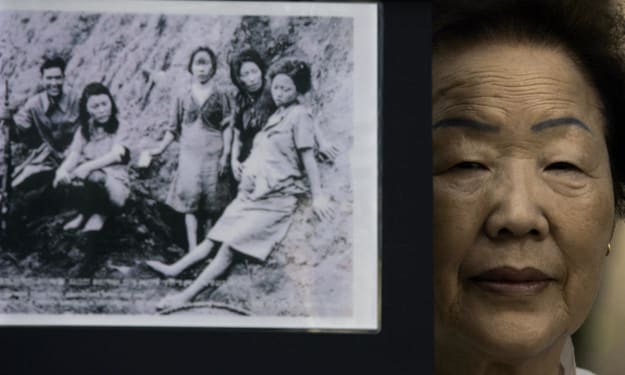
"Comfort Women"
The definition of “Comfort” is: “a state of physical ease and freedom from pain or constraint”.(Oxford Languages). However, for these women there was no comfort, either physically, emotionally or mentally. Many things happened during the Second World War which we may never know about (which may be just as well). “Comfort Women” were ‘almost’ one of those things.
By Ruth Elizabeth Stiff4 years ago in Criminal
Elon Musk
I was born in South Africa, in a household where strictness and violence were the norm. While other kids played, I hid. I was beaten at school, ignored during recess, and once thrown down the stairs, ending up in a hospital bed. But these challenges didn't crush me. They made me stronger.
By Tariq Pathan about 20 hours ago in Criminal
Convicted Murderer Escaped Prison 50 Years Ago
It is shocking to know that prison inmates had such freedom in the old days. Lester Eubanks should be in prison right now. He, instead, walked away from an inmate program 50 years ago and hasn't been seen since. By all appearances, he lived a normal life during this time. He worked, dated women, and hung out with friends. He maintained contact with his dad, Mose, until his death. He even attended his funeral. Why did Eubanks go to prison, and how did he elude authorities for so long?
By Criminal Matters3 days ago in Criminal



Comments
There are no comments for this story
Be the first to respond and start the conversation.