


You Can Bet On It
Prizefight Boxing has long been a favorite with organized crime syndicates as wagering can be lucrative. However, the bookie always comes out ahead of the game when factoring in the "juice," additional fees charged for placing bets.
Gambling has a popular, widespread appeal for crime families, ranking right up there with more traditional earning methods like racketeering, extortion, money laundering, and prostitution.
Boxing, Horseracing, Pro and College Football, High Stakes Poker, and various other games of chance have always been a meat and potatoes revenue stream for organized crime.
The Appeal of Prizefighting
Boxing is a particular favorite, as it allows for quick payoffs regardless if the bouts are legitimate or otherwise. But, of course, with the high volume of matches scheduled, it can be challenging to know which are truly honest versus those that a criminal element might somewhat taint.
Nevertheless, it is an exciting sport to wager on, with little problem seducing significant betting action.
For the uninitiated, there are multiple weight classes within the sport operates. However, the far lower weight classes typically draw little interest in wagering, so the real focus pertains primarily to the welterweight class, under 200 pounds, and the heavyweights, over 200 pounds.
Due to mob intervention, matches that may be questionable will typically have a known choice contender on a winning streak. As a result, those bouts attract greater attention and often have the recognized fighter as the favorite to wager on.
Convincing the favorite to "take a dive" is as sure a bet as organized crime can get.
Boxing Glory Days
In the sixties and seventies, the boxing heyday era of Muhammed Ali, Joe Frazier, and George Foreman, heavyweight title fights peaked in popularity.
While difficult to determine if any of those prizefights were tainted by such mob influence, some lesser-known middleweight contests raised suspicions.
The 1969 match between a heavily favored Jimbo "The Bull" Coltrane versus Irish upstart Mickey O'Connor was one contest. This fight was considered by most to be a tune-up bout for Coltrane, one that would build his winning resume to attract more prominent contenders down the road.
Before the fight, the oddsmakers favored Coltrane to knock out O'Connor by the third round. Therefore, placing a bet on Coltrane would not reward a considerable payout but still garner a small profit with seemingly small risk.
On the other hand, a chance on O'Connor to win, however improbable, would provide significant reward should he beat the odds.
The Tale of the Tape
This particular match had Coltrane on a winning streak, beating his last six opponents with almost ease. To date, he had not lost a fight, and none were even close.
Mickey O'Connor was new blood, having not yet competed in a professionally sanctioned contest. He had several successful amateur bouts back in Ireland but was untested in the professional ranks.
By comparison, the older Coltrane (24 years of age) stood 6 feet 3 inches, weighed in at 194 pounds, and had an 80-inch reach (the length of the fighter's arm extension).
The younger O'Connor (20 years of age) stood a close 6 feet 2 inches and weighed in at 187 pounds, but his reach was recognizably shorter at 76 inches.
O'Connor being younger, shorter, lighter, having a shorter reach, and being less experienced were good reasons the oddsmakers heavily favored Coltrane.
Best to Follow the Money
Heavyweight prizefights can carry a considerable "purse" for the winner.
While there may be several matches on the fight card, the heavyweight bout is always the last scheduled, most bet on, and typically has the largest purse regarding prize money.
At the heavyweight level, the chance of a boxer throwing a fight has far less probability.
The lower class fights are much different and do not pay even close. However, many welterweight fighters will grow into the heavyweight class, thus become motivated to do well with an eye on future earnings.
In addition, up-and-coming welterweights tend to be in the infancy of name recognition, and gamblers like wagering on the new guys.
Lack of sufficient prize money for welterweights makes their fights a target for organized crime, where planning a fix is often a consideration.
This Fix is In
Held in Atlantic City in the Summer of 1969, this match offered $3,000 guaranteed for the winner and a mere $750 for the loser. Considering boxers only have two to four fights per year, sometimes a bigger payoff elsewhere has greater appeal regardless of method.
The Zizzo organized crime family love these type of match-ups. Easy to see that most bettors will wager on the favorite, and convincing Coltrane to take a dive in this fight will only encourage a rematch later on, where the betting line will be much closer.
It was never publicly proven or admitted that this bout was indeed fixed, but the payoff to Coltrane was rumored to be more than $5,000. The offer, or shall we say expectation, was Coltrane would convincingly fight the first three rounds, but by the fourth round, open himself up to a knock-down worthy punch that would send him to the canvas, where he would remain until the referee counted him out.
The Ringside Spectacle
Once the Zizzo operatives had convinced Coltrane to let O'Connor win, they determined it good insurance to be close to the action should Coltrane have second thoughts about throwing the contest. So Don Guiseppe Zizzo, all of his Capos, and at least ten of his family Soldiers all had Ringside seating for a skirmish they knew would be over in under four rounds.
Surprisingly, this fight was over in less than two. With about one minute to go in the second round, O'Connor landed an upper-cut blow that would send Coltrane reeling backward and quickly spread out in the center ring.
He laid motionless for what seemed like an eternity, finally regaining consciousness after about forty seconds. O'Connor was relegated to his corner and instantly declared the victor after the referee's mandatory ten counts.
The 30 to 1 Odds Guarantee
The fix had paid off as expected. Many on the inside placed bets for big money on the underdog, earning thirty times their amount wagered on their sure thing.
Thirty to one odds rarely are winners. The Atlantic City Casinos reported nearly 1.4 million dollars had been wagered legitimately on this fight alone, estimating 88% (approximately 1.23 million) placed on the favorite Coltrane.
Of course, the Zizzo family prospered on several accounts. Individual family members aware of the fix realized an easy 30-1 payoff on their bets. Several Zizzo Soldiers, street bookies taking wagers, also reaped the benefits of Coltrane's early exit from the ring.
The greatest benefactor of them all was Don Zizzo himself. He took in an estimated haul of close to three hundred thousand dollars through his Atlantic City Casino connections, a mere appreciative reward for his fight outcome influence.
Who Knows What the Future Holds
It is called gambling for a good reason. You calculate the odds, weigh in factors that may sway your opinion on the outcome one way or another, then place your bet, hoping you called it correct. At least, that is the way it is for most.
Nonetheless, if you are part of an organized crime syndicate, it becomes your business, and your job becomes not hoping for a particular outcome but creating a predetermined desired result.
As to the conclusion of this fight, many later wondered if the fix was indeed in place. Had the Bull complied, displaying a performance worthy of an Academy Award? Or was there a possibility that his early exit may have been due to a young upstart from Ireland simply beating the odds and besting him?
We may never find the truth to those questions. Nevertheless, Mickey O'Connor achieved the Professional Welterweight Boxing Championship title the following year, going undefeated in four fights beginning with Jimbo Coltrane.
On the flip side, the expected rematch between O'Connor and Coltrane never did get scheduled or take place.
In fact, no future bouts with Jimbo Coltrane ever occurred again, between him and O'Connor or anyone else. Instead, shortly after that big night's event, Coltrane mysteriously disappeared. The boxer vanished as if to have fallen off the face of the earth, never to be heard from again.
Look for more in the ongoing Family business series describing stories and reports of this unique crime family and the Don Zizzo justice system.
About the Author
Thomas Doyle is a professional career chef, entrepreneur, restaurant consultant, writer for the food industry, storyteller, and humorist. A Green Bay, Wisconsin resident, avid Green Bay Packers fan, and lifelong Packer season-ticket holder, Doyle now can be found as a feature writer for Packerstalk.com.
About the Creator
Keep reading
More stories from Thomas Doyle and writers in Criminal and other communities.
Family Business IV
Family Business IV: Golden Summer Memories A Matter of Respect It is interesting how Sicilian organized crime families, despite all the corruption and dirty deeds they engage in, still hold dear their law-abiding brethren’s long-standing customs and religious traditions.
By Thomas Doyle4 years ago in Criminal
Boosie Badazz Will Not Go To Prison Over His Federal Gun Case
In 2023, law enforcement authorities sought to have Boosie Badazz locked down for gun charges. Because he is a convicted felon, he may not possess any firearms. At a traffic stop, officials found multiple guns following seeing a handgun in the waistline of Boosie’s trousers.
By Skyler Saunders3 days ago in Criminal
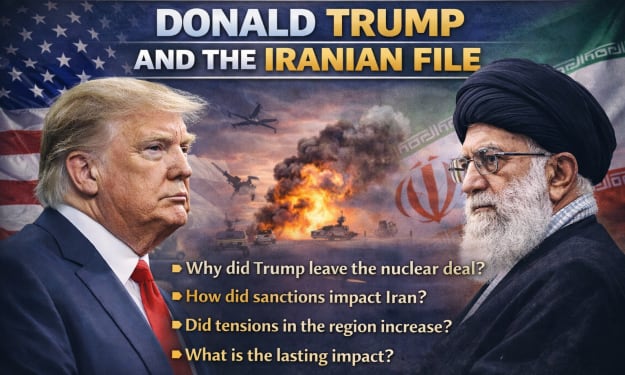
Donald Trump and the Iranian File: Policies, Tensions, and Public Questions
Donald Trump and the Iranian File: Policies, Tensions, and Public Questions Donald Trump’s approach to the Iranian file marked one of the most controversial chapters in modern US foreign policy. During his presidency, relations between the United States and Iran shifted dramatically, moving away from diplomacy toward pressure and confrontation. Trump’s decisions reshaped the Middle East landscape, affected global energy markets, and sparked intense debate both inside and outside the United States. Understanding Trump and the Iranian file requires examining his strategy, its consequences, and the questions people most frequently ask.
By America today a day ago in Criminal



Comments
There are no comments for this story
Be the first to respond and start the conversation.