
El Chapo: The Tunnel King of Mexico
He rose from the mountains of Sinaloa to become one of the richest and most ruthless drug lords in the world — and no prison could hold him for long

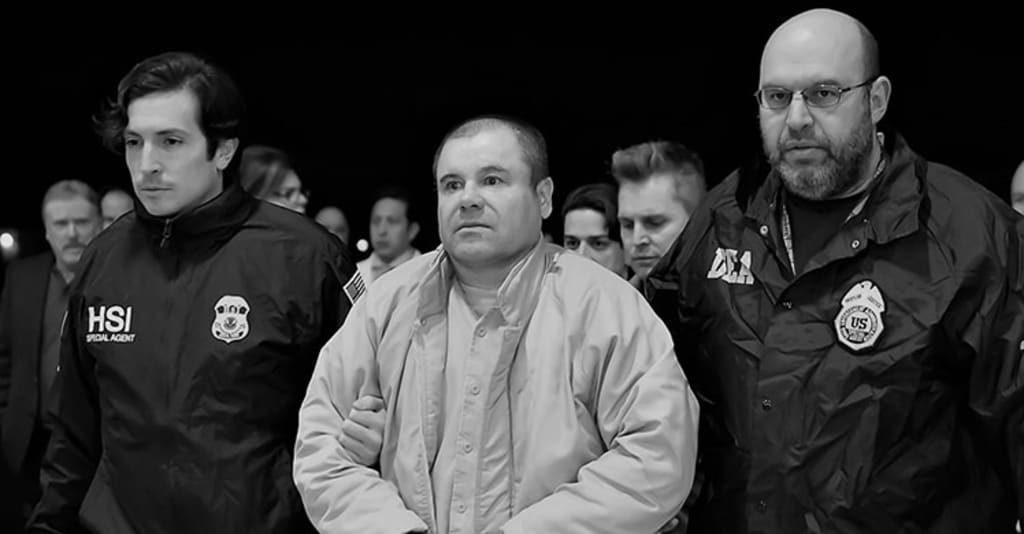
Few figures in modern crime have fascinated the world like Joaquín “El Chapo” Guzmán. To some, he was a hero — a poor boy who built an empire. To others, he was a monster — a man whose greed and violence turned Mexico into a battlefield.
From handmade tunnels beneath the earth to billion-dollar deals in the sky, El Chapo’s story is one of genius, brutality, and a relentless hunger for control.
The Boy from the Mountains
El Chapo was born in La Tuna, a small mountain village in Sinaloa, Mexico, in 1957. His family was poor — his father farmed poppies for the drug trade, and his mother sold small goods to survive.
By age 15, Joaquín had learned the basics of the opium business. By 20, he was transporting marijuana and cocaine for the Guadalajara Cartel, run by Miguel Ángel Félix Gallardo — the “Godfather” of Mexican drug trafficking.
When Gallardo was arrested in 1989, the empire shattered — and El Chapo seized his chance.
He formed his own organization, the Sinaloa Cartel, and quickly became one of the most powerful men in Latin America.
The Empire of Cocaine
Under El Chapo’s command, the Sinaloa Cartel grew into the largest drug trafficking network in history.
He controlled cocaine routes from Colombia, smuggling networks across Mexico, and distribution hubs in the United States, Europe, and Asia. His cartel made billions — so much that he reportedly spent $100 million a month on bribes to police and politicians.
His genius lay in logistics. He built secret tunnels beneath the U.S.-Mexico border, complete with rail systems, lights, and ventilation. These tunnels made it almost impossible for authorities to stop his shipments.
Every time one route was discovered, El Chapo already had two more ready.
At his peak, Forbes listed him among the world’s richest men, with an estimated net worth of $1 billion.
The Man of Many Faces
Despite his empire, El Chapo lived like a ghost. He constantly changed safe houses, traveling through the mountains with armed guards. His security was legendary — locals would tip him off whenever the army approached, and his men would vanish into the hills.
Yet beneath the fear, there was also admiration. In rural Mexico, many saw him as a Robin Hood figure. He built churches, schools, and gave money to poor families. Narcocorridos — folk songs celebrating his life — became radio hits.
But behind that charm was a man capable of terrifying cruelty. Rivals were tortured, informants executed, and entire towns burned as messages of power.
His motto was simple:
“You can’t buy love — but you can rent loyalty.”
The First Escape
In 1993, El Chapo was captured in Guatemala and sent to a high-security prison in Mexico. Most believed it was the end of his reign.
They were wrong.
In 2001, after eight years behind bars, El Chapo escaped — hidden inside a laundry cart pushed by a prison guard. The escape, allegedly aided by millions in bribes, became a symbol of his power.
For the next 13 years, he ran his cartel freely, becoming both a national myth and an international menace.
The Tunnel Escape
In 2014, authorities caught him again after a fierce shootout. He was placed in Altiplano, Mexico’s most secure prison.
But in July 2015, he did the impossible — again.
Guards entered his cell one night to find the floor open. Beneath it lay a 1.5 km tunnel, complete with lights, rails, and an escape motorcycle. It led straight to a nearby warehouse.
The operation had taken months of planning and cost over $1 million. The world was stunned — once again, the Tunnel King had vanished.
The Final Capture
El Chapo’s final downfall came in January 2016.
Mexican marines, acting on intelligence, raided a safe house in Los Mochis. After a gunfight, Guzmán tried to escape through the city’s sewer system — but was captured after his car was stopped at a checkpoint.
He was extradited to the United States in 2017 and later convicted on charges of drug trafficking, murder, and money laundering.
Today, he serves a life sentence at the supermax prison in Colorado — one of the most secure facilities in the world.
The Legacy of El Chapo
Even behind bars, El Chapo’s influence lingers. His sons — known as Los Chapitos — now lead parts of the Sinaloa Cartel, continuing the empire he built.
His story has inspired documentaries, movies, and TV shows, turning him into both a villain and a legend.
But behind the fame lies a darker truth — thousands of lives lost, families destroyed, and a country still struggling with the violence he helped unleash.
El Chapo’s rise and fall reveal one undeniable truth:
No matter how deep the tunnel, no one escapes forever.
About the Creator
shakir hamid
A passionate writer sharing well-researched true stories, real-life events, and thought-provoking content. My work focuses on clarity, depth, and storytelling that keeps readers informed and engaged.
Keep reading
More stories from shakir hamid and writers in Criminal and other communities.
Matteo Messina Denaro: The Last Godfather of Sicily
For decades, the name Matteo Messina Denaro carried both fear and legend across Sicily. Known as “Diabolik,” after an Italian comic-book villain, he was the final link to the old Sicilian Mafia — the Cosa Nostra — a man whose power stretched from the dusty streets of Castelvetrano to the highest offices of Rome.
By shakir hamid5 months ago in Criminal
The Man Who Never Existed
M Mehran In the quiet city of Brookvale, crime was rare. The streets were peaceful, the people friendly, and the police department mostly dealt with minor thefts and traffic violations. That changed on a cold November morning. At exactly 6:15 AM, a jogger running through Riverside Park discovered something disturbing near the old iron bridge. A man was lying motionless on the ground. Within minutes, police sirens echoed through the fog-covered park. Officers quickly sealed the area as detectives examined the scene. The victim was well-dressed, wearing an expensive coat and polished shoes. At first glance, it looked like a robbery. But nothing was missing. His wallet was still in his pocket. His watch remained on his wrist. Detective Laura Bennett arrived at the scene shortly after sunrise. Known for her sharp instincts and calm demeanor, she immediately sensed something unusual. The victim had no visible injuries. Yet he was clearly dead. A Death Without a Cause The autopsy revealed something shocking. The man had been poisoned. A rare and fast-acting toxin had entered his bloodstream only minutes before death. But investigators couldn't find any injection marks or signs of forced consumption. Even stranger, the victim had no identification. The wallet contained cash but no ID cards, no driver’s license, no credit cards—nothing that could reveal who he was. For the first time in her career, Detective Bennett was dealing with a victim who seemed to have no identity. The Invisible Life Police released the man’s photo to the public, hoping someone would recognize him. Days passed. No one came forward. Fingerprints were run through national databases. No match. Facial recognition searches produced nothing. It was as if the man had never existed. But Bennett refused to believe that. She began examining the smallest details. The label inside his coat came from a high-end tailor in the city. When she visited the shop, the owner recognized the design immediately. “Yes,” the tailor said slowly. “I made this coat… about three months ago.” “Do you remember the customer?” Bennett asked. The tailor nodded. “He paid in cash. Said his name was Adrian Cross.” The Name That Led Nowhere Detectives searched every public record for the name Adrian Cross. No birth records. No tax filings. No employment history. No bank accounts. Nothing. The name was fake. But one detail from the tailor stood out. Cross had been accompanied by another man when ordering the coat. A nervous man who kept watching the door. Security cameras from nearby stores eventually captured the pair walking down the street together. Facial recognition finally produced a match for the second man. His real name was Marcus Doyle. And he was already wanted by federal authorities for cyber fraud and identity theft. The Criminal Puzzle Police tracked Doyle to an abandoned warehouse on the edge of the city. When officers stormed the building, they discovered something that shocked even seasoned investigators. Inside were dozens of computers and stacks of fake identification documents. Passports. Driver’s licenses. Bank records. Doyle had been running one of the largest identity forgery operations in the region. But that raised a bigger question. Who was the dead man in the park? When Doyle was arrested, he initially refused to speak. But after hours of interrogation, he finally broke. The truth was darker than anyone expected. The Ultimate Betrayal Doyle admitted that “Adrian Cross” was not a real person. He had created the identity himself. The dead man’s real name was Ethan Ward, a former partner in Doyle’s criminal network. Together, they had built dozens of fake identities and sold them to criminals trying to disappear. But recently, Ward had grown paranoid. He believed Doyle planned to eliminate him to take control of the operation. So Ward threatened to expose everything. Doyle decided to act first. He invited Ward to meet in Riverside Park early that morning, pretending they needed to discuss a new client. Before the meeting, Doyle had poisoned a small bottle of water with the rare toxin. Ward drank it during their conversation. Minutes later, he collapsed. Doyle walked away, confident the man would remain forever unidentified. Without a real identity, Ward’s death would become an unsolved mystery. Or so Doyle believed. The Truth Always Surfaces Thanks to Detective Bennett’s determination, the plan failed. Doyle was charged with murder, fraud, and multiple federal crimes. His network of fake identities was dismantled, preventing countless future crimes. But the case left a lasting impression on everyone involved. In a world filled with digital records and surveillance, it seemed impossible for someone to vanish without a trace. Yet Ethan Ward had almost succeeded in becoming a man who never existed. And if one determined detective hadn’t followed the smallest clues—a coat label, a security camera, a forgotten face—the truth might have remained buried forever. Because in the world of crime, the most dangerous criminals are often the ones hiding behind identities that aren’t real.
By Muhammad Mehran7 days ago in Criminal
I Think My Mirror Is Alive
The Mirror I Found at a Flea Market It started with a mirror I probably should never have bought. Last summer, while wandering through a crowded flea market, I noticed it leaning against a wooden table. It was old—far older than anything else around it. The frame was dark wood, carved with strange patterns that looked almost like twisted vines or claw marks.
By Mohammad Hamid4 days ago in Criminal


Comments
There are no comments for this story
Be the first to respond and start the conversation.