
Echoes of Justice: Inside the Court of America
Where Power Is Tested, Truth Is Unearthed, and Justice Finds Its Voice.
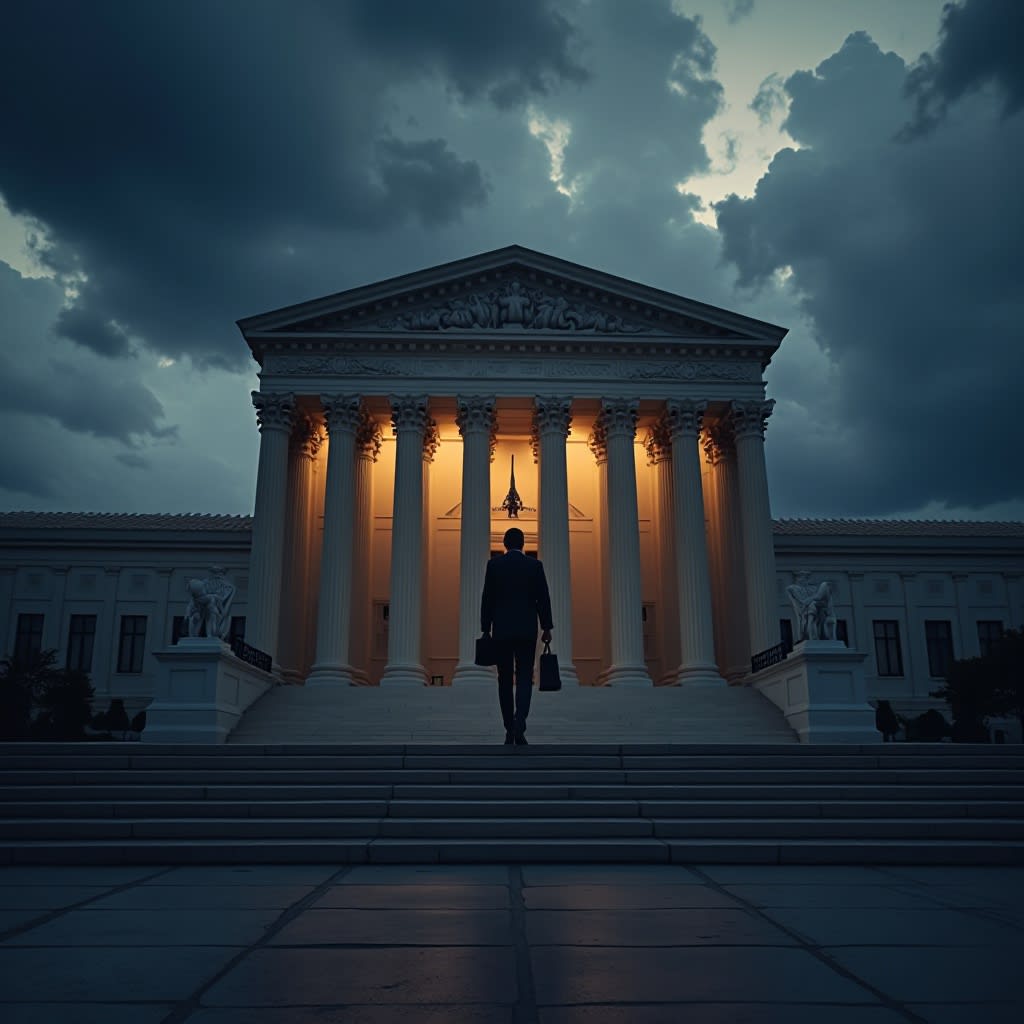
Washington, D.C., 7:42 a.m. The sun had barely crept over the horizon, casting long golden beams across the marble steps of the Supreme Court of the United States. It was a cold spring morning, but the air hummed with a certain electricity—as if the wind itself were whispering the significance of what was to come.
Inside the building, Judge Elena Masterson stood silently in her chambers, sipping her black coffee while staring at a framed photograph of her late father—a civil rights attorney who had once argued before this very court. His eyes looked at her through the photograph, proud yet cautious. Today, she would deliver an opinion that would shape American law for generations.
The case was known to the public simply as Samuels v. United States, but to those inside the legal world, it was far more than just another constitutional challenge. It was a full-throated confrontation between personal liberty and national security, a question as old as the republic itself: Can a government surveil its citizens in the name of safety without violating the core tenets of individual freedom?
The courtroom was packed.
Every seat was taken by members of the press, law students, legal scholars, and civilians who had waited overnight to gain a place in the public gallery. The air was still, yet charged—like the eye of a hurricane. Cameras were not allowed, but pens moved feverishly on notepads, and every breath felt like a held note.
Representing the United States was Solicitor General Richard Howell, a man with a reputation for cold logic and unshakable loyalty to national interests. Opposing him was Maya Torres, a 38-year-old civil rights lawyer from Chicago, who had gained national attention for defending immigrants and whistleblowers.
"Madam Chief Justice, and may it please the Court," Maya began, her voice calm but firm, "this case is not about intelligence protocols. It is about the Constitution. It is about a 19-year-old college student, Tyler Samuels, whose private messages and calls were intercepted without a warrant, without consent, and without cause."
She paused, allowing her words to sink in.
"What is the value of security if it is built on the grave of liberty?"
Somewhere in the crowd, someone exhaled sharply. Elena Masterson noticed. She wrote a note on her legal pad: "Define limits of 'national threat.'"
The Solicitor General rose. "The government does not take liberty lightly," Howell began, "but we must acknowledge the ever-evolving threats against our nation. Tyler Samuels was communicating with individuals flagged in terrorist databases. Algorithms do not act on whim."
Masterson watched both arguments like a grandmaster in chess, evaluating every move not just for legality but for legacy. Her clerks had prepared memos, and her shelves were lined with precedents. But the decision, she knew, would ultimately be hers to make—and its weight was unbearable.
As the hearings unfolded over days, the justices debated in private. The American public, meanwhile, followed every leak and quote with fierce interest. Social media became a battleground of ideologies. Newsrooms buzzed with editorials.
Judge Masterson walked the halls at night, long after the other justices had gone home. She would stand before the grand seal in the rotunda and think about what her father would say.
"The Constitution was not written for safety," he once told her. "It was written for freedom. And freedom, my dear girl, is not always safe."
She thought of Tyler Samuels. A young man with no criminal record, whose only crime had been curiosity. He had visited online forums. He had messaged people overseas. He had questioned government policies on his blog. And for this, he had been flagged.
The opinion was due in three days.
Judge Masterson had drafted three versions: one siding with the government, one with the plaintiff, and one attempting a dangerous compromise. None of them satisfied her.
She met briefly with Chief Justice Ronald Blake, a staunch conservative known for his minimalist interpretations of constitutional rights.
"If we weaken the security apparatus," he warned, "and we are attacked again, that blood is on our hands."
Masterson replied, "And if we ignore the Constitution, we are no better than the regimes we claim to oppose."
He looked at her, neither agreeing nor disagreeing. "You write what you must."
Two nights before the ruling, she visited a quiet diner in Georgetown. Her hood was up. No one recognized her.
An old man at the next table was reading a newspaper headline: "Court to Rule on Citizen Surveillance."
He folded it down and muttered, "God help us if they side with the spooks."
She looked at him. "Why do you say that?"
"Because I remember Nixon," he said. "And the FBI tapping phones of civil rights leaders. It always starts with good intentions, but it never ends there."
She nodded silently.
The day the opinion was released, America held its breath.
Elena Masterson delivered the majority opinion in a 5-4 ruling.
"The Constitution," she read aloud, "does not bend to the anxieties of the age, nor does it retreat in the face of uncertainty. The Fourth Amendment guarantees the right of the people to be secure in their persons, houses, papers, and effects. That right cannot be overridden by artificial intelligence, nor by suspicion without evidence."
The Court ruled that the warrantless surveillance of Tyler Samuels had been unconstitutional.
The room erupted.
Some wept. Some cheered. The Solicitor General looked down at his notes. Maya Torres smiled for the first time in weeks.
That night, Judge Masterson returned to her chambers. The halls were quiet. She poured herself a small glass of wine and stood again before her father’s photograph.
"We did it," she whispered. "You were right. Freedom isn’t safe. But it’s still worth it."
Outside, protestors and patriots alike gathered. Some waved flags. Some held candles. All of them, whether they agreed or not, stood on the firm ground of a nation still willing to debate its soul.
Echoes of Justice had rung out from the Court of America.
And the republic, bruised but unbowed, listened.
About the Creator
Keep reading
More stories from Muhammad Wisal and writers in Criminal and other communities.
Echoes in the Rain: The Brighton Boy Who Walked Into the Sea
Brighton, with its salt-laced air and pastel-painted lanes, is the kind of place where mystery feels out of place. It’s a city of seagulls, surfboards, secondhand bookstores, and stony beaches where people gather with fish and chips under striped parasols. But in the early autumn of 2011, just as the summer crowds thinned and the skies began to frown, something happened that would ripple through the seaside town for years to come.
By Muhammad Wisal7 months ago in Criminal
Two Teens, One Bus, and a Nation Watching
Hello, and welcome to “The True Crime Reader,” where we dig beneath the headlines to unravel the stories that shape our understanding of crime, justice, and society. Today’s episode takes us to Oakland, California, for the story behind Dashka Slater’s powerful nonfiction book, “The 57 Bus”—a case that stunned the Bay Area and reverberated across the country.
By Kristen Barenthaler4 days ago in Criminal
Robert William Fisher: The Unresolved Mystery Behind One of America’s Most Notorious Fugitives
Few criminal cases in the United States have remained as haunting and unresolved as that of Robert William Fisher. More than two decades after his disappearance, Fisher’s name continues to appear on the FBI’s Most Wanted list, symbolizing both a tragic family crime and one of the longest-running manhunts in modern American history. His case blends elements of domestic violence, psychological profiling, forensic investigation, and unanswered questions that still trouble law enforcement and the public alike.
By Salaar Jamaliabout 14 hours ago in Criminal



Comments
There are no comments for this story
Be the first to respond and start the conversation.