
Detective Alice Clement and the Dulcimer Murder
A young victim, an unsuspecting instrument, and a diabolical plan


A murder mystery fit for the likes of Miss Marple, the case of The Dulcimer almost seems too implausible to be true. The calculating length some will go to take another’s life is shocking, but not to Detective Alice Clement.

This story comes from an interview by journalist Courtney Riley Cooper with Alice Clement printed in the Bureau County Tribune, Princeton, Ill, on July 18, 1913.
One morning at the Chicago detective headquarters in the 1910s, a report of a death in the Clark Street area came in. The Captain tasked two officers to investigate, Detective Williams and his partner, Officer Alice Clement. The Captain was sure Clement would be interested since she was drawn to the conditions of sex workers in that area.
The officers arrived at the tenement where the building’s janitor awaited them. Together, they climbed the rickety stairs, and he took the officers to the small room of a young woman.
The janitor told Clement and Williams that the girl had died from typhoid. Williams gave the room a passing glance and announced that no crime had been committed and that they should head back to the station house. From his cursory glance, Williams had deduced that the young woman was a sex worker, and her death came from her high-risk lifestyle.
Clement wasn’t so sure. She began rummaging around the room and discovered a dulcimer in the corner. Upon inspection, Clement noticed the strings were rough, yet appeared new. She pulled out her magnifying glass for a closer look and found small granules stuck to the strings. Clement thought this odd and ordered Williams to take the dulcimer to the microscopist for testing. Williams did as Clement bade, but didn’t look convinced.
As Williams headed off with the instrument, Clement stayed behind to interview the janitor. Clement inquired into where how the young woman had acquired the dulcimer.
The janitor didn’t remember seeing the instrument, but he had heard music coming from her room a few weeks after her arrival. The girl, whom the janitor called Little Miss Perry, had arrived in Chicago from the country searching for work, but the poor thing had found none.
Clement then asked about visitors.
The janitor said that a few businessmen had visited, but rarely, which supported Williams’ speculation that the deceased engaged in sex work. However, three people came with regularity. The doctor, of course, had come daily after Miss Perry had taken ill. Then two settlement workers came from local charities to check in on her. The first was Mr. Grimes, whom the janitor hadn’t liked. Grimes was short-tempered and complained of destitute individuals’ drain on society. The other had been a woman who was always kind and sweet, but the janitor hadn’t caught her name.

Alice Clement then asked if the three visitors had ever come together.
The janitor answered. He hadn’t seen the three simultaneously and doubted they knew each other.
After questioning the janitor, Clement hurried to the station and checked in on the results of the dulcimer strings. Williams confirmed Clement’s suspicions that someone had tampered with the dulcimer, weaponizing the simple musical instrument.
The culprit had intentionally placed typhoid bacteria on the dulcimer’s strings. If one playing the instrument had licked their fingers while playing, they would have infected themselves with the disease.
Clement knew she had a case, but Williams wasn’t convinced. He didn’t see any motive in killing the poor girl. She had no money, wasn’t involved in criminal activity, and hadn’t been in the city long enough to make enemies. Williams offered his theory. Miss Perry wanted some entertainment and bought the used dulcimer from a pawnshop. The typhoid bacteria could have been sitting on the strings for half a year by that point, and her death was nothing more than a horrible accident.
Clement agreed, but couldn’t shake the feeling that someone out there wanted Miss Perry dead. She asked Williams to track down the dulcimer’s origins while checking into Miss Perry’s visitors.
The pair didn’t see each other for a couple of days as they worked on their leads. Finally, Williams reported that Miss Perry had purchased the dulcimer from a pawnshop near her tenement. A traveling musician had left it there several months before. Williams also told Clement that Mr. Grimes, the charity worker, had visited Miss Perry’s body at the morgue. His demeanor was a mixture of excitement and nervousness. Grimes inquired how far the police had gone to locate the girl’s family.
Clement put a pen in Grimes’ strange behavior and focused on the dulcimer. She puzzled at how someone placed typhoid bacteria on the dulcimer. Whoever contaminated the strings needn’t have bought the instrument. They only needed to be alone with it. That Miss Perry had been intentionally poisoned wasn’t off the table as far as Clement was concerned.
Alice Clement asked Williams to watch Mr. Grimes while she went undercover. Williams scratched his head over Clement’s decision to pursue a case with no suspects or motive but did as she asked.
A few days later, Clement returned to the station. She wore glasses and a severe dress. Her hair was done up in a style several years out of fashion, and she carried a briefcase filled with books on charities. This attire was out of character for Clement, who often wore the latest styles and a lovely set of pearls to apprehend criminals.

Williams was amused at Clement’s appearance, but kept his teasing quips to himself as she filled him in on her lead. Clement ushered Williams to a clean and well-kept apartment on the north side of Chicago and asked for Mrs. Brent.
A handsome and well-dressed woman appeared in the living room and told Clement that she had changed her mind about the book. She was no longer interested. Then she noticed Detective Williams and asked what this man was doing with Clement.
This was when Clement’s demeanor changed from that of a kindly salesperson to that of a hardened police officer. 'Our business here this afternoon does not concern books on charity. We are here this afternoon to ask why you murdered your niece Ellen Perry?'
Mrs. Brent swooned, and Williams moved to steady her. Together, they placed Mrs. Brent on her bed, and as they waited for her to recover, Clement said, ‘You have confessed by your actions that you are guilty. Now, before we take you to police headquarters, tell us why you committed this murder.’ (This statement, some hundred plus years later, shows how much policing has evolved yet still has a long way to go.)
Mrs. Brent then began a tale of a person driven to do the unimaginable for the love of money.
Ellen Perry had lived in a small town in rural Pennsylvania and worked as a housekeeper after her father’s death. In earlier days, the Perry family had been well off, but after Mr. Perry’s death, all that was left of his wealth was a worthless piece of land in Colorado. This land was placed under the trust of Mrs. Brent, an aunt of Ellen Perry whom she had never met. Upon coming of age at 18, Ellen would inherit the land to do with what she pleased.
Ellen went on with her life working as a servant in wealthy homes, unaware that she owned land elsewhere. Then, one day as she sorted through her father’s papers, she discovered the deed to the parcel in Colorado and wrote to Mrs. Brent, instructing her to sell the land for whatever she could get.
However, a few years prior, gold had been discovered on the Colorado track and was brought in a bundle for Mrs. Brent. Greed prevented Mrs. Brent from sharing this information with her destitute niece. Mrs. Brent returned the letter stating ‘opened by mistake,’ Ellen went on believing that her aunt had moved on and couldn’t be reached. Ellen then moved to Chicago, where she couldn’t find suitable employment.
In the meantime, Mrs. Brent went to the Pennsylvania town where her niece lived, only to discover that she had moved to Chicago. Mrs. Brent followed Ellen while plotting a way to keep the land and its sizable income for herself. She donned the guise of a charity worker and got close to Ellen.
Mrs. Brent found Ellen through a fictitious employment ad placed in the local paper for a servant. She hoped her niece would see it and apply, which is precisely what happened. Not knowing that Mrs. Brent was her aunt, Ellen took the fake job, and Mrs. Brent made her move.
Not long after taking the job with her beguiling aunt, Ellen discovered the dulcimer hanging in a pawnshop window near her apartment. Nursing fond memories of her father, who’d played the instrument when she was a child, Ellen bought the dulcimer, with the help of Mrs. Brent, who supplied the funds for it, and taught herself how to play.
At first, Mrs. Brant had planned on duping Ellen into signing over the land to her. She began calling on Ellen regularly, taking great interest in the young woman while scheming. Then, one afternoon during a visit to city hall under the pretense of charitable service, Mrs. Brent abandoned the idea of getting Ellen to sign over the land and planned on killing the girl instead.
Mes. Brent spied a bottle containing typhoid bacteria in grabbing distance during her tour of the government building and wasted no time placing the dangerous vial in her handbag. During her time with her niece, she had noticed that Ellen licked her fingertips while playing the dulcimer as she turned the pages on the sheet music.
Mrs. Brent raced to her niece’s apartment and asked for a glass of water. While Ellen was out of the room, Mrs. Brent applied the typhoid bacteria to the stings of her niece’s instrument and waited. Ellen died two weeks later, and Mrs. Brent owned the profitable Colorado land.
As Ellen became sicker and sicker, Mrs. Brent continued to visit, sitting by her bed, nursing her dying niece.
Clement and Williams listed to Mrs. Brent’s confession. Finally, Mrs. Brent asked how Clement guessed all this.
Clement confessed she hadn’t. She’d only had a hunch that something was amiss with this over-attentive social worker. Officer Clement had looked further into Mr. Grimes’ strange behavior at the morgue with Ellen’s body, and found that he acted that way with all deaths he encountered. Next, she looked into the doctor, who had no more contact with Ellen than treating her for typhoid. That left the unknown female social worker.
Noting the social worker’s description from the janitor, Clement pretended to be a bookseller and sought the woman. When she found Mrs. Brent, she brought up the subjects of money and death. Clement noted Mrs. Brent’s reaction to both; her eyes sparkled at the mention of money, and her complexion became sallow at the topic of death. Based on this observation, Clement deducted Brent had killed Ellen for cash.
A sudden scream from the bed startled Williams and Clement, and Mrs. Brent jumped up, produced a penknife from somewhere on her person, and jammed it into her neck. Ten minutes later, the coroner pronounced her dead at the scene.

After telling her story to journalist Courtney Riley Cooper while seated at a sidewalk restaurant, Clement grabbed a menu and said, ‘Charity covers a multitude of sins.’
Who was Detective Alice Clement?
This story begs the question, why do women such as Alice Clement become forgotten by history? Why are their contributions to society not celebrated instead of becoming relegated to footnotes?
Alice Bush was born in 1878 in Milwaukee, Wisconsin. In 1895 she married Leonard Clement, whom she later divorced in 1914 for “desertion and intemperance.” It took the court four years to grant the divorce. When it did finally go through, Clement married her second husband, Albert Faubel, in 1918. Their union was presided over by a female minister.
In 1909, Clement began her career with the Chicago Police Department as a beat cop, patrolling department stores for pickpockets and shoplifters. At this time, police departments across the county were hiring female officers to deal with crimes that affected women and children. Much of their work centered on domestic abuse, sex work, and orphans. Female officers typically patrolled beaches, dance halls, train and bus stations, and parks, looking for suspicious characters and girls in distress. While female officers could make arrests, they were encouraged to observe, take notes, and deescalate. They were viewed a way of softening police work which was associated with violence.
The hiring of these female officers created a media blitz. In one day, the Chicago Police Department hired ten female officers, all trained in social work. They ranged in age from 25 to 50, and eight were widows. The new officers’ training comprised a two-hour talk given by Chief James McWeeny (a fitting name) and covered more of what they weren’t to do rather than what was expected of them; “Don’t stretch the truth”; “Don’t be too strenuous, have compassion”; Don’t be nosy”; “Don’t use too much force in making arrests”; “Don’t complain about long hours”; and “Don’t talk more than necessary; let your commanding officer do most of the talking.” They were then sworn in, given keys to the police and fire boxes, a rule book, and a whistle. Guns were not part of their working uniforms. an unfortunate marriage.
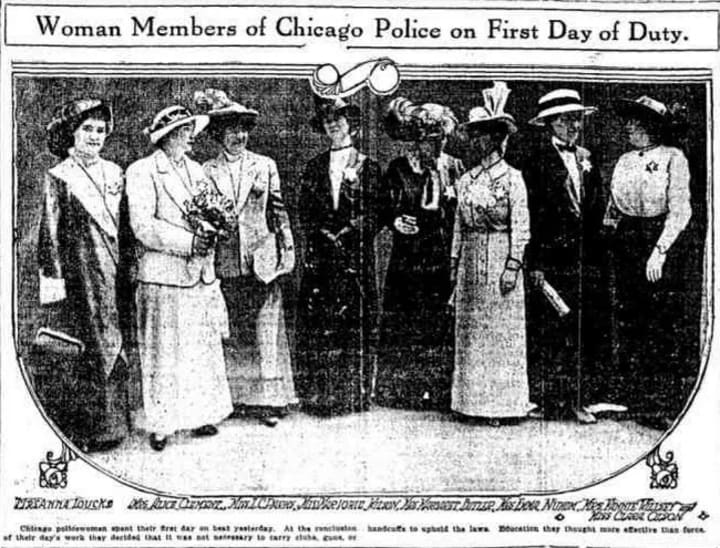
Clement took great interest in the plight of poor women and sex workers. She understood that sex work was a natural progression for some women to turn to when they could not sustain their families through low-pay domestic work. In 1919, she even wrote, produced, and starred in a movie called Dregs of the City, where she played herself. The film highlighted her passion for women’s rights, including the vote and the right to end an unfortunate marriage. The movie received a rave review in every city it premiered in but Chicago, where city officials banned the movie from being shown. Sadly, the film has been lost to history, and all that remains are a few promotional stills.

By August 1913, with her work on the dulcimer case and several other high-profile crimes, Clement’s talents were fully realized, and she was promoted, making her Chicago’s first female detective. Clement was one of 100 new detectives in her graduating class, all of whom were male. Clement stayed in her post, running after criminals and even going overseas to apprehend bad guys until she was demoted in 1926 because of health concerns related to diabetes, a disease she had kept hidden from the department. Later that year, she was forced into early retirement and died the day after Christmas in 1926.
During her career, Clement made headlines repeatedly for her fashion sense (some things never change). Reporters summed her up with “furs, heels, and jujitsu.” Clement made no apologies about her attire or femininity, even though a few news outlets teased her about her fashionable ensembles. She made headlines in Vanity Fair, The Chicago Tribune, and Chicago American. However famous Clement was with the press, things differed from her male counterparts.
Chief McWeeny bristled at the attention Clement and the other female officers received. His irritation became too much, and he finally resigned, which shouldn’t surprise many readers who’ve made it this far.
Luckily, McWeeny’s sentiment wasn’t shared across all avenues of the force. Many knew how important female officers were. They could infiltrate areas where the male officers were barred entry.
Sources
Cooper, Courtney Riley. “The Dulcimer.” Bureau County Tribune, Princeton Ill, July 18, 1913.
Janik, Erika (2018). “The Life of an Early 20th Century Policewoman: Solving Murders and Busting Prostitution Rings.” A&E True Crime Blog: Stories and News. https://www.aetv.com/real-crime/early-20-century-policewomen-in-america-solving-murders-pistols-and-petticoats-excerpt
Norman, Abby, (2015). “Alice Clement: The Female Sherlock Holmes.” All That’s Interesting, https://allthatsinteresting.com/alice-clement
Smith, Bryan (2003). “The Detective Wore Pearls.” Chicago Magazine, https://www.chicagomag.com/chicago-magazine/december-2003/the-detective-wore-pearls/
About the Creator
Cynthia Varady
Award-winning writer and creator of the Pandemonium Mystery series. Lover of fairy tales and mythology. Short stories; book chapters; true crime. She/Her.
Keep reading
More stories from Cynthia Varady and writers in Criminal and other communities.
Fertility Fraud: How DNA Exposed Donald Cline's Sinister Secret
Jacoba Ballard always felt different. She had blond hair and blue eyes, while her parents had dark hair, dark eyes, and olive skin. As a child, Jacoba routinely asked her parents if she was adopted, trying to explain why she felt different. Then, her parents told her she was the product of artificial insemination.
By Cynthia Varady12 months ago in Criminal




Comments
There are no comments for this story
Be the first to respond and start the conversation.