
“Confessions of a Teenage Hacker Who Got Too Deep”
“What Started as a Game Became a National Threat”
1. The Spark
I wasn’t always a criminal.
At least, that’s what I tell myself.
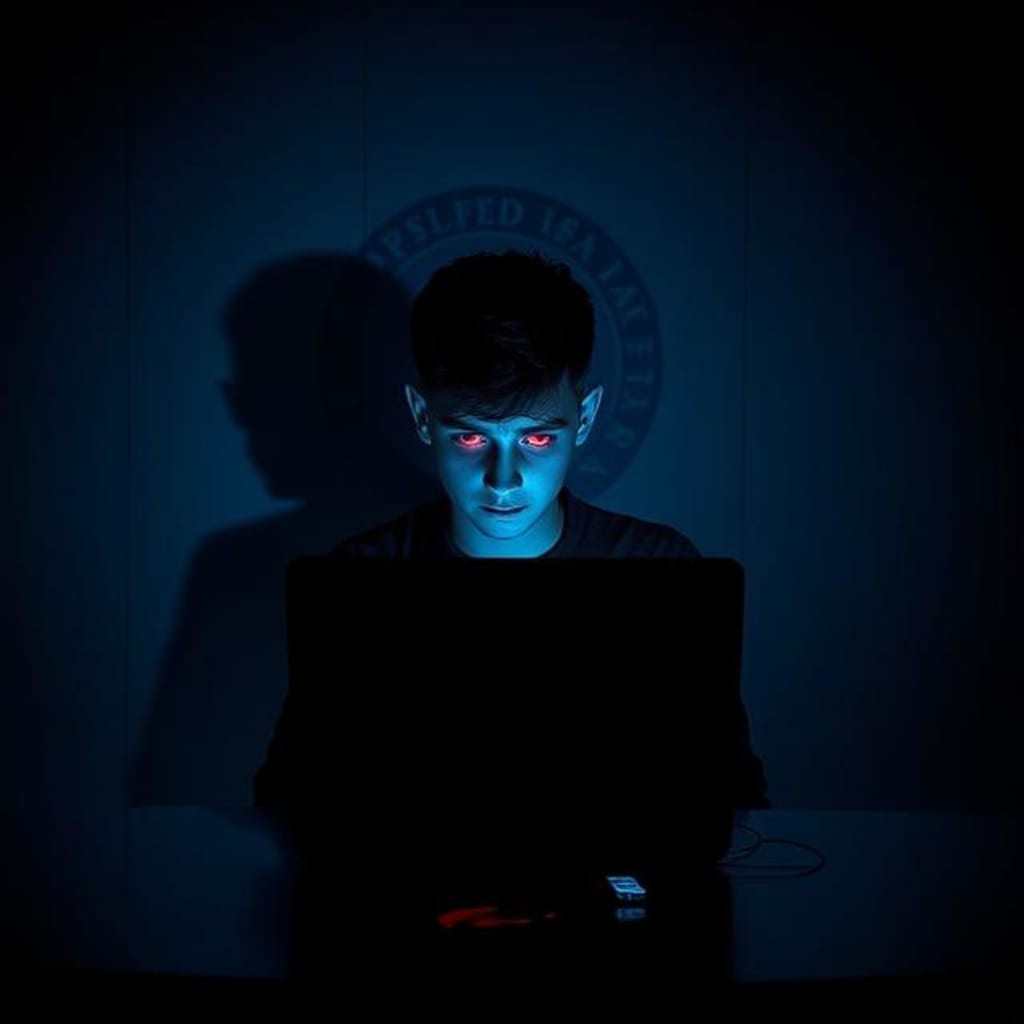
It started with curiosity—nothing more. I was sixteen, sitting in a cramped bedroom in Newark, surrounded by blinking LEDs, sticky notes scribbled with command lines, and a gaming chair I never used for games. My laptop was my weapon. My battlefield? The Internet.
They called me “Specter” in forums—faceless, fast, and untraceable. Or so I thought.
2. Just for Fun
It was supposed to be harmless. My first “hack” was into the school network to bump up a friend’s attendance. Then I moved on to unlocking premium accounts—Spotify, Netflix, gaming mods. I wasn’t stealing money, just... bending the rules.
That’s how it begins for most of us: power without consequences.
I joined a Discord group of other teen coders—some in Germany, others in India, a girl from Brazil who could reverse-engineer APIs like magic. We competed for laughs. Who could break through a firewall the fastest? Who could deface a university website and slip out undetected?
But one night, it all changed.
3. The Door I Shouldn’t Have Opened
It was 2:43 a.m. I was working on a challenge posted in our private server: breach a government subdomain and leave a calling card without triggering detection.
“Easy,” I typed. “Gimme 20 minutes.”
Famous last words.
I found a backdoor into a federal contractor’s system—a minor endpoint, buried behind proxies. But once I got in, I wasn’t just staring at metadata or routine code.
I was staring at “Project Kraken.”
No fancy UI. Just a file directory, a few .json files, and a login-protected dashboard. It looked... boring. But inside those files were keywords that stopped my breath:
“Surveillance Target List.”
“Financial Transfer Protocols.”
“Encrypted Missile Coordinates.”
This wasn’t a game. I had stumbled into a classified ops terminal—NSA or military-grade. And I had no idea what to do.
4. The Panic Protocol
I yanked my USB out of the laptop, crushed it under my heel, and shut everything down—router, VPN, even pulled the battery from my phone.
But it was too late.
The system had logged my IP—or at least the partial spoofed version of it. I had bounced through so many proxies, I thought I was invisible.
I wasn’t.
The next 72 hours were pure dread. Every knock on the door. Every buzz of my phone. Every shadow at the window. I deleted my accounts, nuked hard drives, and tried to act normal.
I was a high school junior. No one suspects a kid who still eats Pop-Tarts for dinner.
Until they do.
5. The Knock
It came on a Tuesday afternoon.
I was doing algebra homework when the doorbell rang. My mom answered, cheerfully calling out, “Someone from the Internet company is here, Rashid!”
Not quite.
Three men in suits. Two in tactical gear. One showed a badge.
“Rashid Khan?”
“Yes...”
“You’re under investigation for unauthorized access to a federal cyber infrastructure. Come with us.”
They cuffed me in my living room. My mom screamed. My dad—who worked nights—came running down in his vest. But it didn’t matter. The silence that followed screamed louder than any siren.
They took me without explanation, without rights read aloud, without mercy.
6. Interrogation and Isolation
They kept me in a gray room for two days. No windows. No clocks. No contact.
At first, I said nothing.
Then they pulled up screenshots—my code, my IP trails, the file paths from the system I’d stumbled into. They had it all. Every keypress, every click.
“You’re lucky,” one agent said. “You didn’t sell anything. You didn’t distribute. Otherwise, you'd already be on the no-fly list—if not something worse.”
They gave me two options:
Option 1: Prosecution as an adult under the Computer Fraud and Abuse Act. Up to 10 years in federal prison.
Option 2: Quiet cooperation. No record. But I’d work for them.
Yes. Work for them.
7. The Deal with the Devil
You hear about these stories—prodigies caught hacking NASA at 14, then recruited by cyber units. I thought it was urban legend.
It’s not.
They offered to train me—ethics, network defense, white-hat operations—and monitor me for a year. I couldn’t say no. Not unless I wanted a record that would follow me forever.
So I said yes.
And that’s how a teenage hacker went from breaking into systems to defending them—from playing cat-and-mouse to being the cat.
But the truth? I never stopped looking over my shoulder. Because I’d gone too deep. And some doors don’t close once opened.
8. What I Didn’t Expect
The real surprise wasn’t the government.
It was my friends.
Or rather, the lack of them.
Word got out—of course it did. Even though I wasn’t “arrested” formally, rumors spread like wildfire through my school. Suddenly I was radioactive. No one sat next to me at lunch. Teachers watched me like I was a bomb.
Even the Discord group vanished. Deleted, gone. No goodbyes.
Turns out, when you enter the underworld of hacking, there’s no safety net. No loyalty. Only risk.
I wasn’t a rebel anymore. I was an example.
9. Redemption in Strings of Code
Months passed.
Under government supervision, I worked on actual threats—ransomware groups, phishing botnets, and dark web marketplaces. I used the same skills I’d sharpened in secrecy, now under fluorescent lights in a government office, sipping coffee instead of Red Bull.
And slowly, the guilt began to ease.
I saw what real cybercrime looked like—children trafficked, identities stolen, money laundered through shell codes.
And I realized: I had only skimmed the surface of how deep this world truly goes.
10. The Final Confession
I’m 22 now.
Clean record. College scholarship. I study cybersecurity, work part-time in a private firm, and give talks at high schools about “the dangers of digital curiosity.”
Most people think I’m just a talented kid who got a lucky break.
They don’t know what I did.
They don’t know how close I came to crashing through the firewall of national security. How one more click could’ve labeled me a terrorist instead of a genius.
They don’t know that sometimes, at night, I still check my window for black cars.
Because I know what it feels like to touch fire and walk away with your fingers still smoking.
11. My Advice to the Next Specter
If you’re reading this, and you’re young, and clever, and curious—
I get it. The thrill of solving what others can’t. The addiction of power.
But know this:
The internet is not a playground.
Every system you poke is a door. And some doors open into rooms you’re not ready for. Some doors lock behind you.
So be smart.
Be ethical.
Because not everyone gets a second chance.
I did.
And I’ve been trying to earn it ever since.
[THE END]
About the Creator
Keep reading
More stories from Hamza Habib and writers in Criminal and other communities.
“How My Family Survived the Partition of India—And What We Lost”
1. The Smoke Before the Fire I was only eight years old when my world was set on fire. The summer of 1947 in Ludhiana was hotter than usual, not just in the air but in people’s eyes. Men spoke in whispers. Our Hindu neighbors, once like uncles and aunties to me, stopped meeting Abbu’s gaze at the chai stall. We didn’t understand it at first. But the signs were there—the ink of partition had been drying long before they drew the line on the map.
By Hamza Habib7 months ago in History
Former Miss Universe Canada Delegate Files $500 Million Defamation Lawsuit Against Grant Cardone and Cardone Capital in Miami
MIAMI, FL — Chealse Sophia Howell, an internationally recognized model, entrepreneur, and former Miss Universe Canada titleholder, has filed a civil lawsuit against Grant Cardone and Cardone Capital, LLC in the Eleventh Judicial Circuit Court, Miami-Dade County (Case No. 25-024299-CA-01). The complaint, officially filed on December 11, 2025, alleges defamation and tortious interference, claiming that the defendants engaged in a coordinated campaign of false statements across multiple digital platforms.
By Dena Falken Esqabout 17 hours ago in Criminal
Miss Persephone's Manual to a Seemingly Ordinary Life
Miss Persephone was found at the dining table, her blue eyes swollen, her tears arriving and retreating like the tides of the ocean. Earlier that day, her family had visited her in the retirement home where she had lived for eight years. It was her eightieth birthday.
By Imola Tóth2 days ago in Fiction




Comments
There are no comments for this story
Be the first to respond and start the conversation.