
Canada's Most Disturbing High Profile Murder Investigation
The Chilling Case of Kenneth Law

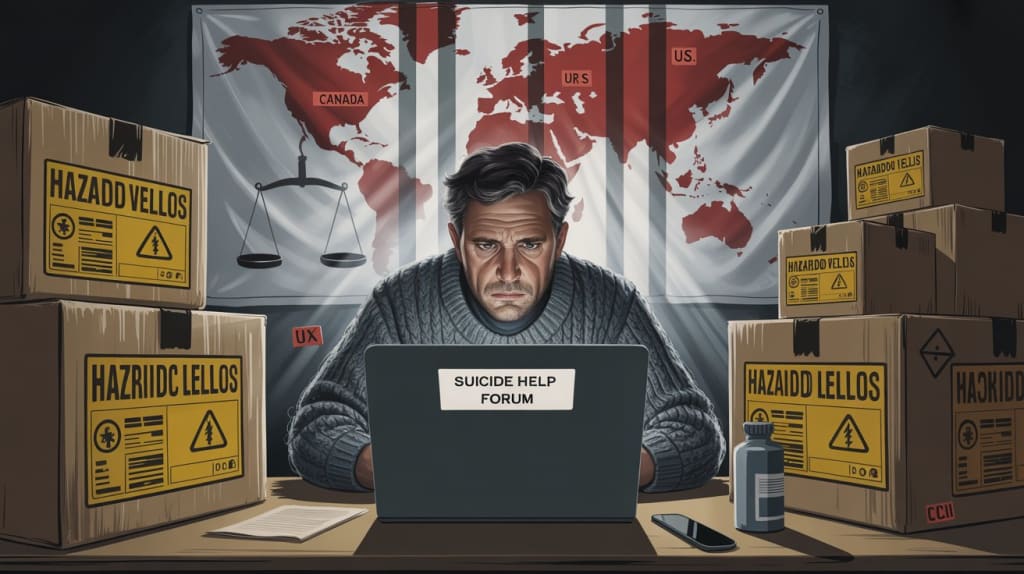
In the heart of Mississauga, Ontario, an unassuming former aerospace engineer has become the epicenter of one of the most disturbing and high-profile murder investigations in recent Canadian history. Kenneth Law, a 58-year-old man, stands accused of orchestrating a horrifyingly methodical operation allegedly aiding or causing the deaths of vulnerable individuals by distributing lethal substances under the guise of a "suicide kit."
What sets this case apart is not just the gravity of the charges—14 counts of first-degree murder and numerous charges of aiding or counseling suicide but the international reach and psychological depth of the crimes. This is no typical homicide. It's a chilling portrait of how the dark corners of the internet can be weaponized to exploit human despair.
A Deadly Web of Online Deception
Authorities allege that Law operated through a network of multiple websites, where he sold sodium nitrite, a preservative that can be fatal in high doses. Law reportedly disguised the sales as food-grade additives, but investigations have uncovered that many of his customers were vulnerable individuals contemplating or discussing suicide on online forums.
He allegedly sent these kits to people across Canada, the United States, the United Kingdom, Australia, and Italy. Law’s operation might have contributed to over 130 deaths worldwide, with at least 97 linked to him in the UK alone, according to British law enforcement.
Law was first arrested in May 2023, after an undercover Toronto Star journalist exposed his role in selling the so-called suicide kits. He was initially charged with two counts of aiding suicide, but as police combed through international case files, internet records, and shipping documents, the case against him snowballed into something far more horrifying.
The Charges and Legal Repercussions
In July 2025, Ontario prosecutors laid 14 charges of first-degree murder against Law, elevating the case to one of the most significant murder trials in Canadian history. The Crown alleges that Law’s actions were not merely passive participation in someone else’s decision but constituted deliberate and premeditated facilitation of death—a direct contradiction of Canada’s laws on assisted dying, which only permit such actions under specific legal and medical frameworks.
The charges signify a landmark shift in how Canadian law enforcement interprets online criminal responsibility. Law did not physically harm his victims. He didn’t even meet most of them. But through calculated digital manipulation and targeted marketing to the mentally vulnerable, he became a virtual executioner—arming people with the means and the confidence to end their lives.
Global Attention and Ethical Debate
The Law case has ignited fierce global debates about internet regulation, mental health support, and legal accountability in the digital age. Mental health organizations argue that such tragedies expose how desperately under-resourced suicide prevention programs are, and how the lack of timely support can lead people into the hands of those like Law.
Families of victims are demanding justice not just from the courts but from tech companies and governments who allowed such websites to operate unchecked for years. Critics are calling for stricter legislation to prevent the online sale of dangerous substances and better international cooperation to track suspicious e-commerce activity.
Others, however, have raised complex questions about bodily autonomy and mental suffering—asking whether Law’s customers were victims of manipulation or individuals who would have otherwise taken their own lives regardless of his involvement. While the courts must weigh such nuances carefully, public opinion remains firm: no one should profit from despair.
Conclusion: A Call for Justice and Reform
The Kenneth Law case is more than just a legal trial it is a stark wake-up call for Canada and the world. It shines a spotlight on the lethal intersection of mental health vulnerability, online anonymity, and predatory exploitation. Law’s alleged crimes are not only a tragic testament to what can happen when regulation lags behind technology, but also a call to rebuild the structures meant to protect our most fragile citizens.
As Law’s trial moves forward into 2026, the families of the deceased wait for accountability. Their pain is shared by a nation grappling with the consequences of unchecked digital marketplaces and a fractured mental health system. Justice, in this case, must go beyond punishment. It must lead to change, reform, and awareness.
For every victim lost in this harrowing case, let this be a message: No life should end in silence, and no death should be aided by cruelty masked as compassion.
References:
- The Toronto Star, “Inside the Kenneth Law investigation,” May 2023
- The Times UK, “Kenneth Law: The poison dealer linked to dozens of suicides,” July 2025
- CBC News, “Kenneth Law charged with 14 counts of first-degree murder in Canada,” July 2025
- BBC News, “UK police link 97 deaths to Canadian poison seller,” July 2025
- Global News, “The ethical questions behind Kenneth Law’s case,” July 2025
- The Globe and Mail, “Canada’s most complex digital-age murder trial begins,” July 2025.
About the Creator
Nowshad Ahmad
Hi, I’m Nowshad Ahmad a passionate storyteller, creative thinker, and full-time digital entrepreneur. Writing has always been more than just a hobby for me; it's a way to reflect, connect, and bring life to ideas that often go unspoken.
Keep reading
More stories from Nowshad Ahmad and writers in Criminal and other communities.
Meghalaya Honeymoon Horror: India's Most Shoking Murder of 2025
The Case That Gripped India In late May 2025, India was stunned by a crime that saw love turn lethal. Raja Raghuvanshi, a 29‑year‑old businessman from Indore, disappeared during his honeymoon in Meghalaya. Two weeks later, his decomposed body was found at the base of a waterfall near Cherrapunji’s Wei Sawdong Falls. The shock deepened when investigators arrested Sonam Raghuvanshi, his 25‑year‑old bride, for allegedly orchestrating his murder.
By Nowshad Ahmad8 months ago in Criminal
Jennifer Kesse: The Unidentified Man and the Vanished Car
The disappearance of Jennifer Kesse remains one of the most perplexing and heartbreaking unsolved missing persons cases in Florida. On January 24 2006 the 24-year-old finance manager vanished from her condominium complex in Orlando without a trace. Nearly two decades later her whereabouts are still unknown, no arrests have been made and the mystery continues to captivate true crime enthusiasts and haunt her family.Jennifer Joyce Kesse was a bright, ambitious young woman living in Orlando Florida. She worked as a finance manager at Central Florida Investments, a timeshare company in Ocoee. Having graduated with a finance degree she had built a stable life, purchasing her own condo in the gated Mosaic at Millenia community near the Mall at Millenia—a place she chose partly for its security features, including a guard. Jennifer was described by loved ones as responsible, family-oriented,and safety-conscious. She maintained close ties with her parents,Drew and Michelle Kesse and her boyfriend Rob Allen.
By Kure Garba5 days ago in Criminal


Comments
There are no comments for this story
Be the first to respond and start the conversation.