
Bread, Stones, and Dreams: A Palestinian Childhood
by.M Shaheen

The aroma of freshly baked bread was always the first thing that greeted Youssef every morning. His mother would wake long before dawn, quietly kneading dough in the pale glow of the kitchen light. Their home was small, the walls worn and cracked, but the bread filled it with warmth and a sense of fragile normalcy. For Youssef’s family, bread wasn’t just food — it was life, dignity, and hope.
Youssef was only nine years old, yet he had already seen more than most children his age. The streets of his town carried the dust of clashes and the echoes of sirens. Checkpoints, soldiers, and curfews were not events — they were part of daily life.
And yet, Youssef dreamed.
He dreamed of becoming a teacher one day, standing in front of a classroom, holding chalk instead of fear. He imagined streets covered in drawings of flowers and stars instead of graffiti of war. At night, when the noise of the world faded, Youssef would climb to the roof and gaze at the stars. To him, they looked like seeds of hope scattered across the sky — waiting to grow into something beautiful.
Bread
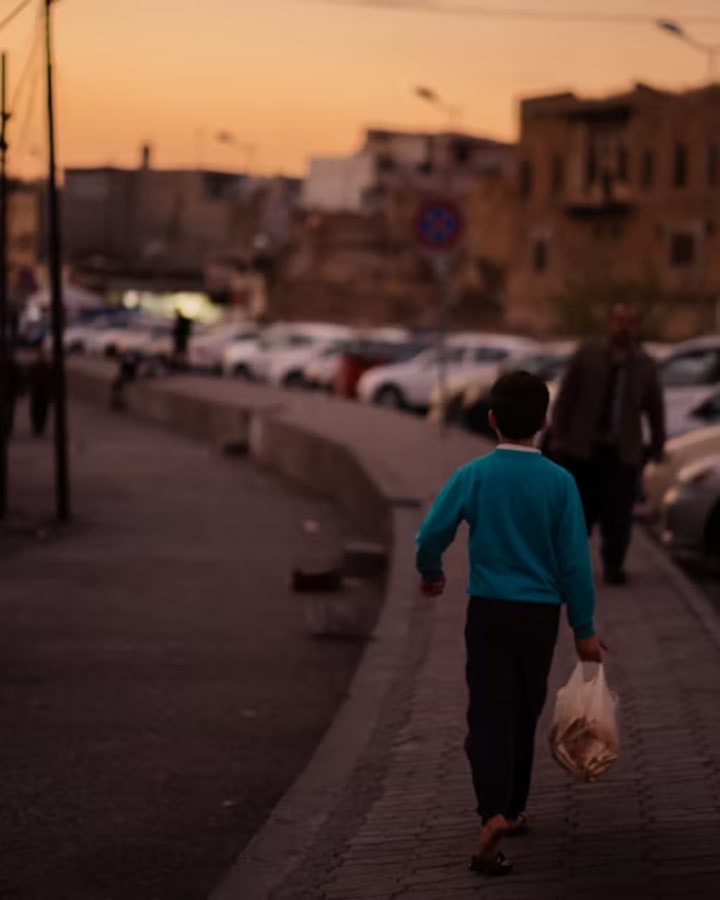
One morning, Youssef’s mother placed a bundle of warm bread in his hands. “Take this to your uncle,” she said softly. The bread’s warmth seeped through the cloth, pressing against his chest like something precious.
The streets were dangerous, but hunger was stronger than fear. As Youssef hurried along, he passed a group of boys crouched behind a wall, stones clenched in their fists. Their eyes burned with anger and determination. Youssef knew they were waiting for the soldiers.
Moments later, boots hit the ground like thunder. The boys threw their stones with all their might, shouting. The soldiers raised their shields, the air filling with smoke and shouting.
Terrified, Youssef clutched the bread tighter and ran. In that moment, he realized something that stayed with him forever: in his world, bread and stones existed side by side — one feeding life, the other fueling anger. And children like him were caught between them.
Stones
That evening, Youssef sat on the rooftop, the bread now shared with his uncle’s family. His cousin Sami, a boy of twelve, sat beside him, tossing a stone up and down in his palm.
“Why do you do it?” Youssef asked quietly.
Sami didn’t look at him. “Because this is all we have. Stones are our voices when no one listens.”
Youssef stayed silent. He understood Sami’s anger, the frustration of living behind fences and walls. But deep inside, he wondered if stones could ever build anything — or if they only destroyed.
That night, in his small notebook, Youssef wrote:
"I don’t want to throw stones. I want to build with them — a school, a library, maybe even a playground. Something that lasts longer than anger."
Dreams
The weeks passed, and nothing changed. Checkpoints grew tighter, soldiers more watchful, and his mother’s face more tired. Yet, the smell of bread still filled their mornings, and Youssef’s dreams still filled his nights.
One afternoon, while helping his mother in the small herb garden, he asked, “Mama, do you think dreams can come true here?”
She looked at him, her hands resting on the green leaves. Her eyes, though tired, softened.
“Dreams are like seeds, Youssef,” she said gently. “Even in the hardest soil, they try to grow. Sometimes they take years. Sometimes they break through stone. But if you keep them alive, they never die.”
Her words stayed with him. He thought again of the stars — seeds of hope waiting for the right moment to bloom.
The Day of the March
One Friday, the town gathered for a peaceful march. For the first time, Youssef’s father joined.
“We will walk with bread in our hands, not stones,” he told Youssef’s mother.
went with him, holding his father’s hand tightly. His mother had packed warm bread, wrapped carefully as if it could protect them.
The crowd walked together, chanting softly, lifting loaves of bread high as a sign of peace. But peace is fragile in a place filled with scars. Soldiers stood ahead, rifles ready. The air felt heavy, ready to break.
Suddenly, a loud bang split the silence. Panic erupted. The crowd scattered. Youssef’s father pulled him close as chaos swallowed the street. The bread slipped from Youssef’s hands and fell to the ground, trampled as people ran.

When they finally reached home, shaken but safe, Youssef sat in silence. He thought of the bread crushed underfoot, the stones scattered in the street, and how fragile life felt in that moment.
That night, he returned to his rooftop and opened his notebook.
"One day, bread will not fall to the ground. One day, stones will not be weapons. One day, children will dream without fear. And I will teach them that dreams are stronger than walls."
Epilogue
Years later, Youssef’s notebook still carried those words, the ink faded but alive. Life had not grown easier, but the dreams he planted as a child had taken root.
He became a teacher, just as he promised himself. In a small classroom, he handed out books to children whose hands might have once held stones. Their laughter filled the air like a song, a sound stronger than sirens.
And every morning, as the smell of fresh bread rose from the kitchen, Youssef was reminded that even in the hardest soil, dreams could rise — soft, warm, and unbreakable.
About the Creator
Keep reading
More stories from Shaheen Khan and writers in Criminal and other communities.
Whispers of Olive Trees: A Palestinian Story of Hope
In the quiet village of Birzeit, ancient olive trees stood tall like watchful guardians of the land. Their twisted trunks and deep roots carried centuries of stories, passed from generation to generation. For Palestinians, the olive tree is more than just a plant—it is a symbol of identity, survival, and hope.
By Shaheen Khan6 months ago in Humans
She Killed Her Sister When She Gave The Teen's Virginity to Her Boyfriend
Any person who can rape and kill an innocent member of their family is truly depraved. One who later admits they enjoyed it is truly demonic. Yet, a woman who took her criminal behavior to the depths of depravity is not even behind bars.
By Criminal Matters4 days ago in Criminal


Comments
There are no comments for this story
Be the first to respond and start the conversation.