
Assassination of Detlev Rohwedder: The Perfect Crime?
The Man Behind Germany’s Privatization Journey

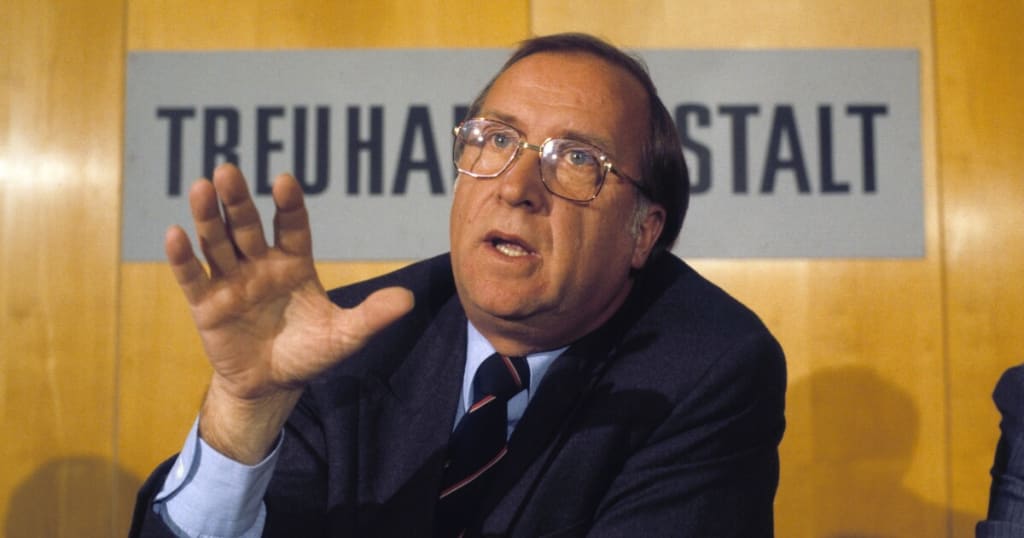
Who Was Detlev Rohwedder?
Detlev Rohwedder was a distinguished German manager and politician who played an instrumental part in privatizing state-owned enterprises in East Germany. His role as the head of the Treuhandanstalt, the agency responsible for this monumental task, profoundly impacted the German political and economic landscape.
Detlev Rohwedder’s appointment as the chairman of the Treuhandanstalt came at a crucial time in German history. With the fall of the Berlin Wall in 1989 and the subsequent reunification of East and West Germany, there was a pressing need to transform the former state-owned enterprises into privately owned businesses. This was seen as a crucial step towards a free market economy. Rohwedder was chosen to lead this massive privatization effort. His management expertise and previous private sector roles made him the ideal candidate for the job.
Early Life and Education
Born on October 16, 1932, in Gotha, Germany, Detlev Rohwedder grew up in immense political and social change. He pursued a degree in law and economics at the University of Bonn, furthering his knowledge in business administration at the University of Cologne.
Rohwedder’s educational background provided him with a solid foundation in both legal and economic principles. This multidisciplinary approach would later prove invaluable in his career as he navigated the complex landscape of privatization. His understanding of the legal framework surrounding business transactions and his grasp of economic principles allowed him to make informed decisions and effectively manage the privatization process.
Career Path and Achievements
Rohwedder’s career began in the private sector, where he held various managerial positions across multiple industries. His leadership roles, specifically as the CEO of Hoesch AG, a steel company, and Klöckner-Werke AG, an engineering and materials company, honed his skills in management and decision-making.
While at Hoesch AG, Rohwedder oversaw the company’s restructuring efforts, successfully navigating the challenges of a changing market and ensuring its long-term viability. His ability to adapt to rapidly changing business environments and his strategic vision were critical factors in his success. Similarly, at Klöckner-Werke AG, he implemented innovative strategies that led to increased profitability and growth.
Rohwedder’s achievements in the private sector earned him a reputation as a capable and forward-thinking leader. His track record of success and his deep understanding of business operations made him a natural choice for the role of chairman of the Treuhandanstalt.
Role at the Treuhandanstalt
In 1990, Detlev Rohwedder was appointed the chairman of the Treuhandanstalt, an institution established to oversee the privatization of former East German enterprises. During his tenure, Rohwedder successfully managed the privatization of thousands of companies, attracting domestic and international investors.
As the head of the Treuhandanstalt, Rohwedder faced numerous challenges. One of the main tasks was to assess the value of the state-owned enterprises and determine the best course of action for their privatization. This involved evaluating the financial health of these companies, identifying potential buyers, and negotiating deals that would benefit both the investors and the German economy as a whole.
Rohwedder’s leadership and strategic decision-making skills were instrumental in navigating the complexities of the privatization process. He implemented transparent and fair procedures to ensure the privatization was conducted efficiently and equitably. His ability to attract domestic and international investors helped stimulate economic growth in the newly unified Germany.
Challenges Faced by Detlev Rohwedder
Despite his accomplishments, Rohwedder’s tenure was challenging. He faced resistance from political factions, economic disparities between East and West Germany, and concerns about job losses and social unrest resulting from the privatization of state-owned enterprises.
One of the significant challenges Rohwedder faced was the resistance from certain political factions. Some individuals were opposed to the privatization process, viewing it as a threat to the social fabric of East Germany. They were concerned about potential job losses and the widening economic disparities between the two regions. Rohwedder had to navigate these political challenges while staying true to his mandate of transforming the economy and creating an environment conducive to private enterprise.
Another challenge was the economic disparities between East and West Germany. The state-owned enterprises in East Germany often needed to be updated and more efficient, requiring significant investment to modernize them. At the same time, the economic conditions in East Germany were less robust than those in the West. Rohwedder had to balance attracting investors to these enterprises and ensuring the privatization did not exacerbate existing economic inequalities.
Job losses and social unrest were also concerns during the privatization process. Many individuals feared that the privatization of state-owned enterprises would lead to widespread unemployment and social upheaval. Rohwedder had to address these concerns and implement measures to mitigate the negative impact of the privatization process, such as providing support for retraining and job placement for those affected by job losses.
Despite these challenges, Rohwedder remained committed to his vision of a free market economy in East Germany. His leadership and determination played a crucial role in overcoming these obstacles and successfully implementing the privatization process.
Why Assassinate Detlev Rohwedder?
On April 1, 1991, Rohwedder was assassinated at his home in Düsseldorf, a tragic incident that sent shockwaves across the nation. The Red Army Faction (RAF), a militant left-wing terrorist group claimed responsibility.
The assassination of Detlev Rohwedder was a devastating blow to Germany as a whole. It resulted in the loss of a highly skilled and dedicated individual and created a sense of fear and uncertainty. The Red Army Faction was known for its violent actions against those they perceived as enemies of their cause. Rohwedder became one of their targets.
The motive behind Rohwedder’s assassination was rooted in the RAF’s opposition to the privatization process. They saw the privatization as a capitalist takeover. They believed that it would lead to the exploitation of the working class. By targeting Rohwedder, they aimed to disrupt the reunification process and send a message to those involved in the privatization efforts.
The assassination of Detlev Rohwedder had far-reaching consequences, both politically and economically. It led to mourning and introspection as Germany lost a visionary leader. The investigation into his murder became a top priority, with law enforcement agencies working tirelessly to bring the perpetrators to justice.
Investigation into Rohwedder’s Murder
The investigation into Rohwedder’s murder was a complex task that involved multiple law enforcement agencies. Despite extensive efforts, the case remains unsolved, with many unanswered questions. The secretive nature of the RAF and lack of conclusive evidence significantly hindered the progress of the investigation.
The investigation faced numerous challenges from the start. The Red Army Faction operated clandestinely, making it difficult for law enforcement agencies to gather reliable information about their activities. The group had a decentralized structure, with cells working independently, further complicating the investigation.
In addition, the lack of conclusive evidence made it challenging to identify the individuals responsible for Rohwedder’s assassination. The RAF was known for its careful planning and execution of attacks, leaving little or no trace of their involvement. This made it difficult to gather the necessary evidence to build a solid case against the perpetrators.
Despite these challenges, law enforcement agencies continued their efforts to solve the case. Over the years, various leads and suspects were investigated, but none resulted in a breakthrough. The investigation remains open, and authorities are hopeful that new technologies and advancements in forensic science may one day provide the answers they seek.
Theories and Speculations Surrounding Rohwedder’s Assassination
Over the years, various theories and speculations have emerged regarding the motive behind Rohwedder’s assassination. Some believe that the RAF targeted him due to his role in the privatization process, which they opposed. Others speculate that political factions or individuals with vested interests may have been involved, aiming to disrupt the reunification process.
One theory suggests that the Red Army Faction targeted Rohwedder as a symbol of the capitalist system they vehemently opposed. They saw the privatization process as a threat to the working class. They believed that by eliminating Rohwedder, they could strike a blow against the forces they perceived as exploiting the workers.
Another theory proposes that political factions or individuals with vested interests may have been involved in Rohwedder’s assassination. The privatization process had far-reaching implications for various sectors of society, and some individuals stood to lose power or influence. These individuals may have seen Rohwedder as an obstacle to their agendas and sought to eliminate him.
While these theories and speculations offer possible explanations for Rohwedder’s assassination, it is essential to note that they remain speculative. Without concrete evidence or a definitive confession, it is challenging to determine the true motive behind the attack. The investigation into his murder continues, and authorities remain committed to uncovering the truth.
The Suspect
The identity of the shooter has never been identified sufficiently to make an arrest in the case. However, in 2001, a DNA analysis found that hair strands from the crime scene belonged to RAF member Wolfgang Grams. The Prosecutor did not consider the findings evidence sufficient to name Grams as a suspect in the assassination. Grams was killed in a shootout with police in Bad Kleinen in 1993. The case is considered unsolved.
Impact and Legacy of Detlev Rohwedder
Rohwedder’s assassination had a profound impact on the privatization process in Germany. It led to a period of uncertainty and slowed down the pace of privatization. However, his initial work laid the foundation for the successful privatization of many East German enterprises, contributing significantly to the economic development of unified Germany.
Rohwedder’s legacy as a skilled manager and politician who dedicated himself to the challenging task of privatizing East German state-owned enterprises remains significant. Despite his obstacles, his vision and leadership paved the way for the transformation of the German economy. The successful privatization of many companies led to increased efficiency, innovation, and economic growth.
The impact of Rohwedder’s work can still be seen today. Many formerly state-owned enterprises privatized under his leadership continue to thrive in the competitive market. The creation of a robust private sector in East Germany has contributed to the country’s overall economic strength. It has helped to bridge the gap between East and West.
Detlev Rohwedder’s untimely assassination highlighted the challenges and risks involved in implementing significant political and economic changes. It served as a reminder of the importance of perseverance and dedication in the face of adversity. Despite his tragic end, Rohwedder’s contributions to the privatization process in Germany will forever be remembered.
Summing Up This Case
Detlev Rohwedder’s legacy as a skilled manager and politician who dedicated himself to the challenging task of privatizing East German state-owned enterprises remains significant. His untimely assassination left a void in the process. Still, his contributions continue to shape the economic landscape of Germany to this day.
Rohwedder’s role as the head of the Treuhandanstalt was instrumental in the successful privatization of thousands of companies. His leadership and strategic decision-making skills were crucial in navigating the complexities of the privatization process. Despite numerous challenges, Rohwedder remained committed to his vision of a free market economy in East Germany.
The assassination of Detlev Rohwedder was a tragic event that sent shockwaves across the nation. The investigation into his murder remains open, with many questions still unanswered. Theories and speculations regarding the motive behind his assassination have emerged, but the actual motive remains elusive.
Despite the challenges and uncertainties due to his assassination, Rohwedder’s initial work laid the foundation for the successful privatization of many East German enterprises. His contributions to the economic development of unified Germany continue to be felt, and his legacy as a visionary leader lives on.
🌟 Enjoyed the read? If my words fueled your curiosity and you want more content, consider supporting my work! Your generosity helps keep the creativity flowing and the coffee brewing. ☕️
Every sip is a vote of appreciation, fueling the next adventure in the world of words. Thank you for being a cherished part of this journey!
Cheers,
Matthew Jack
About the Creator
MJonCrime
My 30-year law enforcement career fuels my interest in true crime writing. My writing extends my investigative mindset, offers comprehensive case overviews, and invites you, my readers, to engage in pursuing truth and resolution.
The Global Power Struggle in 2026: Why Are Tensions Rising Between the United States, Russia, China, and Venezuela?
f tensions between the United States and each of Russia, China, and Venezuela. These tensions cannot be understood as isolated events or temporary crises; rather, they are a direct reflection of a deeper struggle over global influence, strategic resources, and the future shape of the international order. At the center of this complex scene, Venezuela has emerged as a major flashpoint, while Russia and China play the role of supporters and counterweights to U.S. actions.
By America today 5 days ago in Criminal
Two Teens, One Bus, and a Nation Watching
Hello, and welcome to “The True Crime Reader,” where we dig beneath the headlines to unravel the stories that shape our understanding of crime, justice, and society. Today’s episode takes us to Oakland, California, for the story behind Dashka Slater’s powerful nonfiction book, “The 57 Bus”—a case that stunned the Bay Area and reverberated across the country.
By Kristen Barenthaler3 days ago in Criminal


Comments
There are no comments for this story
Be the first to respond and start the conversation.