
Ashes in the Playground: A Child’s Last Drawing in Gaza
n a city bombed beyond recognition, a single crumpled drawing tells a story no news camera ever could.
Ashes in the Playground: A Child’s Last Drawing in Gaza
In a city bombed beyond recognition, a single crumpled drawing tells a story no news camera ever could.
By ZIA ULLAH KHAN
The playground used to be blue.
Not in paint or design, but in spirit—filled with laughter, sunlight, and a sky that, back then, promised nothing more than passing clouds. Children raced across rusted monkey bars and kicked deflated footballs between broken swings. Gaza had few places left untouched by war, but this tiny playground at the edge of the Al-Rimal neighborhood was a sanctuary.
Until the missiles came.
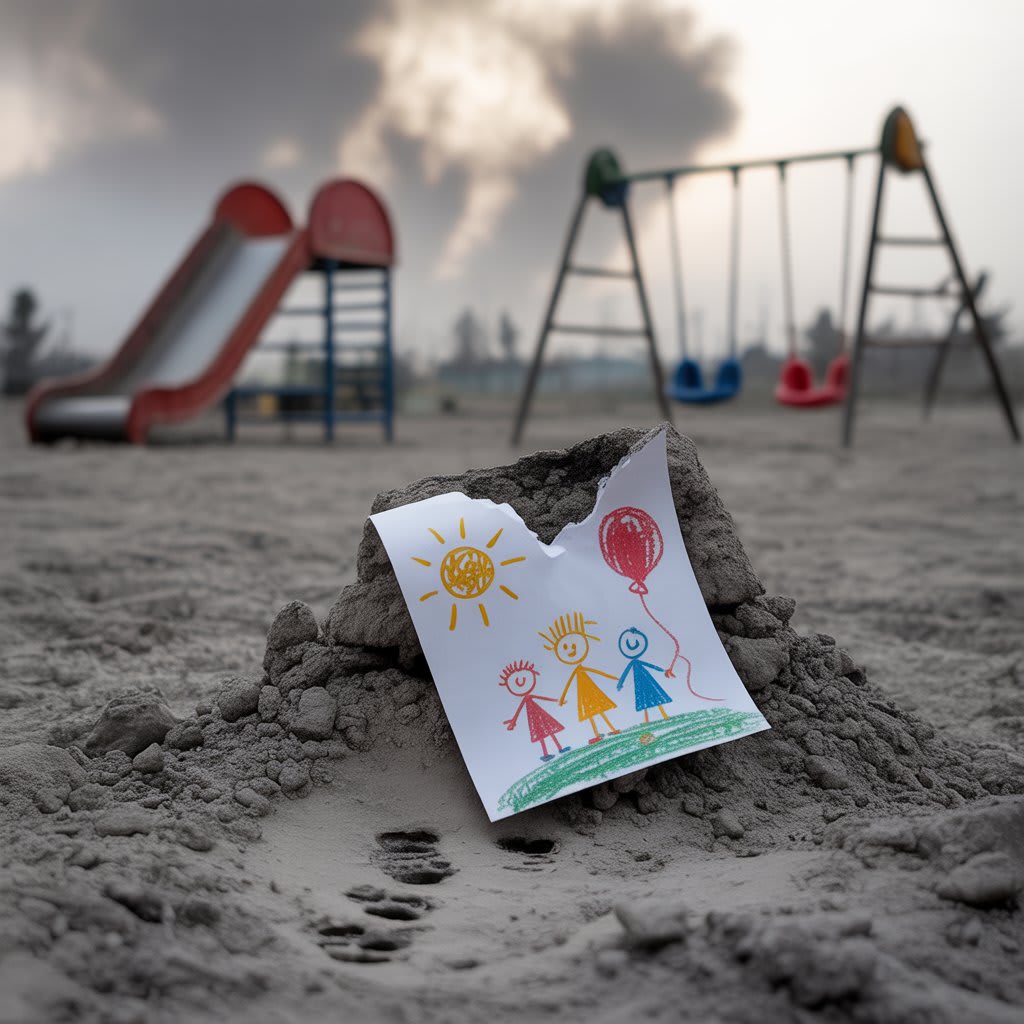
When the bombs hit, the sky turned black. The monkey bars collapsed. The slide twisted in on itself like a dying flame. And under a pile of rubble, between shattered tiles and a piece of a seesaw, someone found a crumpled sheet of paper—dusted in ash, edges torn.
It was a drawing.
A child’s drawing.
Rough strokes in waxy crayon—faded, but still clear. It showed a house, small and square, with four smiling stick figures standing in front of it. A mother in a long dress. A father with big hands. A younger sister holding a red balloon. And the artist—small, scribbled curls, arms outstretched like wings.
In the sky above them, there was a sun with a smile, and a bird flying.
And just behind the house… the outline of a tank.
Her name was Mariam Arafat.
Seven years old. A first-grader at the local UN school. Her teacher, Miss Lina, remembered her as “the girl who always stayed late to color.”
“She never rushed,” Lina said later, through tears. “She colored with care. Like each crayon was made of something precious.”
The day before the bombing, Mariam had asked for more paper to take home. “I want to draw my house,” she’d said. “Before it disappears.”
Lina didn’t understand the meaning then.
But Mariam did.
They never found Mariam’s body. Her home was leveled in the second round of airstrikes. Her parents and sister died instantly, pulled from the wreckage hours later by volunteers who worked through the night without food, water, or even hope.
Only the drawing survived.
Folded and buried in the dust near the playground where she last played hide and seek with her sister. A quiet corner where Mariam had once told a neighbor, “When I grow up, I’ll paint this whole park with flowers.”
The drawing went viral.
A journalist from Turkey photographed it being pulled from the rubble by a boy who had lost two fingers and his father. The image was shared across the world—a child’s art in a land where childhood was being erased.
People reposted it with hashtags. Politicians gave speeches. Artists reimagined the scene in murals and digital renderings.
But in Gaza, where power flickered and hope dimmed, Mariam’s drawing became something else entirely:
A relic. A memory. A prayer.
“They destroy our buildings,” said Mahmoud, a teenage boy whose school was turned to dust. “But this drawing—it’s proof we existed. We loved. We laughed. We had dreams.”
A woman in Rafah sewed the image onto quilts for refugee children. An old man copied it into a wall mural on what was left of a school’s east-facing wall. Others whispered Mariam’s name like a chant—quiet, respectful.
In a place drowning in loss, her innocent art became a beacon of memory.
When the ceasefire came weeks later, there were no celebrations. Just silence. Families counting names, scanning lists, digging through what used to be homes. And in a makeshift memorial near the playground, locals built a small shrine: a crooked bench, a broken swing, and a laminated version of Mariam’s drawing mounted on scorched stone.
No caption. No politics.
Just the sun.
Smiling through crayon lines.
To the world, it was a child's artwork.
To Gaza, it was everything that war tried to steal—and failed.
A testament that even among ashes and silence, a voice can still speak. A witness with no mouth and no breath, but more truth than headlines or briefings or cold diplomatic statements.
A truth that doesn’t beg for sympathy. Just remembrance.
In the end, Mariam never grew up to paint the park with flowers.
But her drawing did something more powerful.
It bloomed in the minds of millions—quietly, defiantly—a fragile crayon sun refusing to be forgotten.
About the Creator
ZIA ULLAH KHAN
A lifelong storyteller with a love for science fiction and mythology. Sci-fi and fantasy enthusiast crafting otherworldly tales and quirky characters. Powered by caffeine and curiosity.
Keep reading
More stories from ZIA ULLAH KHAN and writers in Criminal and other communities.
Murders of Innocence
There is something to be said about childhood trauma. It somehow has a way of showing its ugly head in the life of all monsters. I know it’s only one fact that goes into the making of a monster, hear me out. I know there are other little buildings blocks associated with the “build a little monster kit” most parents don’t even realize they come equipped with in their arsenal of unloving. Yes, I know what I said.
By Cassie Moore4 days ago in Criminal


Comments (1)
nice