
A 14 Year Old Girl Heads To A Neighbouring Town To Babysit And Is Never Seen Again
In 1974, a young girl boarded a bus and set out to her first babysitting job, but a bizarre phone call would soon follow in her absence...


Margaret Ellen Fox was born on February 4th, 1960, to her parents David and Mary Fox, and grew up in Burlington, New Jersey alongside her four brothers. She was a happy, lively child who shared a particularly close bond with her siblings.
Though small in stature, she could more than hold her own when play-fighting with her brothers—both the younger and the older ones.
Her family described Margaret as bright, confident, talkative, caring, and determined. At 14 years old in 1974, she was taking piano lessons and loved riding horses, embracing both hobbies with enthusiasm. After finishing 8th grade at St. Paul’s School in Burlington that summer, Margaret decided she wanted to spend her school break earning her own money. With characteristic determination, she planned to spend her summer babysitting.
She wanted to be able to buy her own clothes and have enough money to go on little day trips with her siblings whenever she wished. Hoping to earn this independence, Margaret asked her parents if she could place an ad in the local newspaper offering her services as a babysitter.
Her parents were hesitant and uneasy about the idea, worried about her safety and the potential risks. But Margaret was determined. After some gentle—but persistent—persuasion, she told them they were being overly protective and assured them she could handle the responsibility. Eventually, they agreed, and her advertisement was published in the paper.

It wasn’t long before Margaret’s ad began to attract interest. She received several calls about possible babysitting jobs, but one in particular would change the course of her life.
One day, the phone rang, and when Margaret answered, a man who introduced himself as John Marshall said he was looking for a babysitter for his five-year-old son.
The unsettling part is that the call wasn’t meant for Margaret in the first place. The man had originally contacted Margaret’s younger cousin, but she declined the job—not only because the location was too far away, but also because the caller seemed disappointed by her age. At just 11 years old, she was far younger than he wanted. Margaret, however, was older. At 14, she would be starting high school soon, and she didn’t mind traveling for work; in fact, she was excited by the opportunity.

The man explained that he lived in Mount Holly, about a seven-mile bus ride from Margaret’s home on Penn Street in Burlington. He offered her $40 per week, plus money for her bus fare, with working hours from 9:30am to 1:30pm.
He told her that she would need to take the bus to the intersection of High and Mill Street, where either he or his wife would be waiting in a red Volkswagen to pick her up and drive her to their home.

The stranger on the line told her that they would also be happy to drive her home around 2:00–2:30pm. To make the job sound even more appealing, he mentioned that she could bring her bathing suit because they had a backyard pool and a swing set, and that his son loved using both. To a 14-year-old, this sounded exciting, and Margaret gladly accepted the job.
Her father, David, however, couldn’t shake an uneasy feeling. Still, he didn’t want to tell Margaret she couldn’t go; she was, after all, spending her summer productively and earning her own money.
Margaret was hired on Wednesday 19th June 1974, and was scheduled to start two days later, on the Friday. But on June 20th, the day after the initial call, “John Marshall” phoned again to postpone her start date to Monday 24th June, claiming there had been a death in the family.
This time, Margaret’s father, David, spoke with the man himself, as did her mother, Mary. David wanted to get a sense of who this “John Marshall” really was. During the conversation, nothing seemed overtly suspicious. Even though David still felt uneasy, there was no clear sign that anything was wrong. Margaret often told him he was too protective of her and her brothers, so he likely kept that in mind—he didn’t want to appear overbearing or hold her back.
When Monday arrived, Margaret woke up bright and early. Her 11-year-old brother, Joe Fox, walked with her to the bus stop that morning. Margaret was dressed in maroon jeans with a yellow patch above one knee, brown sandals, a blue floral top, and a checked jacket. She also carried an eyeglass case decorated with a Huckleberry Hound design.

Joe’s last memory of his sister is watching her step onto the crowded bus that would take her from Burlington to Mount Holly. Margaret’s parents had given her specific instructions that morning: she was to call them as soon as she arrived. But that call never came.
After waiting long enough for what should have been her travel time plus the short drive to the Marshall home, her parents grew increasingly uneasy. They decided to call the number “John Marshall” had provided in case they needed to reach Margaret while she was working.
When they dialled the number, it rang and rang with no answer. Finally, someone picked up—but it wasn’t John Marshall.
In that moment, David and Mary Fox knew something was terribly wrong. The number they had been given wasn’t to anyone’s home at all. It belonged to a payphone outside a grocery store in Lumberton—ten miles from the Fox home and two miles south of Mount Holly, where Margaret was supposed to have been.
When Margaret didn’t return home by 2:30pm as planned, David contacted a friend who worked at the East Hampton Police Station, and together they drove to Mount Holly to search for her. Despite their efforts, there was no trace of Margaret. Soon, police organised large-scale searches of the area, but she could not be found.
A few witnesses did report seeing her near the corner of Mill and High Street—the very spot where “John Marshall” or his wife claimed they would pick her up in their red Volkswagen. But there were no confirmed sightings of her beyond that point. While this at least confirmed she had made it to her destination, everything that happened after she reached that corner remained a mystery.
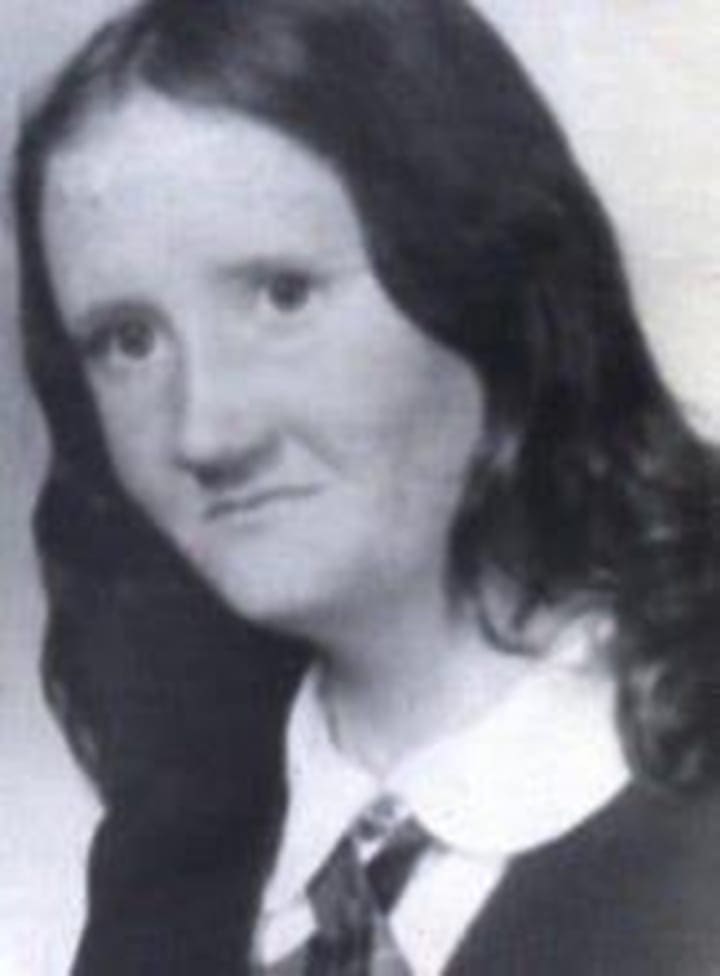
Margaret’s family were devastated. The possibility that she had run away was dismissed almost immediately. She had no reason to leave—she was happy, close to her family, got along well with her siblings, and had no money or outside connections that would have allowed her to run. In fact, the very reason she wanted a summer job was to earn money of her own. With no evidence pointing toward a voluntary disappearance, the family—and the police—had to confront the likelihood of an abduction.
To monitor any potential leads, authorities wired the Fox family’s house phone so all incoming and outgoing calls would be recorded. Tragically, only four days later, their worst fears were confirmed. They received a chilling call from a man who spoke just one sentence:

The recording of this ransom call would not be made public for 45 years. It was finally released in 2019, when investigators said advancements in audio technology allowed them to enhance the quality.
Detective Leonard Burr was originally assigned to the case, and one of his first strategies proved surprisingly effective. He rode the same bus route Margaret had taken on the day she disappeared, hoping daily commuters might recognise her. Before long, several did.
The first woman who came forward said her young son had grabbed Margaret’s hair while they were seated behind her. She had apologized, and Margaret turned around and struck up a friendly conversation. The woman recalled that Margaret had “smiley eyes—like someone who was happy.”
Another witness claimed to have seen Margaret after she stepped off the bus, approaching a young man in a red sports car. Police later located and interviewed this man, but they were confident he had nothing to do with the disappearance.
Detective Burr was certain more people had seen Margaret that day, but sensed that many didn’t want to get involved. With no solid leads emerging, the investigation began to go cold.
In desperation, police turned to an unusual measure: they met with psychics on four separate occasions. They didn’t fully believe in the practice, but with no other direction to pursue, they felt they had nothing to lose. Unfortunately, none of the information provided by the psychics led anywhere.
Investigators then took a more grounded approach and looked into every individual named John Marshall in the region. Surprisingly, there were quite a few. One by one, police ruled them out—until one John Marshall in particular began to stand out.

One of the men named John Marshall immediately drew attention. He worked at the A&P grocery store located in the very same shopping centre where the abductor had used the payphone. To many, this seemed like too much of a coincidence—perhaps even a deliberate setup. After all, why would a kidnapper use his real name?
This John Marshall was interviewed multiple times and even underwent a polygraph test, which he passed. He also provided a solid alibi showing he had been at work at the time of Margaret’s disappearance. With no evidence tying him to the crime, investigators had nothing substantial to build a case against him.
Over time, reported sightings of Margaret surfaced as far away as the West Coast, but none of these leads went anywhere. Most were likely cases of mistaken identity. Many parents in nearby towns also contacted police to report strange phone calls their own children had received, but again, nothing led investigators any closer to finding Margaret.
By August—two months after she vanished—the case had already begun to fade. The heart-breaking possibility that Margaret might never be found was becoming increasingly real.
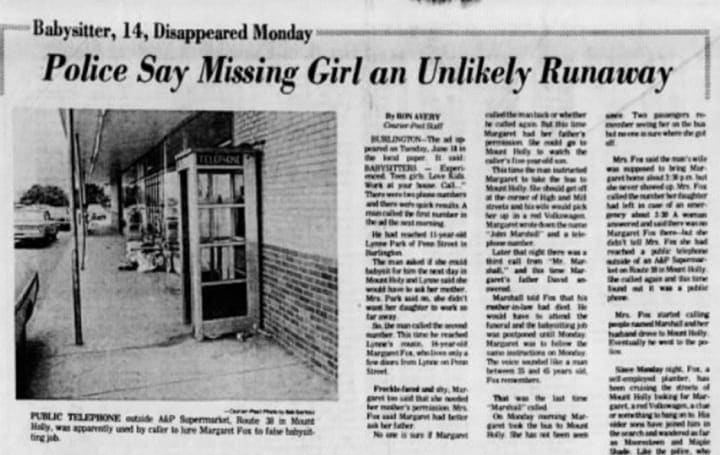
There was never a day for the rest of David Fox’s life when he stopped searching for his daughter. He covered his car windows with a collage of Margaret’s photographs, asked questions of every person he met, and handed out flyers at every opportunity. He once said:

Joe Fox, Margaret’s brother, later shared that her disappearance broke their parents in ways they never recovered from. They were never the same after the day Margaret walked out the door and didn’t return.
In May 1976, it seemed there might finally be a break in the case when a 53-year-old man named Charles Chlobridge confessed to abducting and murdering Margaret. He claimed to have dumped her body in the Catskill Mountains. But after an extensive search, no trace of her was found.
Investigators soon discovered that Chlobridge had actually been hospitalised on the day Margaret disappeared. He was charged with filing a false report. Although he was still investigated further, no evidence linked him to Margaret, and his confession was ultimately dismissed as a cruel and senseless hoax.

Detective Burr retired in 1988, but Margaret’s case stayed with him long after he left the force. He later remarked that one of his greatest disappointments was never being able to bring closure to her family.
Burlington Police Captain John Fine also reflected on the limitations of the era, explaining that at the time, there was virtually no information-sharing between police agencies. The only way to obtain details from another department, he said, was if you personally knew someone there—or begged for cooperation.
In December 1988, a potential breakthrough seemed to emerge when a human skull was discovered on the hills of the Atlantic Highlands. A subsequent search with cadaver dogs uncovered additional remains on a nearby beach, buried less than two feet below the surface. Two tyres had been placed on top of the burial site and covered with dirt.

Partial clothing was recovered at the site, including a platform sandal manufactured in the early to mid-1970s. The victim was initially estimated to be between 15 and 19 years old and around 5’1″ tall. Investigators initially considered the remains could be Margaret’s, but when they attempted to compare the skull with her dental records, they discovered that Margaret’s records had been lost. Later, DNA testing using her brother’s samples confirmed that the remains did not belong to Margaret. Nineteen other Jane Doe cases were similarly compared, but none matched her.
Captain Fine had long wanted someone to re-examine Margaret’s case, but he said it was impossible at the time. Detectives were each overwhelmed with up to 100 active cases, and adding a decades-old cold case—whose records had not been organised or analysed in 10–15 years—would have been unmanageable.
Tragically, David Fox passed away in 1993, never learning what had happened to his daughter. Margaret’s mother, Mary Fox, passed away in 2003; her obituary still listed Margaret as one of her surviving children.
In April 2017, Captain Fine’s hope of revisiting the case was finally realised when retired detective Michael D’Alessio partnered with the Burlington Police, volunteering his time and expertise to review old cases. He described his efforts as re-examining the data to see if any clues had been missed in the original investigation, while keeping his expectations realistic. Although the re-analysis yielded few concrete leads, it did renew media attention on Margaret’s disappearance.
In 2019, the audio of the infamous ransom call was finally released. The recording was of very poor quality, but recent advancements in audio enhancement made it intelligible for the first time.
To this day, Margaret’s family and friends continue to miss and love her, still wondering what happened to her after that fateful summer day in 1974. A $25,000 reward remains available for information leading to the arrest of her abductor.
At the time of her disappearance, Margaret was 5’2″ tall and weighed 105 pounds. She was a Caucasian female with brown hair and blue eyes, two missing front right teeth, freckles, and wore glasses with hexagonal lenses, gold wire frames, and a broken temple and nose piece.
Today, Margaret would be 65 years old.

About the Creator
Matesanz
I write about history, true crime and strange phenomenon from around the world, subscribe for updates! I post daily.
The Crime That Shook Danvers, Massachusetts
The killing of Colleen Ritzer a 24-year-old math teacher at Danvers High School in Danvers Massachusetts remains one of the most tragic and disturbing crimes to affect a school community in the United States in recent years.Colleen Ritzer was widely remembered by colleagues and students as a dedicated and compassionate educator. Early in her teaching career she was known for bringing enthusiasm and patience into the classroom and for taking a genuine interest in the academic and personal wellbeing of her students. Friends and coworkers often described her as someone who believed every student deserved attention, encouragement, and the opportunity to succeed.
By Kure Garbaabout 20 hours ago in Criminal
The Last Train from Platform Seven
M Mehran Every night at 11:40 PM, the last train departed from Platform Seven. Commuters rushed aboard with tired eyes and half-finished thoughts. The station lights hummed. The city slowed. Routine settled over everything like dust. Nothing unusual ever happened on the last train. Until the night one passenger never arrived — yet his briefcase did. By sunrise, the case was linked to one of the most calculated crimes the city had ever seen. The Routine That Made It Possible Central Station was a monument to predictability. Security cameras rotated in fixed patterns. Patrol officers walked identical routes. Ticket scanners recorded entries down to the second. Routine keeps cities moving. But routine also creates patterns. And patterns can be exploited. For six months, someone had been studying Platform Seven — timing security rotations, passenger flow, and maintenance shutdowns. They weren’t looking for a victim. They were engineering an opportunity. The Man with the Silver Briefcase Witnesses remembered him clearly because he appeared forgettable. Mid-forties. Gray coat. Clean-shaven. No distinguishing features except a polished silver briefcase that never left his hand. Every weekday for three weeks, he boarded the last train and exited three stops later. He spoke to no one. Made no phone calls. Kept his gaze lowered. Invisible. Reliable. Predictable. Exactly what he wanted to be. The Night Everything Changed On Tuesday evening, the station was unusually crowded after a football match. Noise echoed through the terminal. Announcements overlapped. Security struggled to manage the surge of passengers. At 11:38 PM, the man with the silver briefcase entered through Gate C. At 11:39 PM, surveillance cameras briefly lost signal during a system reboot. At 11:40 PM, the last train departed. But the man never boarded. The briefcase did. Discovery at Dawn The train completed its route without incident. It was cleaned overnight and prepared for morning service. At 5:12 AM, a maintenance worker discovered the briefcase beneath a seat in the second carriage. Inside were neatly arranged bundles of cash, multiple passports, and a sealed envelope containing a handwritten message: “This is only the beginning.” Within hours, investigators confirmed the money totaled €780,000 — linked to a corporate embezzlement case that had gone unsolved for eight months. The case had just reopened itself. A Crime Beyond Theft Detective Lena Vogt quickly determined the briefcase was not abandoned. It was delivered. The cash belonged to Helios Infrastructure Group, a multinational engineering firm under investigation for financial irregularities. Funds had disappeared through layered shell companies and offshore accounts. No arrests had ever been made. Until now, someone wanted attention. But why return stolen money? And why in such a theatrical way? The Hidden Message Forensic analysis revealed microscopic markings inside the envelope — numbers written in nearly invisible ink. They corresponded to internal project codes within Helios Infrastructure. Each code linked to construction sites across Europe. Each site had cost overruns totaling millions. This wasn’t a confession. It was an accusation. Someone was exposing a system. The Whistleblower Who Became a Criminal Authorities soon identified the man with the silver briefcase as Markus Feldmann, a former financial auditor employed by Helios. Two years earlier, Markus had raised concerns about irregular financial transfers tied to subcontractors. His warnings were ignored. Months later, his position was eliminated during “restructuring.” After losing his job, Markus disappeared from professional networks. But he hadn’t vanished. He had been collecting evidence. Crossing the Line Investigators believe Markus initially intended to expose corporate fraud legally. But when regulatory complaints stalled and legal threats mounted, he chose a different path. He hacked internal systems. Intercepted transfers. Redirected illicit funds. Then redistributed portions to anonymous charity networks. And finally, he staged the Platform Seven drop — returning part of the money to authorities while exposing the corruption behind it. His actions blurred the line between criminal and whistleblower. He committed cybercrime, fraud, and financial theft. Yet he also revealed a corruption network worth hundreds of millions. The Citywide Manhunt When news broke, public opinion fractured. Some called Markus a criminal mastermind. Others called him a hero. Helios Infrastructure denied wrongdoing, but European regulators reopened investigations across multiple jurisdictions. Meanwhile, Markus remained missing. Authorities tracked digital traces through encrypted networks, but he stayed ahead — using public terminals, temporary devices, and anonymized routing. He understood systems. He understood surveillance. And he understood how to disappear inside modern infrastructure. The Platform Seven Sighting Three weeks later, a transit officer reported seeing a man matching Markus’s description standing near Platform Seven minutes before midnight. By the time officers arrived, he was gone. But this time, he left something behind. A folded newspaper with a circled headline: “Audits Expanded Across Three Countries.” Inside the paper was a single handwritten line: “Truth arrives on schedule.” Crime, Morality, and the Gray Zone Markus Feldmann’s actions ignited debate across legal and ethical communities. Was he a criminal who stole and hacked his employer? Or a whistleblower forced into illegal methods by institutional silence? Modern crime is no longer defined solely by violence or theft. It now exists in complex gray zones where digital access, corporate secrecy, and systemic corruption intersect. Markus broke the law. But he also broke open a system designed to protect itself. Why Stories Like This Captivate Us Criminal stories resonate because they challenge our understanding of right and wrong. They expose the fragility of systems we trust — financial institutions, corporate governance, public infrastructure. They force us to confront uncomfortable questions: Is breaking the law ever justified? Who decides what justice looks like? And how far would someone go to expose the truth? The Train Still Runs Platform Seven remains operational. The last train still departs at 11:40 PM. Passengers still glance at their phones, lost in routine. But some nights, commuters pause and look around — wondering if the man with the silver briefcase might step from the shadows once more. Because in a world built on systems and schedules, the most disruptive force is not chaos. It is precision. And somewhere, someone may still be watching the clock.
By Muhammad Mehran3 days ago in Criminal
Echoes
I stepped carefully around the corner, the familiar sights and sounds hitting me like a brick to the face. My eyes watered. I could practically see us, all of us, back then, clustered around the outdoor tables in front of the pizza shop, the bar, the coffee shop. I could smell the various stalls from the events we’d been to on this street. I could taste the churros and nachos.
By Phoenixica246 days ago in Fiction




Comments
There are no comments for this story
Be the first to respond and start the conversation.