
475 Years for Dog Fighting
Why this case matters

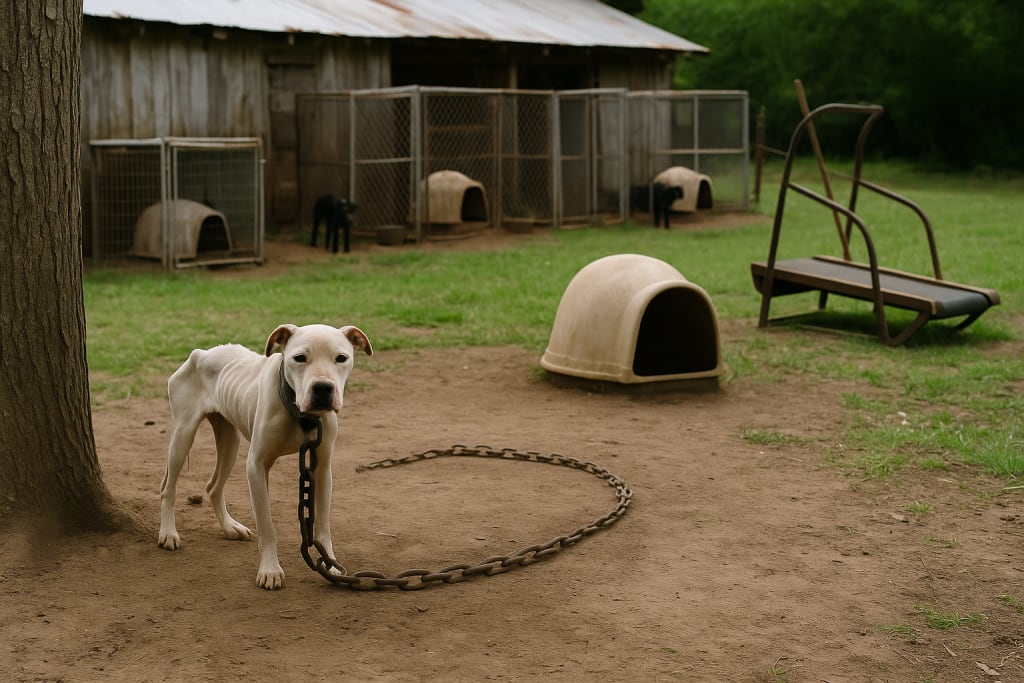
Dog fighting has never been a fringe issue. It has functioned for decades as an organized subculture built on pain, secrecy, and profit. The 2023 sentencing of Vincent Lemark Burrell in Georgia forced that reality into daylight in a way courts rarely achieve. He received 475 years, a number that looks theatrical until the details are examined one by one.
Authorities found more than 100 pit bulls across the property.
- Many were chained with heavy equipment that restricted movement to a few steps.
- Several had open wounds.
- Others showed bite scars in various stages of healing.
- Treadmills, bite cages, metal bars, syringes, and breeding logs filled out the scene.
None of it looked chaotic. It looked deliberate and routine. The case file read like a checklist of what happens when cruelty becomes a business model instead of an impulse.
Each dog counted as a victim. That single judicial decision changed the scale of the sentence. Courts often treat animal victims as a single unit, which turns a large case into a low-number count. This case broke that pattern. When the counts stacked, the years stacked with them.
People who harm animals in sustained ways tend to show the same neurological patterns as people who harm intimate partners, children, or vulnerable adults. They often tune out distress signals and over-rely on dominance, avoidance, or thrill-seeking. Those traits do not fall away with short sentences or traditional talk-based rehabilitation.
To understand why Burrell’s case mattered, it helps to compare it with other major dog-fighting prosecutions.
The 2007 Michael Vick case involved killing dogs by drowning, hanging, electrocution, and blunt-force methods. He served 18 months because the federal charges centered on conspiracy and gambling. Animal-cruelty statutes were not used at the state level. Public outrage pushed several states to revise their laws afterward.
The 2016 Operation Grand Champion investigation spanned 4 states and more than 500 dogs. Sentences ranged from 6 to 60 months, far below the damage inflicted. Federal statutes capped what sentences could be.
North Carolina’s 2021 Bradley Sluder case led to 58 months after officers documented starved dogs, scarred dogs, and breeding-for-fighting setups. It was one of the state’s longest sentences for animal cruelty, yet it remained short enough for full reentry.
Against that landscape, a 475-year sentence reads differently. It wasn’t symbolic. It corrected an old sentencing habit that undervalued the scale of pain, the structure of the operation, and the risk to the community. Dog fighting shares boundaries with narcotics, weapons trafficking, and interpersonal violence. When investigators move in on a ring, they rarely find a person who mistreats only animals.
Most offenders who run cruelty operations show a neurological pattern marked by emotional detachment, thrill-seeking, and low reactivity to suffering. Neuroscience and trauma science have documented for years that people who feel little internal response to pain cues in others often escalate across targets. That is why the court treated the Burrell operation as a threat beyond the property line.
This is also where rehabilitation needs to match the behavior pattern. Courts have relied on cognitive programs for decades, but cognitive models only work on people who already have some internal empathy structure to strengthen. Offenders in cruelty cases often do not. They need a sensory correction, not a verbal one.
My P.E.T. (Psychosensory Empathy Training) VR Program was built for that gap. It uses immersive sensory input rather than verbal instruction. The nervous system processes the scene from the position of the vulnerable figure - whether animal or human - which forces the offender’s body to register what their mind has ignored. Real-time physiological feedback interrupts the flat or thrill-driven responses that show up in cruelty cases. Participants are not lectured. They are put into controlled sensory states that restore a capacity they either shut down or never formed.
When courts are finally able to use PET VR with cruelty or domestic-violence offenders, the pattern I see is simple. People who usually intellectualize their actions stop relying on prepared explanations and start experiencing physical signals they cannot suppress. Talk-based programs rarely reach that layer. Sensory programs do. If the goal is fewer animals harmed, fewer humans harmed, and fewer cycles repeated, then courts need tools targeted at the neurobiology behind the offense. But this cannot happen without your help. Text PETVR to 707070 to see a video about this.
The Burrell sentence set a record. It also set a reminder.
- Hard sentencing protects victims.
- Smart rehabilitation protects future ones.
Dog-fighting cases sit between organized crime and empathy collapse. A justice system that recognizes both sides has a better chance of stopping the next ring before the next raid.
Sources That Don’t Suck
American Veterinary Medical Association. (2020). Dog fighting and animal cruelty. AVMA Press.
Ascione, F. R. (2018). The violence connection: Animal cruelty, domestic abuse, and criminal justice responses. Purdue University Press.
Lockwood, R. (2019). Animal cruelty and interpersonal violence: Forensic perspectives. Academic Press.
National Sheriffs’ Association. (2021). Criminal behavior patterns in animal-fighting enterprises. NSA Publications.
Petersen, L. L. (2022). Neuroscience of empathy deficits in violent offenders. Oxford University Press.
Wenn, R., & Day, C. (2017). Psychophysiology of aggressive offenders: Assessment and intervention. Cambridge University Press.
About the Creator
Dr. Mozelle Martin
Behavioral analyst and investigative writer examining how people, institutions, and narratives behave under pressure—and what remains when systems fail.
Keep reading
More stories from Dr. Mozelle Martin and writers in Criminal and other communities.
Digital Hunting Grounds of Roblox and Discord:
Watching interviews on the Shawn Ryan Show reminded me to write this article as a follow-up to a previous one. You see, there is a moment in every digital-exploitation case where the denial dies. It usually happens when a predator stops pretending to be a decent human and speaks plainly. A Discord user once admitted, without hesitation, that he “has little children because it’s all fun,” then listed the things he tells them to do.
By Dr. Mozelle Martin3 months ago in Criminal
Epstein Files: Story Explained
This is the infamous private island known as Little Saint James, often called “Epstein Island.” Spread across 72 acres, the island had nearly every luxury imaginable — from lavish resorts and private docks to a library and even a cinema. Some of the world’s most powerful figures frequently visited.
By Imran Ali Shah5 days ago in Criminal


Comments
There are no comments for this story
Be the first to respond and start the conversation.