
1999 EPPD's New 1984
How Failure to Respond Hurts the Department


Seeking Answers
On 24 March 2025, I submitted the following Freedom of Information Act request to the El Paso Police Department, via the City of El Paso's FOIA system:
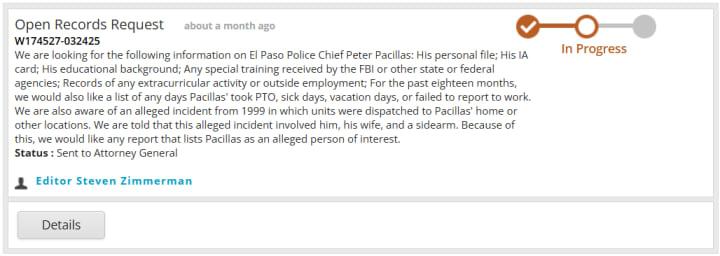
We are looking for the following information on El Paso Police Chief Peter Pacillas:
His personal file; His IA card; His educational background; Any special training received by the FBI or other state or federal agencies; Records of any extracurricular activity or outside employment; For the past eighteen months, we would also like a list of any days Pacillas' took PTO, sick days, vacation days, or failed to report to work.
We are also aware of an alleged incident from 1999 in which units were dispatched to Pacillas' home or other locations. We are told that this alleged incident involved him, his wife, and a sidearm. Because of this, we would like any report that lists Pacillas as an alleged person of interest.
As of today, 15 May 2025, we have not received any response from the City of El Paso or the El Paso Police Department.
According to the Texas Office of the Attorney General, the City of El Paso, Texas, must respond to a Public Information Act (PIA) request within ten business days of receiving it. This response could involve releasing the information, providing notice of a release date, or seeking a ruling from the Open Records Division to withhold information.
The following is a printout of the only communication between me and the City of El Paso:
We will publicly address each item in our request and why it was sought.
Personal file: This request was made to allow our readers to see Chief Peter Pacillas's training and caseload. Current senior officers and retired officers have alleged that Pacillas does not have the request on the job history for Chief of Police.
Internal Affairs Card: The IA card was requested again due to alleged violations of at least one specific act, in which he used his department-issued sidearm, an event we will address later in this article. It was also alleged that Pacillas may have had his IA card cleared.
Educational background: We feel confident that Chief Peter Pacillas's application to be considered for Chief of Police adequately addressed this question. The documents the Chief submitted can be viewed by clicking here or by reading at the bottom of this article.
Any special training received by the FBI or other state or federal agencies: We live in a border community, and based on that fact alone, the person who would be considered for Chief of Police should have received some special training from the FBI, the State of Texas, or another Federal Agency. It has been alleged that Peter Pacillas has not received any outside training for at least fifteen years.
Days off: As we have learned, some will not report to work for an off-duty job. In Northeast El Paso, Lt. Christopher Jones will become AWOL for hours at a time, leaving his department-issued cellphone in his office. Additionally, we've learned that on at least one occasion, Detective Jerome Hinojos has failed to report to work in order to work an off-duty job for El Paso Housing. Likewise, it has been alleged and proven that Lt. Frank Rodriguez will leave his duty station early to be on time for his off-duty work. Most Officers only report to work to set up their off-duty jobs.
You can read more about Rodriguez and Hinojos by clicking here.
We wanted to ensure that the person leading the El Paso Police Department is responsible enough to attend duty on his assigned days. However, in the article linked above, we've learned that some Officers may proactively redact the timesheets for their off-duty work. This means any document we receive is automatically called into question.
1999: Two (2) Officers who claim to have been on the scene have alleged that the Chief of Police, Peter Pacillas, was involved in a situation in which he placed a sidearm in his wife's mouth to, as one of the Officers has said, "help him get off."
To put this growing allegation down, we requested any documentation that would prove or disprove the events of 1999.
A Failure to Communicate
While it is not mandatory for anyone to answer a question or media request put forth by a reporter, failing to answer does allow readers to draw their own conclusions.
Refusing to answer, especially when it's a matter of public interest, can lead people to assume the worst. While researching the alleged facts behind our request, we have learned that much of what is being ignored may, in fact, be true.
"The Chief has bragged that he doesn't even know how to use the computers in the patrol cars," says an Officer from Five Points.
The Chief's alleged inability to use the MPS suggests that he may not have received any updated training in quite some time. Shouldn't the Chief of Police lead by example and know how to use current technology? You would think so.
"Aren't police supposed to be held to a higher standard?" asks Miguel Madrid, an El Paso resident. The answer is yes; even the Chief says they [police] are to be held to a high standard.
If someone refuses to engage, journalists will likely seek information elsewhere. This means the narrative about that individual or situation might be shaped by other sources, potentially in a less favorable way. Failing to provide your own perspective can lead to an incomplete or biased story.
Are my articles about the El Paso Police Department biased? There is some degree of bias in what I wrote. The reason for that bias is that a department led by a man who championed a new era of transparency has drawn a curtain so that we can't even have a glimpse of truth.
For public officials, like those at the El Paso Police Department, declining to answer questions, especially on essential matters, can damage their credibility and erode public trust.
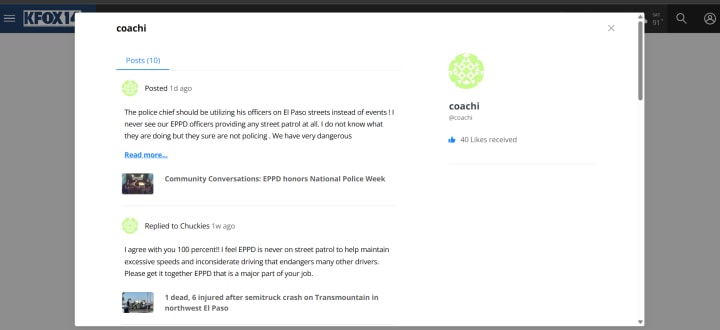
A recent comment on the KFOX.com website says the following:
"The police chief should be utilizing his officers on El Paso streets instead of events ! I never see our EPPD officers providing any street patrol at all. I do not know what they are doing but they sure are not policing . We have very dangerous roads right now because there are no officers controlling speed or even monitoring! This is the first time I have seen the Police chief or even heard from him. I feel he needs to work on the safety of his community not celebrate his Department."
The public trust the El Paso Police Department once had is quickly eroding. Evidence can be seen on their Facebook page by reading the comments under any Rapid Response Friday video.
While silence is an option, it can be risky when dealing with media inquiries. Engaging with reporters, even strategically, can offer a better chance to influence the narrative and avoid potential negative consequences.
Without a response, I have no choice but to share my questions with the Department with those who take the time to read my articles. While I support the El Paso Police Department, I cannot support its leadership or how it squanders police resources. For more on how resources are used, read "It's Not Your Job, But Do It Anyway."
Once again, the ball is in EPPD's court. As history has shown, I am sure you and I will be left to draw our conclusions, right or wrong.
About the Creator
Steven Zimmerman
Reporter and photojounalist. I cover the Catholic Church, police departments, and human interest.
Keep reading
More stories from Steven Zimmerman and writers in Criminal and other communities.
Two Teens, One Bus, and a Nation Watching
Hello, and welcome to “The True Crime Reader,” where we dig beneath the headlines to unravel the stories that shape our understanding of crime, justice, and society. Today’s episode takes us to Oakland, California, for the story behind Dashka Slater’s powerful nonfiction book, “The 57 Bus”—a case that stunned the Bay Area and reverberated across the country.
By Kristen Barenthaler5 days ago in Criminal
Robert William Fisher: The Unresolved Mystery Behind One of America’s Most Notorious Fugitives
Few criminal cases in the United States have remained as haunting and unresolved as that of Robert William Fisher. More than two decades after his disappearance, Fisher’s name continues to appear on the FBI’s Most Wanted list, symbolizing both a tragic family crime and one of the longest-running manhunts in modern American history. His case blends elements of domestic violence, psychological profiling, forensic investigation, and unanswered questions that still trouble law enforcement and the public alike.
By Salaar Jamalia day ago in Criminal


Comments
There are no comments for this story
Be the first to respond and start the conversation.