
The surprising trend of converting to Islam around the world: Why people are choosing Islam.
The Turning of Hearts

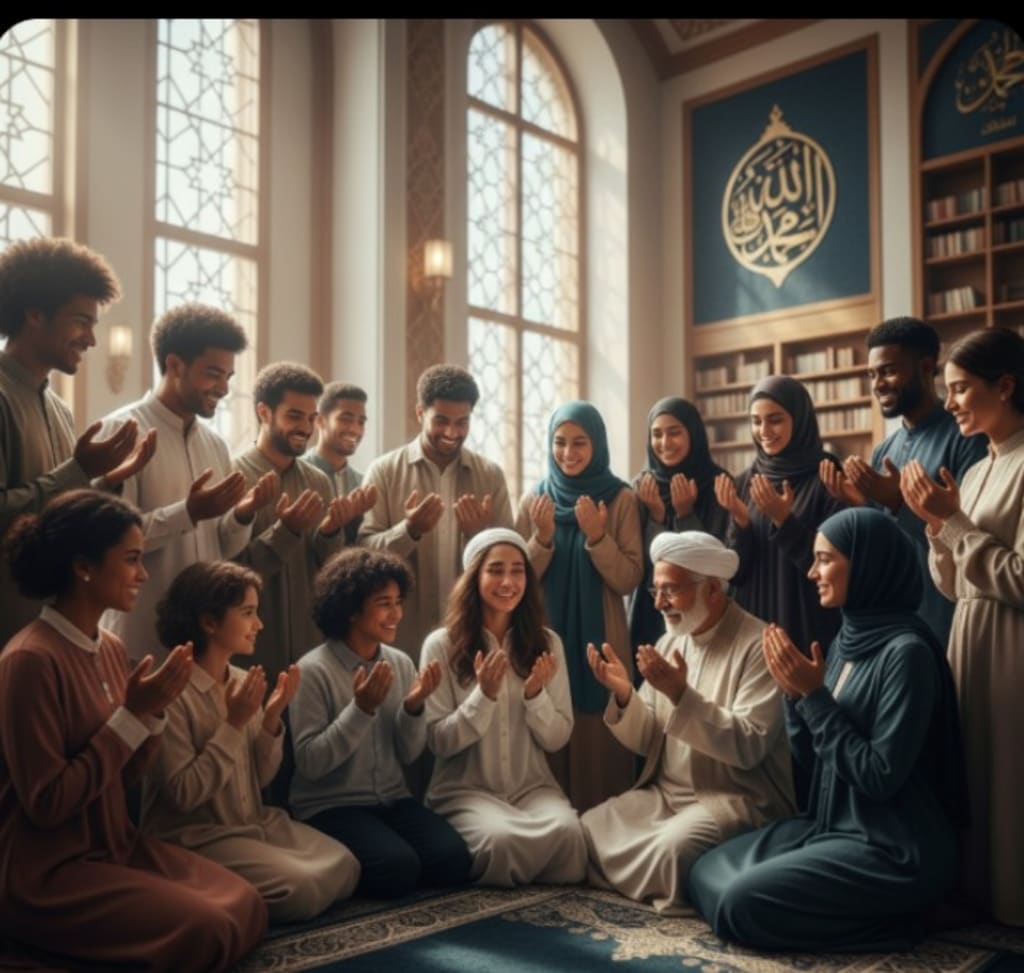
The Turning of Hearts
When the sun dipped behind the city skyline, the hum of evening traffic softened, and the mosque courtyard glowed beneath amber lights. Maya stood at the gate, fingers tightened around the strap of her backpack. She wasn’t sure why she’d come back—only that something in her life had been shifting, like pieces rearranging quietly in the background.
Inside, she heard soft chatter. A small circle of people had gathered for a weekly “Open Door” session—an informal evening where newcomers could ask questions about Islam without judgment or pressure. Maya eased in, choosing a spot near the back. She noticed others like her: hesitant, curious, carrying questions that weighed more than their notebooks.
At the front sat Imam Kareem, warm-eyed and calm. “Tonight,” he said, “I want to talk less. I want to listen more. Something is happening around the world. People from different places and backgrounds are exploring Islam for reasons uniquely their own. Maybe some of you are here because you feel something changing, too.”
Maya looked down quickly, as if he might have been speaking directly to her.
A woman with sandy-blonde hair raised her hand. “Everywhere I look,” she said, “I hear about people converting. Not just immigrants—people like me. Why now? What’s drawing them?”
The imam nodded, thoughtful. “There isn’t just one reason. Some are searching for peace. Some for structure. Some for purpose. And others,” he smiled gently, “simply follow a feeling that grows quietly until they can’t ignore it.”
---
After the discussion, people lingered. Tea was served in tiny glass cups, releasing wisps of mint-scented steam that curled into the night air. Maya found herself standing beside an older man with silver hair and a steady demeanor.
“First time?” he asked.
“Second,” she admitted. “I’m… still figuring out what I’m doing here.”
He chuckled softly. “You and half the world.”
Maya raised a brow.
“I’m only half joking,” he continued. “I converted six years ago. Back then, I thought I was an anomaly. But now? It feels like I meet new Muslims every month—teachers, engineers, artists, quiet neighbors, loud activists. People who never imagined it for themselves.”
“What made you change?” Maya asked.
The man took a thoughtful sip of tea. “I wasn’t looking for religion. I was looking for clarity. The world felt loud—chaotic, unanchored. Islam gave me a rhythm, a structure that helped me move through life with steadiness. It asked for sincerity more than perfection. That made sense to me.”
His words hung in the air like notes from a distant melody.
---
When Maya left the mosque that night, the city felt different. Not quieter—just clearer, as if her senses had sharpened. On the train home, she watched people move through their routines, each absorbed in their own world. She wondered how many of them carried unspoken questions like she did.
Over the following weeks, she returned again and again—sometimes for the open discussions, sometimes just to sit quietly in the back as others prayed. She listened to stories from people who had embraced Islam for reasons that were as diverse as their faces.
There was Leila, a former dancer from Brazil, who said she found discipline and direction in the structure of the prayers. There was Omar, once an atheist poet from Norway, who said he converted after years of studying world religions and finding a philosophical resonance in Islam’s concept of oneness. There was Hana, a Japanese medical researcher, who described her conversion as “a long, slow unfolding,” something that happened internally long before she said any words aloud.
They all spoke without pressure, without expectation. Their stories were personal, not promotional.
But each one stirred something inside Maya.
---
One particularly rainy evening, Maya arrived early. The prayer hall was nearly empty, just a few warm lights glowing along the walls. She found a quiet corner and sat cross-legged. The patter of rain against the windows created a steady rhythm, like a heartbeat.
For the first time, she allowed herself to ask the questions she had been skirting around.
Why do I keep coming back? What am I searching for? Why does something inside me feel at peace here?
It wasn’t a dramatic realization—no sudden epiphany or flash of brilliance. It was an accumulation, a slow and subtle gathering of emotions she had been carrying for months. The calm she felt in the mosque, the sincerity she saw in the people, the clarity in the teachings—it all felt like a door gently opening inside her.
She wasn’t sure what step she would take next. But she knew one thing: she wanted to understand more. The world might call it a “trend,” a surprising rise in conversions, a global shift. But sitting there in the quiet, Maya understood that behind every headline was a story like hers—personal, intimate, shaped by a search for meaning.
And maybe, she thought, that was why the world was changing: not because of numbers or movements or statistics, but because individual hearts were moving quietly toward something that felt true to them.
---
When she finally stood to leave, the rain had stopped. Puddles reflected the streetlights in shimmering patches, and the evening breeze carried the faint scent of earth and renewal.
Maya walked home slowly, each step steady—not because she had found all the answers, but because she had finally stopped running from the questions.
And in that stillness, she felt something new: a beginning.
About the Creator
Keep reading
More stories from waseem khan and writers in Confessions and other communities.
The Day My Supervisor Said the Shahada
The Day My Supervisor Said the Shahada” (An Unexpected Journey to Faith) I had worked under Mr. Thompson for almost three years. He was the kind of supervisor everyone respected — strict, punctual, and professional. But behind that calm demeanor, there was a cold distance. He never joined us for Friday prayers, even though he would always excuse us early.
By waseem khan3 months ago in Confessions
US Attack on Greenland Would Mean End of NATO, Says Danish PM
Denmark’s prime minister has issued a stark and unprecedented warning, declaring that any U.S. attack on Greenland would effectively mean the end of NATO. The remarks have sent shockwaves through diplomatic circles, raising alarms about the future of the world’s most powerful military alliance and exposing deep tensions beneath the surface of transatlantic relations.
By Aarif Lashari6 days ago in Confessions


Comments
There are no comments for this story
Be the first to respond and start the conversation.