
The Paradox of Choice: Why Having Too Many Options Makes Us Less Happy
How Overabundance Overwhelms Our Minds and Undermines True Satisfaction
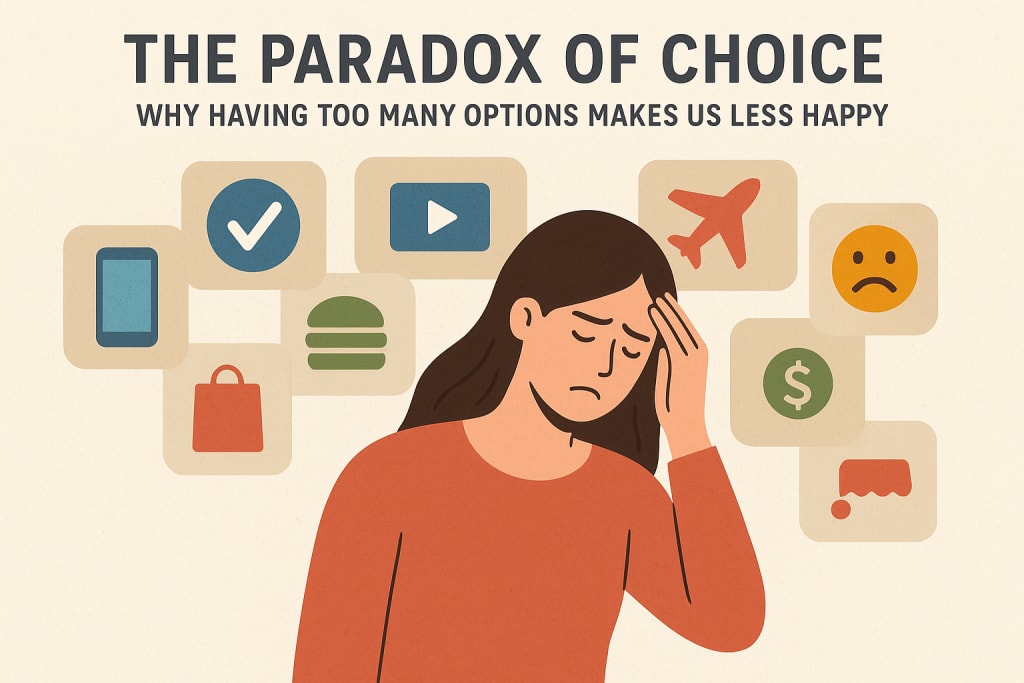
Introduction
We live in an age of abundance. Walk into a supermarket, and you’ll be confronted with dozens of cereal brands, hundreds of snack variations, and countless flavors of bottled water you didn’t even know existed. Open Netflix, and you’ll spend half an hour scrolling through endless recommendations before finally choosing something—or perhaps giving up altogether. On the surface, this looks like progress. More choices should logically mean more freedom, more customization, and ultimately, more happiness. After all, if we can choose exactly what we want, shouldn’t we be more satisfied?
Yet research, psychology, and real-life experiences suggest otherwise. Too many options often leave us anxious, indecisive, and dissatisfied with whatever we pick. This phenomenon is known as the Paradox of Choice—a term popularized by psychologist Barry Schwartz in his 2004 book of the same name. The paradox suggests that while choice is essential for freedom, excessive choice can backfire, leaving us less happy.
In this article, we’ll explore why too much choice overwhelms us, how it affects our mental health, and what we can do to navigate the modern world of endless possibilities without drowning in it.
The Illusion of Freedom
At its core, choice is about freedom. Being able to decide what we eat, wear, or pursue as a career is central to autonomy and individuality. In societies where choices are restricted—whether politically, socially, or economically—people often feel trapped. This is why having options is generally considered a marker of progress.
But there’s a difference between having enough choices and being bombarded with too many choices. For example, having a handful of job offers allows someone to select the one that best aligns with their values. But being overwhelmed with hundreds of similar options, each with slightly different perks, can make the decision paralyzing.
Freedom, paradoxically, becomes a prison when every decision feels like a gamble, and every outcome risks regret.
The Psychology of Overchoice
Psychologists have studied what happens when people face too many options. One of the most famous studies, often referred to as the jam experiment, involved setting up two displays at a grocery store. One table had six varieties of jam, while the other offered twenty-four. While more people were attracted to the larger display, shoppers were ten times more likely to actually buy jam when they only had six options.
This experiment highlights a key point: more choice attracts attention, but less choice drives action and satisfaction.
Why? Because our brains have limited cognitive bandwidth. Every option requires mental processing—comparing, weighing pros and cons, considering possible outcomes. The more choices we face, the heavier the cognitive load. At some point, we hit decision fatigue, where the effort of deciding becomes exhausting. Instead of feeling empowered, we feel drained.
Decision Paralysis: When Too Many Choices Freeze Us
We’ve all experienced decision paralysis. It’s the moment when you scroll endlessly through a restaurant’s 15-page menu and end up ordering something safe—because choosing feels impossible. Or when you can’t commit to a new pair of shoes because there are too many styles, colors, and price points.
Psychologists call this choice overload, and it explains why more options can actually lead to no decision at all. In professional contexts, this shows up when entrepreneurs stall on launching a product because there are too many possible directions, or when graduates hesitate on career paths because the options feel overwhelming.
Inaction, ironically, becomes the default choice in a world that offers everything.
The Rise of Regret and Second-Guessing
Even when we do make a choice, having too many options can haunt us afterward. Imagine buying a new laptop. You’ve compared ten brands, twenty models, and dozens of reviews. You finally pick one—but instead of feeling satisfied, you keep wondering: Did I make the right decision? Was there a better deal? Should I have chosen the other one with slightly more storage?
This phenomenon is known as post-decision regret, and it’s far more common when the alternatives are plentiful. The more options we had to reject, the more likely we are to imagine those rejected options as potentially better. In contrast, when choices are limited, we tend to accept our decision with greater peace.
Maximizers vs. Satisficers
Barry Schwartz also distinguishes between two types of decision-makers: maximizers and satisficers.
Maximizers strive to make the absolute best decision. They exhaustively compare every option, double-check reviews, and often delay action until they’re certain they’ve found the “perfect” choice. While this might sound smart, maximizers often end up less happy because the quest for perfection leaves them anxious and regretful.
Satisficers, on the other hand, settle for a choice that is “good enough.” They have clear criteria, and once something meets those, they stop searching. For example, if a phone has the features they need within their budget, they buy it without worrying about whether there’s a marginally better one out there. Unsurprisingly, satisficers are generally more content with their decisions.
In a world of infinite choice, adopting a satisficer mindset may be key to maintaining happiness.
The Impact on Mental Health
Too much choice doesn’t just frustrate us—it can affect our mental health. Studies show that excessive decision-making can lead to:
Anxiety: The fear of making the wrong choice can create stress and worry.
Depression: Regret and constant comparison can fuel dissatisfaction with life.
Lower self-esteem: If we believe that the “perfect” choice exists, failing to find it can feel like personal failure.
Burnout: Decision fatigue contributes to exhaustion in both personal and professional settings.
In extreme cases, the burden of choice can even discourage people from pursuing opportunities altogether, leading to stagnation.
Real-World Examples of the Paradox
Streaming Services: With platforms like Netflix, Hulu, Disney+, and Amazon Prime offering thousands of shows, people often spend more time browsing than watching. The sheer abundance diminishes satisfaction, leaving many feeling like they “wasted time” choosing.
Online Dating: Apps like Tinder and Bumble create a marketplace of endless profiles. While this should increase chances of finding a match, it often leads to superficial swiping, indecisiveness, and dissatisfaction. The thought that “someone better might be out there” keeps people from committing.
Consumer Shopping: E-commerce sites bombard shoppers with countless variations of products. While choice boosts sales, it also increases returns, as customers often regret or second-guess their purchases.
These examples illustrate how abundance, instead of simplifying life, often complicates it.
How to Escape the Trap of Too Many Choices
The good news is that we’re not helpless in the face of overwhelming options. Here are some practical strategies to reduce the burden of choice:
Limit Options Deliberately
Narrow your choices before you start. For example, if you’re buying clothes, set constraints: only consider items under a certain price, or only look at two trusted brands.
Set Clear Priorities
Decide in advance what matters most. If you’re choosing a job, focus on one or two key factors—like work-life balance or salary—instead of trying to optimize for everything.
Adopt the “Good Enough” Mindset
Instead of hunting for the perfect option, accept one that meets your needs. Remember: perfection is an illusion.
Impose Deadlines
Give yourself a time frame to make decisions. Deadlines prevent endless deliberation and reduce anxiety.
Practice Gratitude After Choosing
Focus on appreciating what you’ve chosen instead of dwelling on alternatives. This shift in mindset boosts satisfaction.
Finding Happiness in Simplicity
The paradox of choice teaches us an important lesson: more isn’t always better. While options empower us, too many can weigh us down. Happiness doesn’t come from exploring every possible alternative—it comes from making a choice and embracing it fully.
This idea aligns with movements like minimalism, which emphasize fewer possessions, fewer decisions, and more intentional living. By curating our lives instead of filling them with endless options, we create space for clarity and peace.
In the end, freedom isn’t about having unlimited options. It’s about making decisions that align with our values and allow us to live meaningfully without being trapped in a cycle of endless comparison.
Conclusion
The modern world offers more choices than any generation before us, but with this abundance comes a hidden cost: stress, indecision, and dissatisfaction. The paradox of choice reminds us that happiness isn’t found in exploring every option but in learning to navigate abundance wisely. By setting limits, clarifying priorities, and embracing “good enough,” we can reclaim the joy of choosing.
Sometimes, the secret to a happier life isn’t more—it’s less.
About the Creator
Keep reading
More stories from Aiman Shahid and writers in Confessions and other communities.
The Attention Economy: Why Focus Is the New Currency
In today’s world, attention is one of the most valuable commodities — not gold, not oil, not even data (though that’s a close second). We live in what many call an “attention economy,” where companies, apps, and platforms are in a fierce competition to capture and monetize your focus. From the moment you wake up to the minute you close your eyes at night, your attention is under siege.
By Aiman Shahid5 months ago in Confessions
Word of the Day: 推し
I am not putting any more time on my timer right now. I am just trying to get by here. There is almost no point to school because, like 35% of the time is technical difficulties and the rest of the time is things that actually aren't really useful.
By Kayla McIntosh4 days ago in Confessions



Comments
There are no comments for this story
Be the first to respond and start the conversation.