
The Attention Economy: Why Focus Is the New Currency
How Distraction Drains Productivity and Why Protecting Your Attention Is the Ultimate Competitive Edge
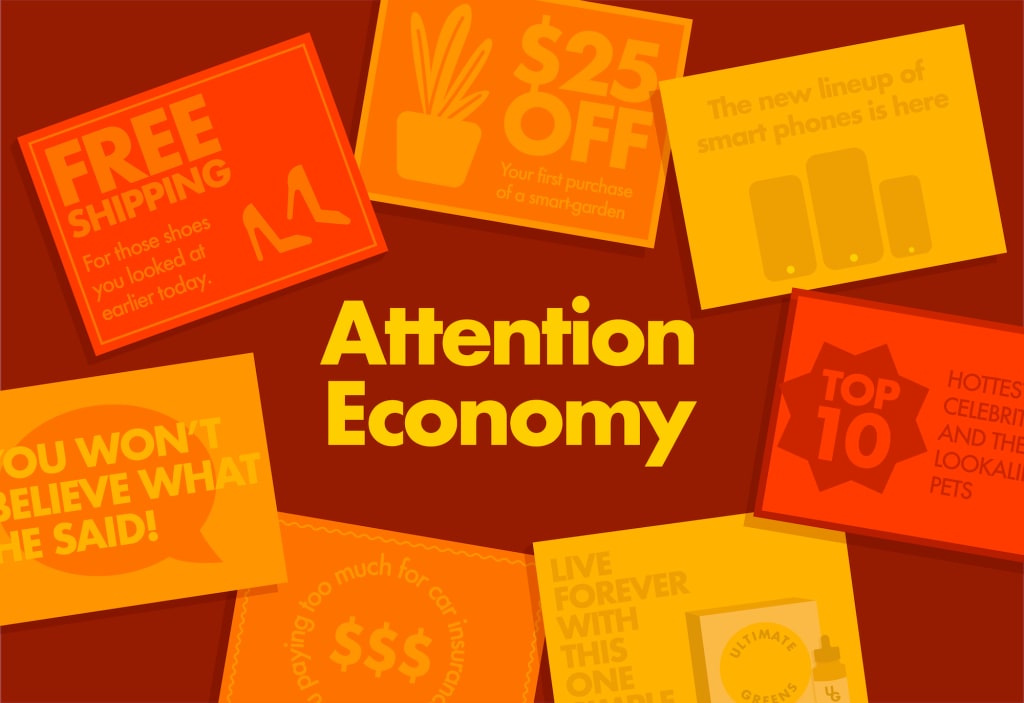
In today’s world, attention is one of the most valuable commodities — not gold, not oil, not even data (though that’s a close second). We live in what many call an “attention economy,” where companies, apps, and platforms are in a fierce competition to capture and monetize your focus. From the moment you wake up to the minute you close your eyes at night, your attention is under siege.
Think about it: how many notifications pop up on your phone each day? How often do you find yourself switching between tabs, checking emails mid-task, or scrolling through social media without even realizing it? The battle for your attention is relentless — and the more distracted you are, the more money someone else makes.
So, why has focus become such a rare and precious resource? And how can reclaiming your attention give you a true edge in your work, creativity, and well-being? Let’s dive in.
The Rise of the Attention Economy
The term “attention economy” might sound like a buzzword, but it’s grounded in economic reality. Just as traditional markets are driven by supply and demand, our digital lives operate in a market where the supply is infinite (content, information, entertainment) and the demand is finite (your time and attention).
Every scroll, click, and swipe is tracked, analyzed, and sold. Social media platforms, streaming services, news sites — all of them are designed to keep you engaged for as long as possible. The longer you stay, the more ads you see, and the more data you generate.
In this environment, your attention has real monetary value. The more distracted you are, the more someone else profits. As former Google design ethicist Tristan Harris famously said, “If you’re not paying for the product, you are the product.”
The High Cost of Constant Distraction
Distraction doesn’t just waste time — it erodes your ability to think deeply, create meaningfully, and work effectively.
Studies show that every time you get interrupted — even for a few seconds — it can take up to 25 minutes to fully regain your focus. Multiply that by dozens of interruptions a day, and it’s easy to see why so many people feel burned out, overwhelmed, and unproductive.
Distraction also keeps you operating at a surface level. Instead of diving deep into a task, you’re constantly switching contexts, which prevents you from reaching a state of flow — that sweet spot where you’re fully immersed and performing at your best.
In other words, distraction isn’t just a minor inconvenience. It’s a silent killer of productivity, creativity, and mental clarity.
Why Focus Is the Ultimate Competitive Edge
In a world where most people are constantly distracted, the ability to focus has become a superpower.
When you can block out noise and give your full attention to what matters, you immediately stand out. You produce better work in less time. You solve problems more creatively. You build deeper relationships.
Focus allows you to do “deep work” — the kind of high-value, cognitively demanding work that creates real impact. As author Cal Newport puts it, “Deep work is like a superpower in our increasingly competitive twenty-first-century economy.”
In other words, while others are reacting, scrolling, and multitasking, you’re creating, leading, and excelling.
How to Protect Your Attention in a Distracted World
Reclaiming your focus isn’t easy — but it is possible. Here are some practical strategies to help you take back control of your attention:
1. Design Your Environment for Focus
Your surroundings shape your behavior. Create a space that minimizes distractions:
Keep your phone out of sight during focused work.
Use website blockers to limit access to time-wasting sites.
Set clear boundaries for when and where you work.
4
2. Practice Digital Minimalism
Be intentional about your tech use. Uninstall apps you don’t need. Turn off non-essential notifications. Choose tools that support your goals instead of sabotaging them.
3. Time-Block Your Day
Schedule specific blocks of time for focused work, email, meetings, and breaks. Protect those blocks fiercely — treat them like appointments with your future self.
4. Embrace Single-Tasking
Multitasking is a myth. Focus on one task at a time, give it your full attention, and then move on. You’ll work faster, smarter, and with less stress.
5. Take Regular Breaks
Your brain needs rest to perform at its best. Use techniques like the Pomodoro Method (25 minutes of work, 5-minute break) to keep your focus sharp throughout the day.
6. Practice Mindfulness
Mindfulness helps you become more aware of when your attention is drifting — and gently bring it back. Even a few minutes of mindfulness meditation each day can improve your focus.
6
The Bigger Picture: Reclaiming Your Life
This isn’t just about productivity. It’s about reclaiming your life.
When you take control of your attention, you take control of your time, energy, and choices. You stop reacting to every ping and start living with intention. You prioritize what truly matters — whether that’s your work, your health, your relationships, or your peace of mind.
In a world where everyone else is chasing clicks and likes, you’re creating meaning and momentum.
Conclusion: Your Attention Is Worth Protecting
The attention economy isn’t going away. If anything, it’s getting more aggressive.
But you have a choice. You can either let others dictate where your attention goes — or you can take back control.
Protecting your focus is one of the most powerful decisions you can make. It’s not about doing more — it’s about doing what matters, with intention and clarity.
Because in today’s world, focus isn’t just a skill — it’s a competitive advantage.
So guard your attention like it’s gold. Because it is.
About the Creator
Keep reading
More stories from Aiman Shahid and writers in Confessions and other communities.
The Hidden Cost of Multitasking: Why Doing More Means Achieving Less
In today’s fast-paced, always-connected world, multitasking has become a badge of honor. We juggle emails while attending meetings, cook dinner while scrolling through social media, and watch television while trying to finish work assignments. The underlying belief is simple: doing multiple things at once must mean we’re being more efficient, productive, and capable. However, beneath this cultural glorification of multitasking lies a surprising truth: instead of helping us achieve more, multitasking often diminishes our productivity, damages our focus, and compromises our well-being.
By Aiman Shahid5 months ago in Confessions
I Didn’t Realize I Was Ruining My Own Life Until It Was Almost Too Late
By: Tazamain Khan For a long time, I believed I was doing exactly what I was supposed to do. I stayed busy, pushed myself hard, and ignored anything that felt uncomfortable. I told myself that stress was normal, exhaustion was temporary, and success would eventually make it all worth it.
By Tazamain khan 4 days ago in Confessions


Comments (2)
Hi, I read your story and I really liked it. It seems like you are a professional writer because you give each scene its own unique value, which very few people manage to do. I really liked your work it was very, very good. Actually, I’m just a casual reader, and I really enjoy reading stories. and I liked it a lot, too. Also, how long have you been doing this work?
Hi, I read your story and I really liked it. It seems like you are a professional writer because you give each scene its own unique value, which very few people manage to do. I really liked your work it was very, very good. Actually, I’m just a casual reader, and I really enjoy reading stories. and I liked it a lot, too. Also, how long have you been doing this work?