
🎭 The Lies We Tell Oursel
How Self-Deception Holds Us Back—and How to Break Free

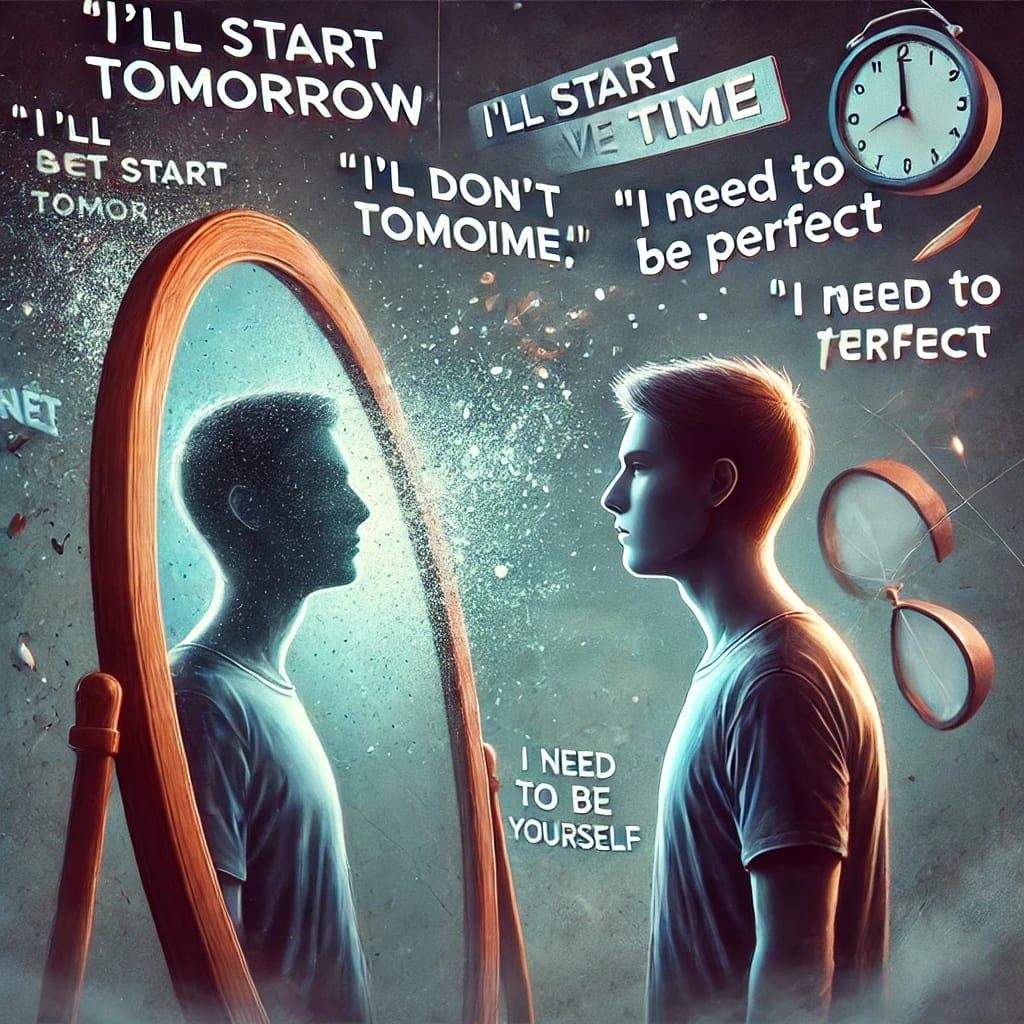
Introduction: The Stories We Tell Ourselves
“I’ll start tomorrow.”
“I don’t have enough time.”
“I need to be perfect.”
We all have internal dialogues that shape our decisions, emotions, and behaviors. Sometimes, these thoughts are empowering. Other times, they become barriers—invisible walls made of excuses, doubts, and half-truths that keep us from growing.
The truth is, we are masters of self-deception. Our brains are wired to protect us from discomfort, often by convincing us of things that aren’t entirely true. But why do we do this? And more importantly—how do we break free from the lies we tell ourselves?
Let’s uncover the most common self-lies, the psychology behind them, and the ways we can rewrite the stories that hold us back.
⸻
1. “I’ll Start Tomorrow”—The Lie of Procrastination
We’ve all said it. Diet starts Monday. I’ll write that book next year. I’ll get serious about my goals… soon.
But tomorrow never comes—because the problem isn’t the date, it’s the habit of delaying discomfort.
Why We Believe It:
✅ The brain craves comfort. Taking action requires energy; avoiding it feels easier.
✅ We overestimate future motivation. We think we’ll be more disciplined tomorrow, but we won’t.
✅ It keeps failure at bay. If we don’t start, we can’t fail—right?
How to Break Free:
🔥 Start small. Instead of “I’ll work out tomorrow,” do one push-up today. Small steps lead to momentum.
🔥 Make it real. Write your goal on paper, say it aloud, or tell someone. Commitment makes it harder to ignore.
🔥 Forget motivation. Action creates motivation, not the other way around. Move first, motivation will follow.
⸻
2. “I Don’t Have Time”—The Lie of Priorities
Let’s be real: If you had one hour added to your day, would you suddenly do everything you’ve been postponing? Probably not.
It’s not that we lack time—it’s that we don’t prioritize what we claim is important.
Why We Believe It:
✅ It lets us off the hook. If we’re “too busy,” we don’t have to face the discomfort of change.
✅ It feels like a valid excuse. Everyone is busy—it’s a socially acceptable reason for inaction.
✅ It protects our ego. If we admit we do have time but aren’t using it wisely, it forces us to take responsibility.
How to Break Free:
⏳ Track your time. Spend a day noting how you use your hours—you’ll see where time actually goes.
⏳ Replace “I don’t have time” with “It’s not a priority.” It forces honesty: “I don’t prioritize my health.” Ouch.
⏳ Create micro-time. Even 10 minutes a day towards your goal adds up—progress doesn’t require perfect schedules.
⸻
3. “I’m Not Ready”—The Lie of Perfectionism
You think you need more skills, more confidence, more preparation. But the people who succeed aren’t “ready” either—they just start.
Why We Believe It:
✅ Fear of judgment. We delay action because we fear failing in front of others.
✅ Imposter syndrome. We think we’re not qualified enough—when in reality, nobody feels 100% prepared.
✅ Perfectionism is disguised fear. If we wait for the “perfect time,” we’ll wait forever.
How to Break Free:
💡 Accept imperfection. The first version of anything—writing, business, relationships—will be messy. Do it anyway.
💡 Take action before you’re “ready.” Confidence isn’t a requirement for action—it’s a result of it.
💡 Remember: Nobody is watching. Most people are too busy with their own lives to notice your mistakes.
⸻
4. “I Need to Be Perfect”—The Lie of Unrealistic Standards
Perfection is a moving target—even when we get close, we raise the bar higher. It’s an illusion that keeps us stuck.
Why We Believe It:
✅ Society rewards perfectionism. Social media highlights success, not struggle.
✅ It keeps us safe. If we aim for perfection, we avoid the risk of criticism.
✅ It delays action. If it can’t be perfect, why start at all?
How to Break Free:
⚡ Redefine success. Instead of “perfect,” aim for “done.” Done is better than perfect.
⚡ Celebrate effort. Progress is more valuable than flawless execution.
⚡ Embrace failure. Every mistake is proof you’re doing something. The only real failure is never trying.
⸻
5. “I’m Too Late”—The Lie of Missed Opportunities
“If I had started years ago, I’d be successful by now.”
“I’m too old to change.”
“The best time was before. The second-best time is never.”
This lie is a silent dream killer. It convinces us that because we didn’t start earlier, we shouldn’t start at all.
Why We Believe It:
✅ We compare our beginnings to others’ successes. It feels like everyone is ahead.
✅ Regret disguises itself as reality. We mistake “I wish I had started earlier” for “I can’t start now.”
✅ It gives an excuse for inaction. If it’s “too late,” then we don’t have to try.
How to Break Free:
⏳ Start where you are. The best time to plant a tree was 20 years ago. The second-best time? Today.
⏳ Look for late bloomers. Colonel Sanders started KFC at 65. Vera Wang became a designer at 40. Your timeline is yours.
⏳ Do the math. If you start today, where will you be in a year? Five years? The time will pass anyway—use it well.
⸻
Final Thoughts: Changing the Narrative
We are the stories we tell ourselves. If those stories hold us back, we stay stuck.
The good news? You can change the narrative.
🚀 Replace “I’ll start tomorrow” with “I’ll take one small step today.”
🚀 Replace “I don’t have time” with “I will make time for what matters.”
🚀 Replace “I’m not ready” with “Nobody ever is—I’m starting anyway.”
Because the only real lie is the one that keeps you from living the life you want.
And the truth? You’re capable of more than you think.
About the Creator
Ahmet Kıvanç Demirkıran
As a technology and innovation enthusiast, I aim to bring fresh perspectives to my readers, drawing from my experience.
Keep reading
More stories from Ahmet Kıvanç Demirkıran and writers in Confessions and other communities.
Digital Ghost Towns: The Rise and Fall of Online Communities
There was a time when the internet felt like a neighborhood. You'd log in not just to consume, but to belong. You had a username, a signature, maybe even an ASCII avatar. Forums buzzed with late-night debates, LiveJournal updates felt like whispers between friends, and blog comment sections were where you checked in after class or work. Every space had its own rhythm, its own inside jokes, its own culture.
By Ahmet Kıvanç Demirkıran7 months ago in Confessions
I Didn’t Realize I Was Ruining My Own Life Until It Was Almost Too Late
By: Tazamain Khan For a long time, I believed I was doing exactly what I was supposed to do. I stayed busy, pushed myself hard, and ignored anything that felt uncomfortable. I told myself that stress was normal, exhaustion was temporary, and success would eventually make it all worth it.
By Tazamain khan 3 days ago in Confessions



Comments (1)
So true a story 😊♦️😊