
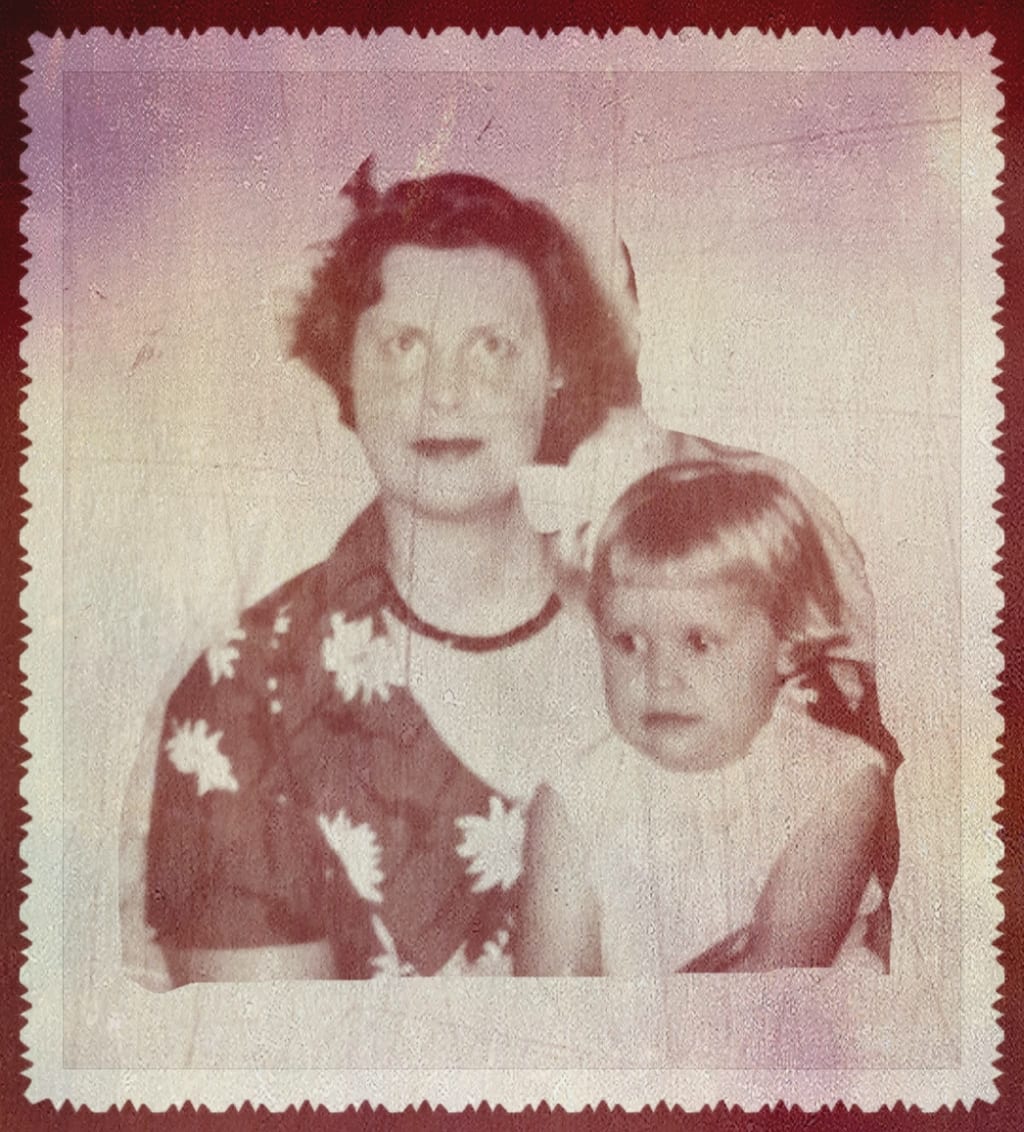
I sit inside my my mother's head, my back leaning into the curve of her skull. It is smooth, cool. Reassuring. I close my eyes, as if anticipating the lightness of her fingers brushing my forehead, her voice softly lulling me to sleep.
It is uncomfortable to be older than my mother ever was. Unfair. Unjust. Only now do I understand how young she was when she died. Your mother is your mother, not a woman with vulnerabilities. Immutable.
Unless you outgrow her. You don't think about this, or rarely. I remember once sitting on my mother's knee, my tears dampening her crisp cotton dress, so that it began to wilt against her legs. "I never want you to die," I said. Perhaps my grandmother - her mother- which made her death more plausible to me? I was looking at a scratch on the wooden floor, not her face, but I am certain her eyes reflected grief as she said, " I'm not going to die anytime soon, sweetheart. And by the time I do, you'll be married and have children of your own. Please don't worry."
She was wrong. I am not worried and have no children. A disappointment to both of us. When she lay in hospice, she asked for photographs of all her grandchildren be pinned on the wall at at the end of her bed. At her insistence, I pinned a photograph of my cat.
If I were to stretch my legs as far as I could, and my feet, I would almost touch the place where her left ear had been. Hr ears were perfect, I thought, Reminding of the curve of the mother-of-pearl shell on the windowsill. She dressed them with simple, elegant earrings that caught your eye, even through the luxurious cascade of her curly hair. More importantly, her ears were attuned to the sounds of her children. When I was but a day old, my mother heard urgent cries from the nursery where all the babies lay in rows of cribs. There was an emergency somewhere else on the floor, to which all the nurses had scrambled. My mother got up, quickly pulled her aqua robe around her thin floral nightgown, and ran barefoot down the hall. In some houdini-like move, I had forced my head through the rungs of the crib, but couldn't pull it back. My mother said as soon as she heard the cries, she knew, without hesitation, it was me. Such is the powerful intuition of mothers.
The place of my birth no longer exists; the hospital was torn down and replaced by coffee shops and chic salons. This unsettles me, this erasure of my birthplace. When I was born, digital records were a dream in the future, and the decades of dusty paper records were destroyed. When my birthplace vanished, I no longer felt tethered to the world. There is an absence where my life begins, and it is only my mother's stories that secure me.
I realise my cheeks are wet with sorrow. I reach into my pocket for a tissue, but touch instead a sharp, uncomfortable object. I pull it out; it is a memory. A bitter memory that I had stuffed into the recesses of my mind.
It was summer, sticky with humidity. I wanted to spend a night or two at a tumbledown cottage in a small fishing village, purchased by my parents when my mother was pregnant with me. Ever summer holiday, as I was growing up, we all crammed into it, with its fibro walls and tin roof. That bathroom was not much more than a concrete hose down spot under the house. But the sea-breeze curled around the walls with delicious salty highlights, easing the tensions we carried within us.
I drove to my parent's house to collect the key, as I had often done. My mother was in a Mood, and it was clear that getting the key would first involve a battle. I was frustrated, irritated by my mother's apparently endless list of complaints about me, her health, her life. My father, as usual, sat quietly in the living room as our voices roiled and surged around him. He never knew what to do when my mother and I bickered with ever- increasing force. Finally she shouted, " I wish you had never been born". From the woman who had run down the hall to her wailing new-born baby. We were both shocked by this statement and stood, momentarily, staring into each other's pained and confused eyes. She had never said this before, and although I knew her words were a symptom of anger and anguish, they pierced like a sword. I turned silently and swiftly, leaving a trail of tears and blood from my wounded heart. We never spoke of this moment again.
The uncomfortable memory in hand, I feel compelled to write to my mother. I stand and turn, and begin etching into the smooth rounded surface of her skull. Surprisingly, the letters form with ease, like chalk on a blackboard.
Dear Mum, The last letter I wrote you was brief, but the envelope was plump with photos of the sky and red earth of the landscape in which I then lived; an attempt to convey the vastness, the incalculable size of the space in which I was immersed. Desert and sky are different elements, but they reflect each other in a perfect union of timelessness. You never saw those photos. In the measurable passage of time between sending and receiving, you died. And I found - still find- myself confronting the vastness of an absence that can never be defined, and from which I will not be released in this lifetime.
There are many things unsaid between us, conversations we never had, some of which have only become apparent to me only since passing the age of your own death. I was recently diagnosed with the same mental illness you had. It was strange to learn this when I am closer to the end of my life than its beginning. I reflect back and see directions my life took, or did not take, consequences of choices and actions colored by the illness. I do this with neither remorse nor regret; no-one can re-write their life through a new filter. One lives with, and through, and perhaps learns from, the cycle of cause and result.
I wish I could convey how I now understand your pain a little better, the pain I never wanted to acknowledge as a young moan. I closed my ears and heart to you.
I have something to confess to you. Remember when I borrowed your gold and pearl earrings to wear to Alex's wedding ? I accidentally pulled the blue velvet backing out of the box, and underneath I found a letter from Grandma to you that you must have kept hidden for decades. With some guilt, I read it.
You had written to your mother during a period of darkest depression. Your mother wrote that you had told her your life and dreams were constrained by young children, the youngest being me. You felt that your husband was unable to comprehend this, despite what you said to him. This only amplified your sense of failure, resentment and uncertainty of a future worth living.
Your mother responded with a story. She asked you to recall a day when you were 17, and you were walking together on a path by the river. Your hair was tied back with a lilac ribbon, she said, that matched the weeping wisteria in your garden. You too, were weeping, because your father had said you could not go to University, and must move with the family to a city on the other side of the country, leaving everything familiar behind. She said to you that life doesn't always go the way we had dreamed, for reasons we probably don't understand, and that is always hard. Falling into a deep well of grief is heart-breaking, but you must never forget there are always, always, hands reaching out to help you. I am here for you, she said, as I was when you were a child. You will rise above it, as you have before, although you may carry a sense of loss in a small corner of your hearts. Be present, take your medication and know you are loved.
I stop. My writing tool has shattered. Its pieces refract off the surface off the skull then cascade around me, splinters of time long past. In that moment. the potency of painful memories dissipates. I inhale and exhale slowly, as thought and emotions re-arrange themselves in my mind.
My mother's sense of loss intermittently leaked into her life, and the lives of those close to her, including mine. That was the source of pain and anger that sometimes flared to scorch me. But it was never about me. My mother had never not loved me. I always loved her.
Dear Mum, I shouldn't have read that letter. It was a private conversation between you and Grandma. I am sorry. As I am sorry for your lost dreams and the shadows formed by mental illness, and the times I refused to listen or see your sadness.
I am glad you were my mother. I wish it had been for longer, that you were still alive. But you are not, except in memory.
There are many words to fill moments of silence that hung between us too many times. But there is nowhere to write them, except in my own head. For yours is lost to me by the passage of time. Time and space remain vast and beyond comprehension.
I sit on your knee and you comfort me. Thank you.
About the Creator
Keep reading
More stories from writers in Confessions and other communities.
Thoughts on Vocal and the way the world is
"Death cannot stop true love, only delay it." – Wesley in The Princess Bride. I decided to come back to Vocal on a very cold and dark night at the end of December. I had been, and still am, convalescing from a horrible staph infection that had gone misdiagnosed for months. This, paired with the increasing challenges of being healthy, making the best choices for my co-parented child, being a wife, and being a director at a new job, was a lot to manage.
By Jazzy 2 days ago in Confessions
Word of the Day: 推し
I am not putting any more time on my timer right now. I am just trying to get by here. There is almost no point to school because, like 35% of the time is technical difficulties and the rest of the time is things that actually aren't really useful.
By Kayla McIntosh7 days ago in Confessions
Wild Card Weekend Recap: What Happens Now?
I think I figured out why I love Wild Card Weekend so much. It's because it's the first playoff anything of the calendar year. The NFL season starts in the fall, and once upon a time, the champion was crowned either on or slightly before New Year's. The evolution of the NFL schedule has resulted in the playoffs starting just into the New Year, and currently, the final week of the season falls on the first weekend of the New Year, with Wild Card Weekend coming a week after that. So yes, chronologically, the NFL's Wild Card Weekend serves as the first playoff anything of the calendar year.
By Clyde E. Dawkins8 days ago in Unbalanced




Comments
There are no comments for this story
Be the first to respond and start the conversation.