
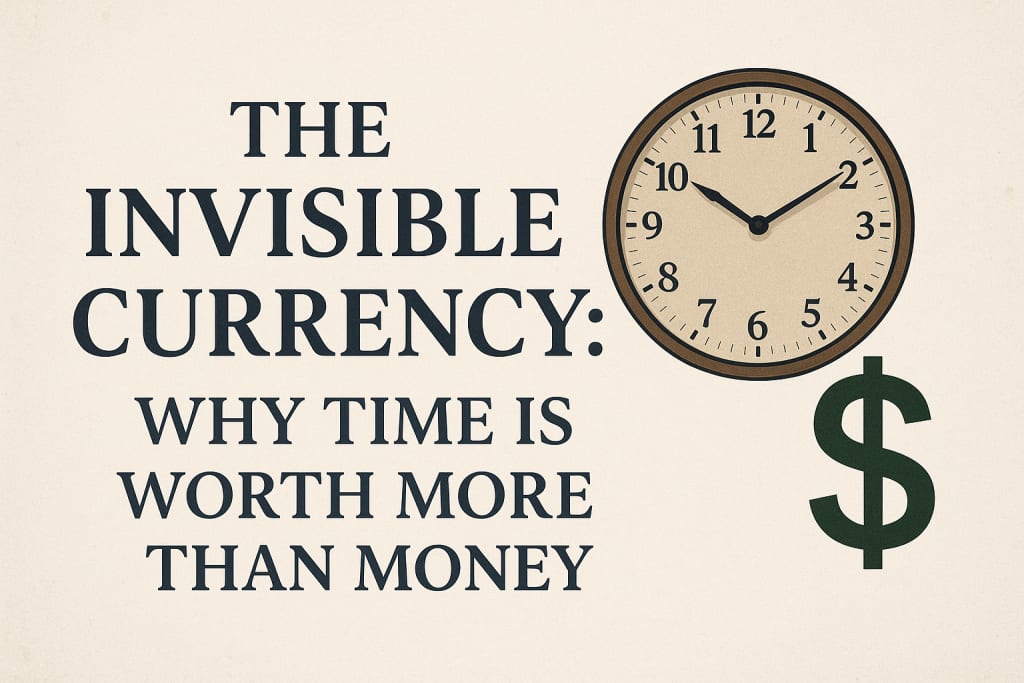
The Invisible Currency: Why Time Is Worth More Than Money
Redefining wealth by measuring life in moments, not money.
Introduction
We live in a world that often equates success with the weight of a paycheck, the square footage of a home, or the digits in a bank account. From childhood, many of us are taught that financial security is the ultimate goal—the shield against hardship and the key to happiness. Yet, lurking quietly beneath this cultural obsession with money lies a resource even more valuable, yet far less celebrated: time.
Unlike money, which can be earned, saved, invested, or replaced, time is finite. Each moment that passes is a piece of our life we can never get back. Recognizing this truth transforms the way we view our priorities, relationships, and choices. Time is not just an invisible currency—it’s the ultimate one. And when we learn to value it properly, we redefine what it truly means to be wealthy.
The Myth of Money as the Greatest Currency
Money undeniably matters. It buys comfort, convenience, healthcare, education, and opportunities. In societies built on markets and trade, financial resources open doors. But our cultural obsession with money often blinds us to its limitations.
People chase higher salaries and more prestigious jobs, often at the expense of their health, relationships, or personal fulfillment. We treat money as if it were infinite in its value—but money cannot buy back lost time with loved ones, repair the years we spent in stress and burnout, or extend our lives beyond the natural clock we are given.
In essence, money is a tool. Time, however, is the stage on which life plays out. Without time, money is meaningless.
Why Time Is the Ultimate Wealth
Time Is Non-Renewable
If you lose money, you can work to regain it. If you make a bad investment, you can recover. Time, once lost, is gone forever. That makes it the most precious resource we have.
Time Creates Experiences
Life is not measured by the size of our bank account but by the richness of our experiences. Traveling with friends, watching your child’s first steps, enjoying a quiet sunrise—these moments give life meaning. None of them can be bought back once missed.
Time Shapes Relationships
Strong relationships require the investment of time—time to listen, to connect, to share in life’s ups and downs. Money might fund a vacation or a fancy dinner, but without genuine time spent together, relationships weaken.
Time Protects Health
All the wealth in the world cannot reverse years of neglecting sleep, exercise, or stress management. Prioritizing time for rest, self-care, and wellness is a form of wealth far greater than luxury possessions.
The Trap of Trading Time for Money
Modern life often pushes us into a trap: trading our time for money in ways that diminish our overall well-being. Long work hours, side hustles, and constant availability blur the line between productivity and personal life.
The paradox is this: many people spend their healthiest, most energetic years working endlessly to earn money—often so they can “enjoy life later.” But by the time retirement comes, health, energy, or relationships may have faded.
This does not mean work is unimportant, but rather that blindly sacrificing time for money without balance can rob us of the very life we’re trying to build.
Redefining Success Through Time
What if success was not about how much money we earn, but how much time we truly own?
Time Affluence vs. Time Poverty
Studies in psychology and economics introduce the concept of “time affluence”—the feeling of having enough time to do what matters. Conversely, “time poverty” describes the stress of constant busyness. Research shows that time affluence is more strongly correlated with happiness than wealth.
Freedom as the True Luxury
The ability to choose how we spend our time—whether on work we love, relationships, hobbies, or rest—is the deepest form of freedom. Unlike luxury cars or designer clothes, this freedom is invisible but profoundly felt.
Practical Ways to Value Time Over Money
Prioritize Experiences Over Possessions
Instead of asking, “What can I afford?” ask, “What will bring me joy and memories?” Vacations, learning a new skill, or spending time with loved ones often create more lasting fulfillment than material purchases.
Create Boundaries with Work
Set limits on overtime or constant availability. Protecting personal time is not laziness—it’s an investment in health and happiness.
Invest in Time-Saving Solutions
Sometimes, spending money can actually buy back time. Hiring help for chores, using efficient tools, or outsourcing tasks can free up hours for more meaningful pursuits.
Practice Presence
Even when we do have time, we often spend it distracted—scrolling, worrying, or multitasking. True wealth comes from being fully present in each moment.
Schedule Joy, Not Just Obligations
We often pack our calendars with work meetings and errands but forget to schedule leisure, hobbies, or time with loved ones. Treat these as non-negotiable appointments.
The Emotional Return on Time Investment
Time is not just measured in minutes—it’s measured in meaning. Every hour we spend is an investment with an emotional return.
An hour spent scrolling through social media may return little but fleeting distraction.
An hour spent exercising might return energy and better health.
An hour spent with a friend might return laughter, connection, and belonging.
When we begin to evaluate time not just as something to “fill,” but as something to invest intentionally, we start to see life differently.
Stories That Illustrate the Point
The Regret of the Wealthy Businessman: Many successful entrepreneurs admit late in life that they regret missing their children’s milestones while chasing financial success. Their fortunes cannot buy back those lost years.
The Minimalist Movement: People who downsize their lives often report greater happiness, not because they have more money, but because they free up more time—time to travel, pursue passions, or simply slow down.
The Pandemic Reminder: During the global lockdowns, many people realized how precious time was—time with family, time to reflect, time to rest. Money lost during that period could be rebuilt, but the forced slowing down revealed the true scarcity of time.
Rethinking Our Legacy
At the end of our lives, what will we wish we had more of—money or time? Most people on their deathbeds don’t regret not working harder or not buying more things. They regret not spending enough time with loved ones, not chasing dreams, not living fully.
If we want to leave behind a meaningful legacy, it won’t be measured in financial wealth alone, but in the moments we created, the people we touched, and the way we used our precious hours.
Conclusion
Money is necessary. It creates comfort, security, and opportunities. But time is life itself. It is the invisible currency that defines our wealth in ways that money never can.
When we begin to treat time as the ultimate form of wealth, our decisions shift. We prioritize relationships over possessions, experiences over status, and freedom over endless hustle. We learn to live, not just work.
True success is not about having it all—it’s about having enough money to meet our needs and enough time to live meaningfully.
Time is the currency of life. Spend it wisely.
About the Creator
Keep reading
More stories from Aiman Shahid and writers in Confessions and other communities.
The Happiness Gap: Why Having “Enough” Matters More Than Having It All
Introduction: The Endless Chase Modern life often feels like a never-ending sprint. There’s always a higher salary to earn, a bigger house to buy, a newer phone to upgrade to, and more experiences to post about online. The cultural narrative tells us that happiness is linked to accumulation—more money, more achievements, more recognition. But somewhere in that pursuit of “more,” we lose sight of what truly sustains us: the sense of having “enough.”
By Aiman Shahid5 months ago in Confessions


Comments
There are no comments for this story
Be the first to respond and start the conversation.