

athur.....shahjhan
When I inherited the farmhouse, I thought it was a joke.
A letter arrived in an envelope too thick for junk mail and too old-fashioned for modern bills. I almost threw it out. But the return address—no name, just Valemount Road, Willow Creek—gave me pause. My mother once whispered that our family came from a place with a name like that. She never explained. She was gone now.
Inside was a lawyer's letter: You are the last living descendant of Miriam Alcott. The estate now belongs to you. There were keys taped to the back.
I had never heard of a Miriam Alcott. But when you’re 27, jobless, and fresh off a breakup with someone who said you were “emotionally difficult,” a free house in the country doesn’t sound like a curse. It sounds like permission to begin again.
The house stood in the middle of a valley like it had been waiting.
Two stories tall, with worn blue shutters and a porch that sagged slightly left. The garden was overgrown. Ivy climbed one side like fingers clinging to an old lover. The air smelled like lavender and rot. But inside, the wood floors groaned like an old man getting up from a nap, and the light through the stained-glass window scattered rainbows across the dust.
That first night, I dreamed of a girl standing in the hall.
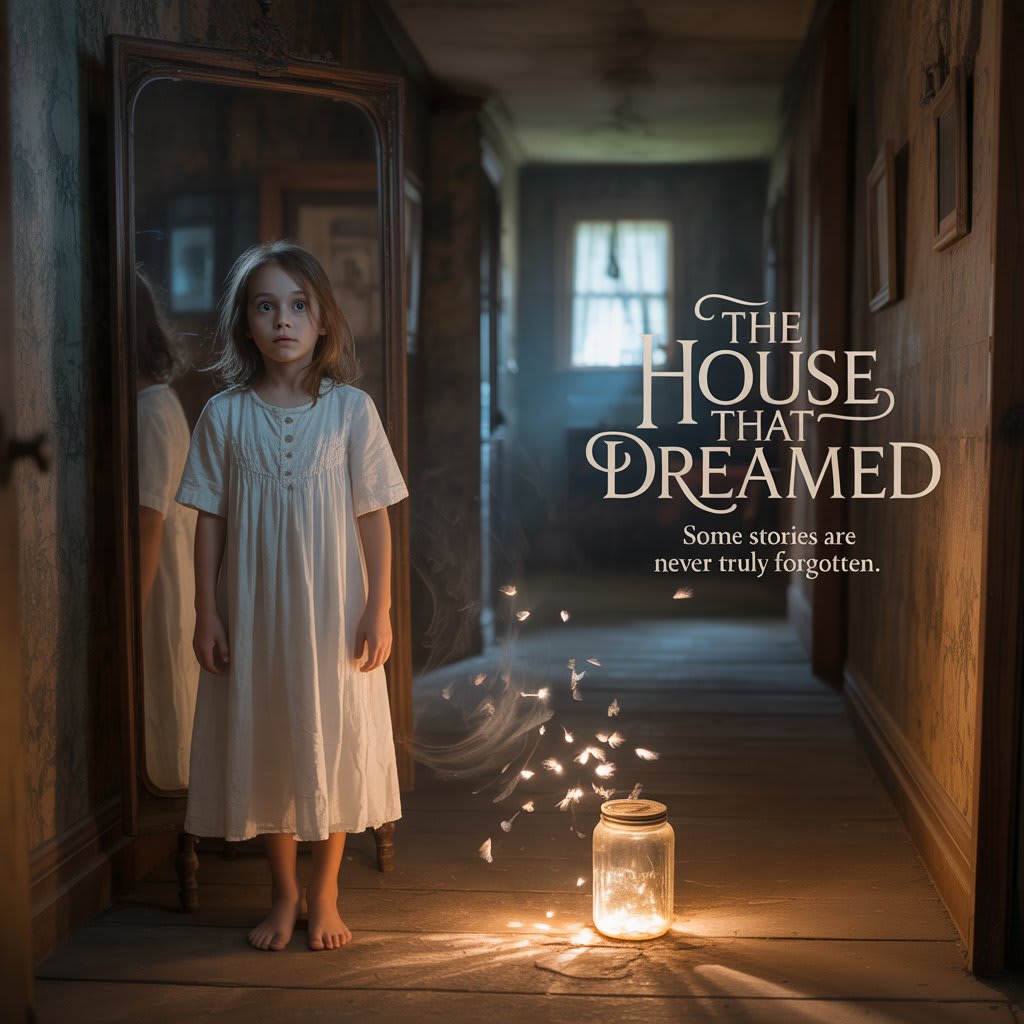
She barefoot, hair in long braids, wearing a nightgown that looked stitched by hand. She held a glass jar full of fireflies. She stared at me with the kind of silence that wasn’t threatening, but pleading.
I woke up standing in the hallway. The floor beneath me was warm.
The next day, the house changed.
The floral wallpaper in the kitchen, faded and peeling when I arrived, was whole again. The pattern had shifted, slightly. The pink flowers were brighter. The stems curled differently. Like someone had gently corrected a mistake.
I thought it was my mind playing tricks—grief, confusion, or just exhaustion.
But it kept happening.
Curtains I hadn’t touched began to drift in the wrong windows. A door I had jammed shut was open, revealing a room full of sewing equipment and old photographs, none of which had been there before. One night, I found a child’s drawing on the kitchen table: stick figures, a red house, and three names scribbled underneath. One was mine.
I was alone.
keeping a notebook:
Day 6 – Bedroom window swapped with attic window. No breeze, no sound.
Day 9 – Blue cup in sink refilled with warm tea. Smelled like mint and honey. Drank it. Still alive.
Day 12 – Girl again. In dream. Same eyes. Tried to say something but no sound came out. Jar was broken.
The house wasn’t haunted. That was too easy. It was alive. And it was dreaming.
I called the lawyer who had handled the estate. No one answered. The number disconnected a day later. I tried researching Miriam Alcott. No birth records. No death certificate. Just one blurry newspaper photo from 1911—a woman standing in front of the same house, holding hands with a child who had my nose
I gave in.
Every night, I left the front door open. I let the house dream as it wanted.
Some nights, I woke in different rooms. One time, I woke on the roof, a blanket around me and a single cup of cocoa on the chimney ledge. The stars felt close enough to touch. I didn’t question it anymore. I started listening.
The breakthrough came on the 29th night.
I woke in the sewing room. The mirror was lit with a soft glow, and the girl was there—on the other side. Not a reflection. A separate space. She pressed her hand to the glass. I did the same.
Her lips moved: “Help me remember.”
That day, I went through every drawer, every floorboard, every loose stone in the garden. I found dozens of small objects, buried and tucked away—hair ribbons, a tiny bell, letters written in cursive I couldn’t decipher. A photograph of the girl and an older woman, both smiling. On the back: “To Miriam, from your daughter. 1924.”
The girl wasn't a ghost. She was a memory, unfinished. The house was trying to remember her for her.
And somehow, through me, it was learning how.
Weeks passed. I began to speak out loud to the walls.
“I think your name was Eliza,” I said one morning, laying the photo on the kitchen table. “And I think you loved fireflies.”
The jar appeared on my bedside table that night, full of them—glowing, silent, alive.
I’ve been here six months now.
I don’t keep track of the days anymore. The wallpaper changes sometimes. A new song plays from the old radio on rainy afternoons. The house hums when it’s happy. I write for hours, transcribing the dreams it shows me. Slowly, I’m piecing together Eliza’s story
She ran away from something. Or someone. Miriam never stopped searching for her. That love—that desperate, hopeful love—never died. It’s stitched into the walls. It breathes through every floorboard. And the house... the house just wants her remembered.
Sometimes I wonder if I was chosen... or if I was dreamed, too
But in this house that dreams, I’ve found something I never had before—peace
Ev if I am only a chapter in someone else’s memory, I will write it well.
Because some stories deserve to wake again.
About the Creator
Shahjhan
I respectfully bow to you
Keep reading
More stories from Shahjhan and writers in Confessions and other communities.
Word of the Day: 進捗
I came to school with a really heavy bag. I packed both of my computers in my backpack today. I guess I need to actually work too but I am just spending my time here for some reason. I am not getting financial aid, they keep sending me emails about that I made " changes " so I am like... ok I guess I have to handle it. It is very annoying. Hence why I am sitting here. My backpack is super heavy and I don't want to climb all those steps. I haven't eaten a lot lately. I mean I am happy I lost like 4lbs so that's good but, I am pretty miserable for the most part.
By Kayla McIntosh38 minutes ago in Confessions
📢 Raise Your Voice Thread: 01/08/2026
Our “Raise Your Voice Threads” are hosted most alternating Thursdays at 12PM ET to offer creators more avenues to uncover exceptional stories on Vocal. As we are continuously searching for fresh creators and inspiring stories, this thread provides an opportunity to exchange and discuss the stories that have moved and motivated us on Vocal.
By Raise Your Voice by Vocal5 days ago in Resources


Comments
There are no comments for this story
Be the first to respond and start the conversation.