
The Experiment They Tried to Bury
How inconvenient science changed the world anyway
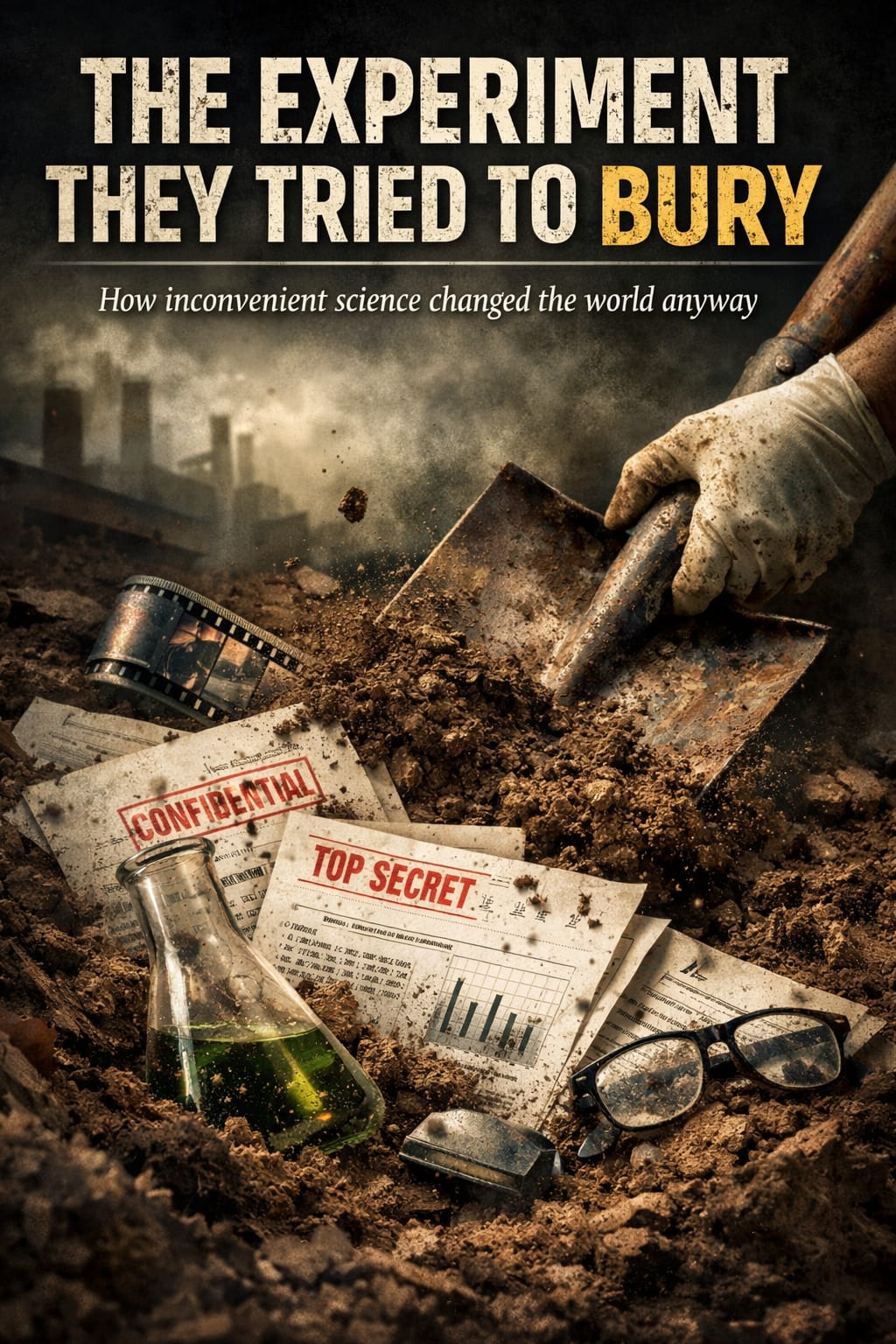
Science is often imagined as clean, neutral, and unstoppable—a steady march toward truth guided by logic and evidence. But history tells a messier story. Some experiments didn’t fail because they were wrong. They failed because they were dangerous to the wrong people. Dangerous to authority. Dangerous to profit. Dangerous to comfort.
These are the experiments they tried to bury.
Not because the data was flawed, but because the truth was inconvenient.
When Science Becomes a Threat
An experiment is supposed to answer a question. But sometimes, the answer is one no one wants to hear.
Throughout history, scientists have uncovered results that threatened political power, economic systems, social beliefs, or institutional reputations. When that happens, science stops being an intellectual pursuit and becomes a liability.
Funding disappears. Papers are rejected. Careers stall. Results are “lost.” Researchers are discredited, ignored, or silenced—not through dramatic censorship, but through quieter, more effective methods: denial, delay, and doubt.
The experiment doesn’t die. It’s buried.
The Tobacco Experiments That Knew the Truth
One of the most infamous buried truths in modern science comes from tobacco research.
By the 1950s, internal experiments conducted by cigarette companies themselves had already shown a strong link between smoking and lung cancer. Animal studies, chemical analyses, and early epidemiological data all pointed in the same direction.
The companies knew.
But admitting the truth would have destroyed a multibillion-dollar industry.
So instead of publishing the results honestly, tobacco companies did something far more strategic: they buried the experiments under manufactured uncertainty. Research was reframed. Data was questioned. Scientists were paid to emphasize doubt. The public message wasn’t “smoking is safe,” but something more subtle and more damaging:
“The science isn’t settled.”
For decades, this deliberate burial delayed regulation and cost millions of lives.
The experiment existed. The evidence was there. But the truth was buried beneath profit.
When Environmental Science Threatened Industry
Environmental science has long been one of the most buried branches of research—not because its findings are weak, but because they are disruptive.
In the mid-20th century, scientists studying pesticides began noticing alarming patterns. Bird populations were collapsing. Fish were dying. Ecosystems were unraveling. Experiments revealed that chemicals designed to kill pests were accumulating in food chains, poisoning entire environments.
The data was clear. The implications were terrifying.
But banning these chemicals would threaten agriculture, chemical manufacturers, and economic growth. So the findings were dismissed as exaggerations. Scientists were attacked personally. Research funding was threatened. Industry-backed reports contradicted independent experiments.
Only when the damage became impossible to ignore did the truth resurface.
By then, the experiment had already spoken. Society just refused to listen.
Medical Trials That Exposed Uncomfortable Ethics
Not all buried experiments were buried by corporations. Some were buried by institutions trying to protect themselves.
In medicine, experiments have sometimes revealed not just scientific truths, but moral failures.
Clinical trials have exposed racial bias, unethical testing, and deliberate neglect. In some cases, experiments showed that treatments were withheld, data manipulated, or participants harmed—all in the name of research.
When these results surfaced, they threatened trust in medicine itself.
So institutions responded by minimizing findings, delaying publication, or framing the experiment as a “product of its time.” The data existed, but acknowledgment was slow and incomplete.
The experiment didn’t just reveal scientific outcomes. It revealed uncomfortable truths about power, inequality, and who science is allowed to serve.
The Climate Experiments We Ignored
Perhaps the most consequential buried experiments in human history are those related to climate science.
As early as the 1970s, experiments and models conducted by both independent scientists and energy companies accurately predicted global warming trends. Carbon dioxide measurements, atmospheric modeling, and long-term climate experiments all pointed to the same conclusion: human activity was altering the planet.
Once again, the science was inconvenient.
Acknowledging these experiments would require systemic change—energy transitions, economic restructuring, and political accountability. Instead, doubt was funded. Scientists were discredited. Results were selectively interpreted or delayed.
The experiments were not wrong. They were early.
And burying them didn’t make the consequences disappear. It only postponed action while the damage accumulated.
How Experiments Are Buried Without Being Banned
What makes buried experiments so dangerous is that they are rarely destroyed outright. Instead, they are buried through softer methods that appear legitimate.
Common tactics include:
Defunding research so it cannot continue
Rejecting publication under claims of “insufficient evidence”
Delaying peer review indefinitely
Discrediting researchers instead of addressing data
Creating competing studies designed to confuse, not clarify
These methods leave no obvious villain. There is no burning of papers, no public trials. Just silence.
And silence is often enough.
The Scientists Who Refused to Stay Quiet
For every buried experiment, there are scientists who refused to let the truth disappear completely.
Some leaked data. Others wrote books when journals wouldn’t publish them. Some waited decades until political or social climates changed enough for the experiment to be heard.
Many paid a price: lost careers, public ridicule, financial instability.
But history has a pattern. Buried experiments have a habit of resurfacing.
Truth has momentum. It moves slowly, sometimes painfully, but it moves.
Why These Experiments Matter Today
Buried experiments are not just historical curiosities. They are warnings.
They remind us that science does not exist in a vacuum. It operates within systems of power, money, and ideology. Data alone does not guarantee truth will be accepted. Evidence alone does not ensure action.
What matters is who controls the narrative.
In a world facing pandemics, climate collapse, and technological disruption, the cost of burying science is higher than ever. Every delayed experiment, every silenced finding, becomes a debt paid later—with interest.
Listening Before It’s Too Late
The real question isn’t whether experiments will continue to be buried. They will.
The question is whether we’ve learned to recognize the signs.
When scientists are dismissed as “alarmist.”
When evidence is framed as “controversial” without reason.
When powerful interests insist we wait for “more proof” while harm continues.
Those are not neutral positions. They are acts of burial.
The experiment is speaking.
The choice is whether we listen now—or dig it up later, when the cost is far greater.
Final Thought
Science doesn’t shout. It measures. It observes. It records.
When experiments are buried, it’s not because they are weak—but because they are strong enough to challenge the world as it is.
And history has shown us one thing again and again:
You can bury an experiment.
You can delay its truth.
But you can never silence it forever.
About the Creator
Keep reading
More stories from Aiman Shahid and writers in Confessions and other communities.
When Your Voice Shakes but You Speak Anyway
There is a particular moment many of us know too well—the second just before we speak, when our heart races, our throat tightens, and our voice threatens to betray us. It’s the moment when silence feels safer, when staying quiet seems easier than risking judgment, rejection, or consequences. Yet sometimes, despite the shaking, despite the fear, we speak anyway. That moment is not weakness. It is courage in its rawest, most honest form.
By Aiman Shahida day ago in Confessions
5.11
I am craving you – not in a lustful way – I just want to get to know you more and more … at the same time I am scared to get hurt and that only me is feeling this way … you calm me down and in the first time in forever I can really be myself again …. Not a random version .
By _ lilinanaabout 11 hours ago in Confessions


Comments
There are no comments for this story
Be the first to respond and start the conversation.