Embarrassment
I Judged Someone Too Quickly—and I Was Totally Wrong
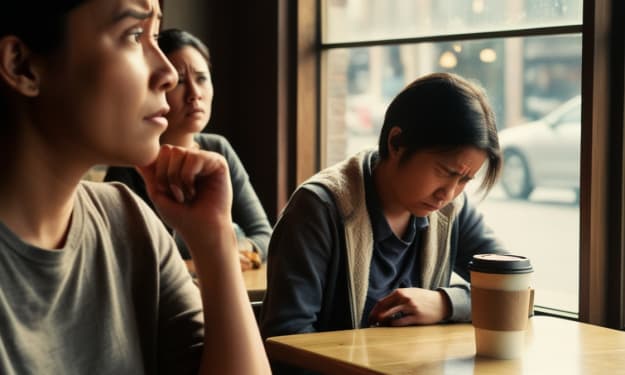
We judge people all the time, often without realizing it. A glance, a tone of voice, a facial expression—we take fragments of a person and create a story in our minds. I used to think I was particularly skilled at reading people. I relied on intuition, on my gut, and I was confident that I could assess someone’s character within moments of meeting them. That belief came crashing down the day I judged someone too quickly—and learned just how wrong I could be.
By Muhammad Asim7 months ago in Confessions
The Time I Said ‘I’m Fine’ and Everything Fell Apart
I remember the moment as clearly as if it were yesterday. I was sitting on the couch, phone in hand, exhausted after a long day filled with obligations, stress, and the silent weight of things I couldn’t name. Someone asked, “How are you doing?” and without hesitation, I said, “I’m fine.” Those two words — short, sharp, simple — felt like a shield. But beneath them, I was anything but okay. That moment marked the quiet beginning of everything unraveling in my life.
By Muhammad Asim7 months ago in Confessions
I Found a Hidden Letter in My Husband’s Jacket—What I Read Changed Everything
I’ve always believed truth doesn’t knock politely—it barges in when you least expect it. That’s exactly how I found it: in the dusty inner pocket of my husband’s jacket, buried behind fabric and forgetfulness.
By Zahir Ahmad7 months ago in Confessions
The Digital Masquerade: A Bosnian Couple's Tale of Accidental Infidelity
In 2007, a peculiar and telling story emerged from the town of Zenica in Bosnia, a modern-day parable for the age of the internet. A married couple, Adnan and Sana Klaric, found their relationship had grown stale and emotionally distant. Like many others before and since, they sought solace and connection not in couples counseling or heartfelt conversation, but in the glowing screens of their computers. They ventured into the anonymous world of online chat rooms, a digital landscape where identities are fluid and reinvention is just a username away.Adnan, adopting the moniker "Prince of Joy," and Sana, under the alias "Sweetie," found themselves drawn to one another in a forum. They poured their hearts out, lamenting their unhappy marriages and the lack of affection from their respective spouses. They discovered a profound connection, a meeting of minds and souls that was conspicuously absent from their real lives. "The way this Prince of Joy spoke to me, the things he wrote, the tenderness in every expression was something I had never had in my marriage," Sana later recounted. Adnan, for his part, was equally smitten, saying, "I still find it hard to believe that the person, Sweetie, who wrote such wonderful things to me on the internet, is actually the same woman I married and who has not said a nice word to me for years."The irony, of course, was that they were complaining about the same marriage, the same lack of communication, the same emotional void. But shielded by the cloak of online anonymity, they were free to be the partners they wished they had, and in doing so, they found in each other the very person they were trying to escape. The digital affair blossomed, a fantasy relationship built on shared discontent and the promise of something more. Eventually, the inevitable next step was proposed: a face-to-face meeting. They agreed to meet, each carrying a single rose for identification. The denouement, however, was not the romantic climax of a Hollywood film, but a far more awkward and revealing moment. As they arrived at their rendezvous, they discovered the shocking truth: their online soulmate was, in fact, their real-life spouse.The story of Adnan and Sana, while seemingly a bizarre outlier, is a potent illustration of the complexities of modern relationships in the digital age. The internet, with its promise of anonymity and endless connection, has become a fertile ground for infidelity. The internet makes it easier than ever to connect with new people, rekindle old flames, and engage in clandestine relationships, all from the privacy of one's own home.The anonymity afforded by the internet is a key factor in this phenomenon. It creates a sense of disinhibition, allowing individuals to shed the constraints of their real-world identities and behave in ways they otherwise wouldn't. This "online disinhibition effect," as psychologists call it, can lead to increased self-disclosure and a feeling of intimacy that can be incredibly seductive. People may feel more comfortable sharing their deepest thoughts and feelings with a stranger on the internet than with their own partner, precisely because there are no real-world consequences—or so it seems.However, as the story of Adnan and Sana so vividly demonstrates, the line between the online and offline worlds is often blurred. What begins as a harmless flirtation or an emotional outlet can quickly escalate into a full-blown affair, with devastating consequences for real-life relationships. Even in the absence of physical contact, online affairs can be just as damaging as traditional ones, triggering feelings of betrayal, jealousy, and insecurity. Many people rationalize online infidelity, believing that if there's no physical contact, it doesn't count as "real" cheating. But for the betrayed partner, the emotional intimacy and secrecy of a cyber-affair can be just as painful, if not more so.The story of the Bosnian couple did not have the happy ending some might have hoped for. The revelation of their mutual infidelity did not lead to a reconciliation or a renewed commitment to their marriage. Instead, they divorced, each accusing the other of being unfaithful. The trust had been broken, and the fact that they had been cheating with each other did little to mitigate the sense of betrayal. Their story serves as a cautionary tale, a reminder that the search for connection in the digital world can sometimes lead us further away from the very people who are closest to us. It highlights the importance of open and honest communication in our relationships, and the dangers of seeking solace in the anonymous and often deceptive world of the internet. In an age where our digital and real-life personas are increasingly intertwined, the story of Adnan and Sana is a powerful reminder that the person on the other side of the screen may be closer than we think.
By DigitalAddi7 months ago in Confessions
How Social Media Is Quietly Changing Who We Are
It was all fun when we first joined Facebook, Instagram, or Twitter. We felt a little more connected to the world because we were able to communicate with friends who lived far away, share photos, and write about our feelings. However, gradually, something began to alter. We used more than just social media — We began to change as a result. It started to shape how we see ourselves, how we talk, and how we feel slowly and quietly. It began to quietly rewrite our identity.
By kaykobad7 months ago in Confessions
He Was Everything I Wanted—Until He Broke Me
I didn’t think I was the kind of woman who ignored red flags. I used to be smart, guarded, self-aware. But somehow, somewhere in the mess of late-night texts, love bombing, and the intoxicating feeling of being chosen, I let my guard down for someone who was never safe to begin with.
By Khayal Muhammad 7 months ago in Confessions
When You Outgrow Your Coping Mechanisms
At some point in your healing, you look around and realize you’re not in survival mode anymore. The alarms have stopped ringing. The ground beneath you is steadier. The chaos has quieted—but you’re still flinching. You’re still over-explaining. You’re still waiting for the other shoe to drop.
By Irfan Ali7 months ago in Confessions