
How About the World As Animals See It?
world of animals

this is Finch and he's a tarsier I know
he looks like someone's just pointed
their headlights at him in the middle of
the
night but the size of his eyes was an
evolutionary adaptation that allowed him
to see better in the
dark his eyeballs are as big as his
brain Tarsiers have the biggest eye to
head size ratio out of all
mammals now it's a known fact that
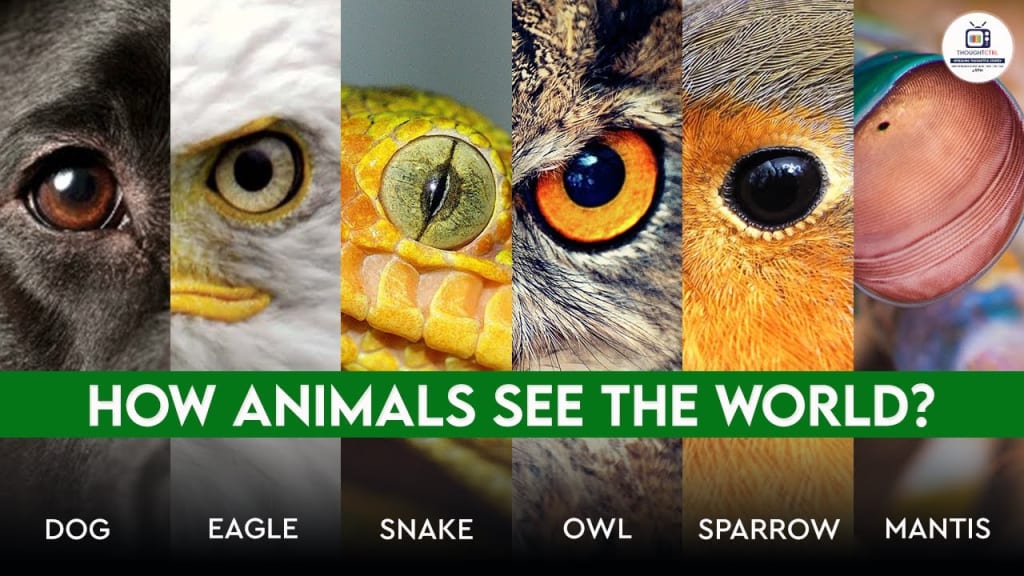
humans and animals don't see the world
in the same same way but how about we
dive into how some creatures experience
our
reality to start out with Finch well he
rocks at night vision while humans
experience the nighttime in a scale of
gray colors Tarsiers can only see
monochromatically but the orbs in their
eyes allow them to gather every single
bit of light available in an environment
this means that they can hunt insects
and Tiny Birds with a bizarre precision
even if it's pitch black
outside they can't move their eyeballs
though so if they see something to their
left or right they have to turn their
entire
heads FYI there's actually a night
vision goggle named tarer that allows
humans to experience Darkness much like
these animals
do in case you're wondering this is what
a forest would look like to a
tarer and speak of seeing in the dark
these pals are called Arctic reindeer
they developed an interesting feat that
helps them see in dim light the back of
their eyes changes color according to
the season in the summertime the back of
their eyes is gold and in wintertime
it's blue you see winter light is at
least 100,000 times fainter than
summerl this adaptation helps reindeer
find food and protect themselves from
predators during the 3 months of harsh
winter you can also find this type of
adaptation in other nocturnal animals
such as our beloved cats picture it like
a mirror sitting behind the
retina this is the basic structure of an
eye on the outermost layer you'll see
the pupil and the iris this is where
light first enters the eye and the
muscles behind the iris squeeze and
stretch the lens to direct the light on
to the back of the
eye this innermost part aka the back of
the eye is what we call the retina over
there we can find photo receptors called
rods which capture dimmer lighting and
other ones called cones which perceive
bright
light for animals that have to see well
in the dark as a matter of survival the
photo receptors absorb every bit of
photo Photon available in an
environment by the way photons are
another name for tiny units of light if
you've ever flashed some light into a
cat's eye in the middle of the night
you've probably seen this mirrorlike
adaptation in action it bounces back all
the light it receives to the photo
receptor giving it a second chance to
absorb everything it possibly
can it's what makes feline or owl eyes
look so yellow in the dark and make give
the feeling that you're inside a horror
movie now if we enrolled all animal
species of the world in a competition to
see who had the best eyesight which
species do you think would win well this
result is not as straightforward as it
may look it depends on which category
we're talking
[Music]
about if we're thinking about the animal
with the sharpest Vision we have to talk
about birds of
prey more specifically the likes of a
paragen Falcon these Falcons have a type
of binocular vision eight times as sharp
as humans do this means that while
they're flying at impressively fast
speeds they can spot with immense
Precision a rabbit over a mile away this
is possible because Birds of Prey have
around 1 million cones in their phobia
on the back of their eyes for comparison
humans have only around 30,000
cones but if we're talking about which
animal can perceive the widest range of
color then things get a bit more
complicated remember when we talked
about cones and rods they are the ones
responsible for perceiving light and
sending the signals to our brains that
allow us to form images but our cones
and rods only capture certain
wavelengths of light to put it simply
the amount of colors a species can see
depends on which types of photo
receptors it
has our dog buddies have only two types
of
receptors this means that they mainly
see the colors from the blue and yellow
Spectrum if you wear anything from the
red color spectrum while you're walking
your dog they will probably perceive it
as a gray or something like
that amazingly this blue bottle
butterfly has at least 15 types of photo
receptors seven of them are wired to
different tonalities of Blues and greens
which means that they can see colors
humans can only ever drink dream of
seeing researchers believe that since
these butterflies live in dense lush
green forests this adaptation might help
them track other of their species during
high-speed
chases if we change environments and
take a look at aquatic animals mantis
shrimps probably have a pretty
psychedelic Vision these funny looking
creatures have a whopping 16 varieties
of photo receptors with five of them
reserved for the ultraviolet or UV
Spectrum ultraviolet rays are really
short wavelengths which are invisible to
humans the thing science still doesn't
understand is how exactly these mantis
shrimps view the world around them sure
they can perceive a bunch of colors but
they can't necessarily distinguish all
of these colors amongst themselves this
happens because image processing is done
in the
brain after the light hits the retina
the retina sends information down our
nervous system and a colored image
starts being formed in our brains one
might wonder though what goes on inside
these mantis shrimp's brains
huh and what about motion the winners in
this category are insects you've
probably seen a movie scene where an
insect's eyesight looks like a
kaleidoscope of thousands of tiny TV
screens but that's not really true
these multiple lenses serve as photo
receptors to capture all available
light you see to have the fastest motion
Vision photo receptors need to quickly
sense changes in light so let's take a
fly as an example although they're
shortsighted their eyes give them an
almost
360° view of their surroundings that
would be a pretty neat superhuman power
to have
huh their brain processes motion
information pretty quickly
10 times faster than humans do which is
why it's so hard to catch
them some species have terrible eyesight
and have to depend on other mechanisms
to see the world around
them for example Dolphins use their ears
to see under the
water I know that sounds weird but they
use something called
echolocation Dolphins emit extremely
high frequency sound waves that are
classified as ultrasound which humans
can't
hear while they're swimming they emit a
type of clicking sound to scan the water
for food and other
animals whichever way sound bounces back
to them will help them identify what's
in the water ahead and move around
them that's also what bats do to help
them move around the really dark
environments they usually live
in snakes have pretty bad eyesight it's
believed that some some can't see color
at all snakes that spend most of their
time under the ground have small simple
eyes that can only tell the difference
between light and
dark snakes that live above ground have
better eyesight they can see ultraviolet
light which helps them hunt in broad
daylight now the most interesting ones
are snakes such as pythons and
Vipers they have a special something
called pit organs on their heads pit
organs are an important adaptation that
allows snakes to see heat
sources actually they can detect
infrared radiation from a body source
which helps them to detect their
prey if I were a rodent living in the
forest I'd be pretty scared of these
guys
About the Creator
fatimazahra
each day I will share with you very interesting subjects that can help you to understand very important things in our live
Keep reading
More stories from fatimazahra and writers in Confessions and other communities.
The Shadow Manifesto: Search for Meaning
"What did I do wrong, papa? I don't understand why you are beating me. For what? It hurts. I am just 7 years old. . ." "This hurts me more than it hurts you, my son. You must learn to take pain like a man for that is what life is about. So stop crying. Don't be a cry baby. Be a man."
By WILD WAYNE : The Dragon Kinga day ago in Confessions
Wild Card Weekend Recap: What Happens Now?
I think I figured out why I love Wild Card Weekend so much. It's because it's the first playoff anything of the calendar year. The NFL season starts in the fall, and once upon a time, the champion was crowned either on or slightly before New Year's. The evolution of the NFL schedule has resulted in the playoffs starting just into the New Year, and currently, the final week of the season falls on the first weekend of the New Year, with Wild Card Weekend coming a week after that. So yes, chronologically, the NFL's Wild Card Weekend serves as the first playoff anything of the calendar year.
By Clyde E. Dawkins7 days ago in Unbalanced



Comments
There are no comments for this story
Be the first to respond and start the conversation.