
Compendium of Good & Evil
Everybody's Got Choices

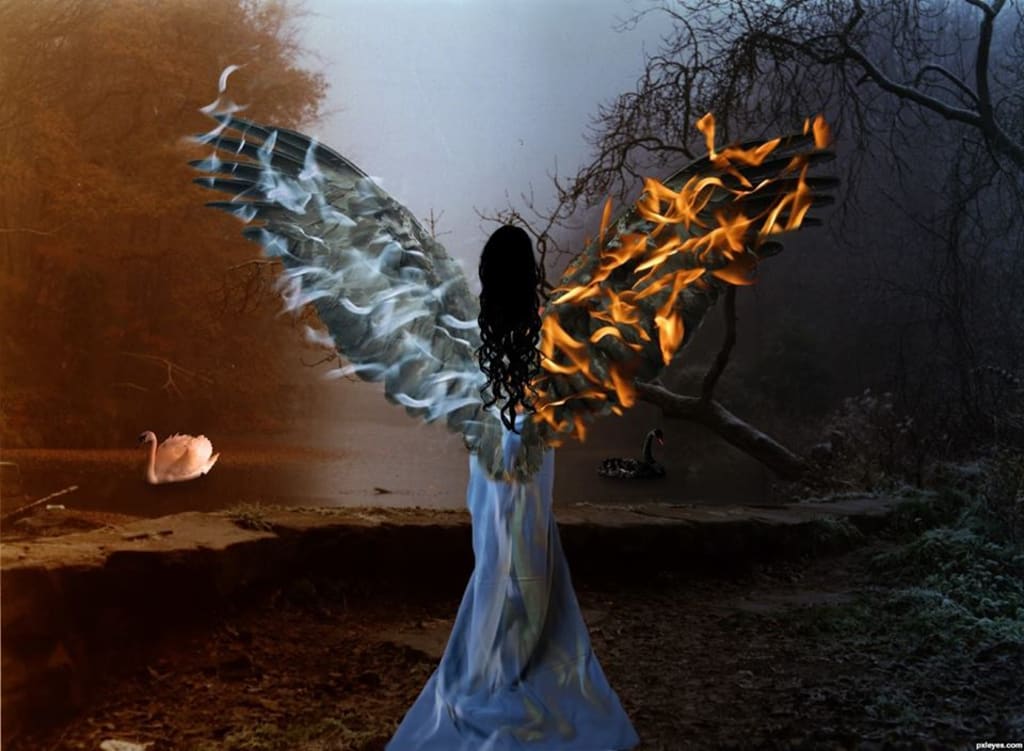
This is how Lillith was created. Unlimited, exponential love, and eternal, complete, heartbreak. One of Satan’s most vicious, powerful, and useful, warriors. She is the compendium of brightness, light, flowers, hope, yet endures as a troubadour of death, destruction, darkness, and dust. Yin and yang, black and white, good and evil. The torrential battering of soul, light, love, goodness, most certainly proliferates the intensification of soulless, dark, hate, and evil in the human psyche. Jordan Peterson (cite) has said that in order to succeed, “make it” in today’s world, one must be capable of evil. One must learn one’s limits of monstrosity and be able to enact such malevolent deeds in order to survive. If one is incapable of such things, then they will most certainly not progress, succeed or grow in this life. I disagree. If one is capable and possesses the emotional capacity to simply love and be kind to others, without the use of any negative tactics or nastiness towards your fellow mankind, one may still be able to obtain success, power, and abundance. Yes, the journey will be that much more difficult and may take a little to achieve, but it is my theory that it is indeed still possible without becoming any type of monster.
Human nature is to grow, expand, multiply, survive, learn, understand, connect, pursue wealth, power, knowledge, experience, etc. Often at the expense, abuse, manipulation, exploitation, and control of another. This is the theory of evolution at work, the concept, the quantifiable measure of the human condition. Its prerogative, its goal, its necessity. In our existence we all have witnessed the gross abuse and misuse of “power” in the wrong hands. The corruption of greed by industry, The fear mongering by media, the perpetuating of ideology and even theology by corporations, individuals, and politicians alike. When does one decide for themselves what path to walk, which code of ethics to follow, how to conduct oneself in society and amongst other human beings? When as a species did, we collectively decide we were the judge, jury, and executioner, in our own judgement of another soul, human being? When did we decide that it was not only our right, but our duty as flawed, unperfect, bodies, to place limitations, labels, definitions, on another person? Why do we as people, seek to control, hold power over, govern, any other living organism? When it is so very obviously not our place or our right? This desire, this NEED, will most certainly result in our, as a society and an individual, inevitable downfall. And on the other hand when does one decide to step in and offer aid, help, or save another? Is it not apparent when someone needs assistance? Our issue is not that we do right or wrong as a people, but our issue lies more in the fact that one will see wrong, and yet still decide to turn a blind eye and do nothing about it. We are here for each other. We are here for making each others lifes a better more positive and fulfilling experience.
When does a persons desire to help turn into something else? Like a God-complex? When is it no longer help but instead a desire for control? The paradox of control is that one must maintain and eternally hold onto said control, or be faced with the inevitable result of the subject of control becoming resentful, angry, vengeful, intolerant, and unforgiving of the one who began the strategy of said concept. For every action, there is indeed an equal and opposite reaction. Hence the notion that everyone is solely responsible for their own existence. No matter the age, upbringing, experiences, or traumas one may brave, each human being is naturally instilled with the underlying knowledge, definition, and understanding of the simple concept of ethics. Right and wrong, good and evil.
An individual must never allow the influence, actions, or opinion of another person to change who they are or what they perceive as right or wrong. One must remain steadfast in their own perception of what is right and wrong. Integrity is doing the right thing even when no one is looking. When a person has been wholly good for the majority of their lives and is then faced with true, treachery, deceit, or evil, they will most certainly find themselves questioning whether or not being good is indeed a personal deficit. Is being “good” a detriment to an individual? Yes, it can be. However, it is my firm believe that being a good and wholesome person is a far more positive, satisfying, and righteous way of life and philosophy to live by. People are so quick to do unto others as they would have done unto them and I feel that is the bane of human existence. One can live a fulfilling and happy life by living within the confines of the philosophy of being kind, charitable and helpful, however, one must also be sure to apply those same concepts to their own being as well.
Ghandi says, “be the change you wish to see in the world.” So if that adage holds true, wouldn’t one always treat others with kindness, love, and understanding? Wouldn’t a person desire and hope for the best for all people? Wouldn’t they stop to pick up trash, or help the elderly woman across the street, or carry the feeble man’s groceries to their car? If a person steals from you, would you take something from them back? If one lies to you would you return the same to them? If someone strikes you would you strike them back? This would seem to be the concept of natural selection or survival of the fittest. So these concepts, in my opinion are wrong and outdated. We must learn to live collaboratively, harmoniously, kindly, civilly, with and to each other and ourselves in order to maintain a more peaceful, liberating, and positive existence.
We have stunted our own progression by becoming selfish and narcissistic in our desire for power, money, and growth. In order to achieve a more symbiotic, fulfilling and positive reality, we must stop seeking out those selfish needs. We must truly let our own happiness take a back seat and focus on the happiness and peace of those around us.
Human nature is expressly defined in birth. Freud theorized that human nature was an equation of a few separate variables. Unique to each person.
My theory is that moral ambit is innate. Natural, in all of us. Much like our natural desire or ability to know, to understand, to connect with one another and our carnal need to procreate. What decides whether a person is good or evil? What parameters do we (society and the individual) set that denotes one’s definition of wrong or right?
Yet as a species, we tend to craft justifications and vindications for those who commit atrocities to another being. Don’t we all have the express consent, right, and option to live, love, and pursue happiness? Isn’t that a cornerstone of our great country’s philosophy? Life, liberty, and ones pursuit of happiness? Our current translation and enaction of our written and implied laws is not only insanely exaggerated, corrupted, and perverted, but, in my opinion, transmuted incorrectly. All in the name of personal gain and selfish pursuits.
Perception is everything. However, ones perception can change and be skewed by simple experiences. One can begin as a seeker of heroism and niceties, only to find themselves devolved into a cruel, insurmountable villain. Irreparable damage can be committed by such an innocent and pure act. One can find themselves changed into someone else entirely simply by allowing the actions or influence of another to affect them and subsequently change them. That notion purely applies to the weak minded. Those who are not firmly planted in the abstract view and finite details of who and what they are.
When is it no longer merely an act of survival and when do we begin to define it as evolution? When is it inspiration and when does one allow the ideas, thoughts, words of another to invade upon their psyche, their core values and beliefs? Is it not human nature to evolve? Change? Adapt? Yet it would seem that once a person allows another’s concepts to become an ideology for them, it would in response also cause an undeniable and inexplicable change in them. Does the core of who you are remain the same? Or can your moral compass be swayed by any number of real variables?
The inevitable experiences one must endure in life will most surely change them into another person then they once were. So then how does one define who they are? What they stand for and who they aspire to become? Freud’s theory on child development and the stages that we invariably face as we progress from infancy to young adulthood, surely seem to play a role in defining our individual characters. Yet what happenings in our existence affect our souls, hearts, and minds most profoundly?
The affects of trauma on ones life are far reaching and deeply ingrained. It is up to us as people to decide that we don’t wish to be or act as a negative influence to others. That we choose the option to help, instead of harm. However therein lies one of the many moral issues a human being will face, when is it your place to make your affect known and apparent to life? When should one “step in” or make the effort to change/affect another? My belief is that when help is needed, it is greatly apparent. Hence the idea that we as people must not turn a blind eye to injustice. Must not hold out on helping each other when help is very evidently needed.
Yet with this idea one must hold great caution and always take the time to discover whether or not someone is indeed in NEED of help. Need and want are two different things entirely. It is up to each person to discern what their own personal boundaries regarding this matter. What are the things a human truly needs and what are their wants? Maslow’s hierarchy of needs is a decent stencil of the start of what a human being actually needs to survive and of the physiological basic necessities of people. The first being the need for food and water, the second a need for safety and shelter, the third a need for love and belonging, fourth is esteem needs. Having all of these needs met and maintained will lead to a person reaching their own self-actualization. Or one’s true potential. When a child is deprived of said needs it will invariably lead to a difficult vitality.
But life is about “falling down seven times and getting up eight.”
About the Creator
Jessica Lombardi
I am a student of life & love. I am an avid supporter of free speech. Hopefully my stories will resonate with someone and possibly make them feel not so alone. Universe Inc.
Keep reading
More stories from Jessica Lombardi and writers in Confessions and other communities.
Thoughts on Vocal and the way the world is
"Death cannot stop true love, only delay it." – Wesley in The Princess Bride. I decided to come back to Vocal on a very cold and dark night at the end of December. I had been, and still am, convalescing from a horrible staph infection that had gone misdiagnosed for months. This, paired with the increasing challenges of being healthy, making the best choices for my co-parented child, being a wife, and being a director at a new job, was a lot to manage.
By Jazzy 7 days ago in Confessions
Two girls, one library, and a hunger for worlds beyond your own—Last part
🌙 “How could I have forgotten all of this?” Because life pulls us in a thousand directions. Because adulthood layers over childhood like sediment. Because pain, distance, and responsibilities bury the softer memories. But they don’t disappear. They wait.
By C.M.6 days ago in Confessions


Comments (1)