
BIS Certification for Foreign Manufacturers to Export to India
ERCS Pvt Ltd


Exports and imports display the relations of a country with the world economy and the Indian economy is not an exception. India provides a diversified basket of products and services, with export-magnitude products comprised of software, pharmaceuticals, textiles, agriculture products, etc.
On the import side, essential commodities such as crude oil equipment, and electronics meet domestic needs and boost industrial growth as well.
Foreign demand, government policies, and international trade significantly influence India's trade relationships which have far-reaching effects on the country’s economic performance and development path.
Importance of a BIS certificate for the Imported goods -
Any goods being imported into India must obtain a BIS certificate of import for the following reasons:
So that the end consumer would accept it since it is safe, trusted, and is of high quality.
Check that the product is compliant with the Indian market.
Gain a competitive advantage over competition.
To ensure that, the public receives high-quality, dependable, secure, and risk-free products.
Sell the goods in the Indian market.
Make sure that you have the certification to prove that the product was given through a series of tests.
Check product quality and affix their standard mark on the product.
BIS certification is necessary if the product is on the obligatory certification list.
Now that you understand why a BIS is essential for import in India, let's look at the types of certifications that an importer can obtain -
Types of BIS Certifications for Importers:
Importers import various products manufactured by a foreign company for sale and distribution in the Indian market. As prescribed by the BIS of India, all imported products to be marketed in the country require certification by BIS and meet the quality standard specified.
The manufacturer must get a BIS Import certificate before using the standard mark (ISI Mark) on the products and selling them in the Indian market. To sell products in the Indian market, the importer must verify that their overseas producer obtains BIS certification under one of the BIS' several certification programs.
Importers can obtain two types of BIS certification, depending on the product category
Foreign Manufacturers Certification Scheme (BIS FMCS)
Mandatory registration program (BIS registration for electronics and IT goods)
BIS Certification Scheme X
To get BIS certification for import into India under the BIS FMCS program or BIS registration for import under the CRS scheme, all foreign firms must designate an Authorized Indian Representative (AIR). AIR will seek the BIS certification on behalf of a foreign producer. AIR, therefore, undertakes to strictly abide by the provisions of the Indian BIS Act, Rules, Regulations, and Terms & Conditions contained in the BIS Licence.
Let us first comprehend BIS's foreign manufacturer certification procedure for foreign manufacturers.
Foreign Manufacturer Certification Scheme for Import of goods into India
The Bureau of Indian Standards has a foreign manufacturer certification process that grants a BIS license to foreign manufacturers that use the standard mark (ISI Mark) on their products.
It applies to all products except the electronics and IT equipment. As the product is exported to India, the foreign producer must guarantee that it meets Indian Standards rather than the standards of their country before selling it in the Indian market.
If the exported product is not electronics or information technology, the foreign producer must get BIS certification under the FMCS scheme.
Among crude oil, gold, machinery, chemicals, and fertilizers; electronic goods are a major component of India’s imports.
The electronic and IT goods to be imported must get BIS certification under the CRS scheme.
Compulsory Registration Scheme -
BIS registration for electronics and IT products is another term for a compulsory registration scheme. It is mandated by BIS and is used to label and certify electronics and IT items.
According to the CRS scheme, no one may produce, sell, or distribute items in the Indian market without BIS registration. All items must fulfill Indian standards and display the standard mark with a unique registration number.
A BIS registration certificate is essential before launching any electronics or IT products in the Indian market. If you manufacture or import electronics and IT items, you must obtain BIS registration for your product. To get BIS registration for importing electronics and IT items, check that your product fulfills the necessary Indian criteria.
BIS issues a BIS registration certificate allowing electronics and IT goods makers to use the standard mark with a unique registration number.
If you wish to export electronics and IT items to the Indian market, you must first get a BIS registration certificate under the BIS CRS program. BIS CRS certificates would be provided based on the self-declaration of conformity of products and articles to Indian standards.
Scheme X certification
Scheme X, is established under the Bureau of Indian Standards (BIS) Conformity Assessment Regulations, 2018. It is a significant breakthrough in India's product certification regulatory structure.
It was further revised by the BIS Conformity Assessment (Amendment) Regulations, 2022.
BIS Scheme X is a customized conformity assessment scheme for goods that must meet certain technical and safety criteria. It enables producers to obtain a BIS license or a certificate of compliance before using or applying the BIS Standard Mark to their goods. The program applies to a wide range of items, notably those that require rigorous respect for safety.
Scheme X applies to goods that must fulfill specified expectations or standards as defined in relevant Indian Standards. This scheme allows firms to select between a license for continuous production and a certificate of conformity for batch manufacturing. This flexibility is especially important for products that are not produced continuously but must fulfill high-quality requirements.
Under these three schemes, foreign manufacturers can get their products certified to export to India. The procedures involved in getting these certifications are - turning in applications, testing products, and inspections, etc. Obtaining certification helps to ensure that quality and safety-conscious products and services find their market while, on the other hand, restricting unsafe product entry. That way it would enhance market access and customer confidence as well as avoid legal complications.
About the Creator
ERCS Private Limited
ERCS Pvt Ltd: Your global partner for certification & compliance services. Setting industry standards since 2019. Excellence, Integrity, Service.
Visit- https://www.elitasrcs.com/
Keep reading
More stories from ERCS Private Limited and writers in Confessions and other communities.
Can I Import Goods Without BIS?
Certain certifications are lodged on imported products in India. To maintain the reliability and safety of the products, it is important to get marked by these licenses, which state that the goods comply with Indian standards. These certifications ensure that the imported products are safe to use and do not fall back in terms of quality. Eventually, this builds a strong professional relationship between consumers and manufacturers. Let us explore what BIS certification for import in India means and why it is necessary.
By ERCS Private Limitedabout a year ago in Confessions
Thoughts on Vocal and the way the world is
"Death cannot stop true love, only delay it." – Wesley in The Princess Bride. I decided to come back to Vocal on a very cold and dark night at the end of December. I had been, and still am, convalescing from a horrible staph infection that had gone misdiagnosed for months. This, paired with the increasing challenges of being healthy, making the best choices for my co-parented child, being a wife, and being a director at a new job, was a lot to manage.
By Jazzy 4 days ago in Confessions
I Missed the Meeting, But the Fire Cats Stayed
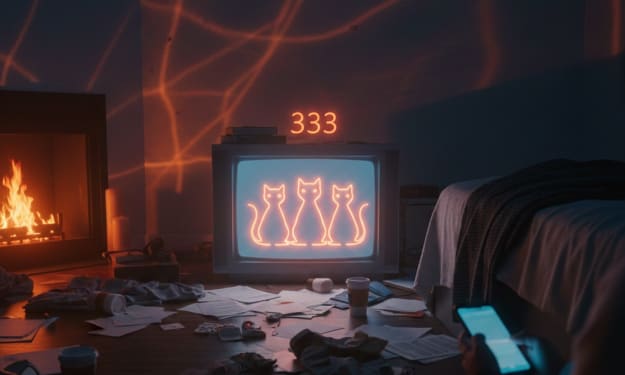
I’m sitting here watching a strange video—three orange cats, neon-bright, glowing like embers. The number 333 keeps flashing on the screen, and for some reason it feels intentional, like the universe is tapping me on the shoulder instead of shaking me awake. The sound from the TV hums softly, almost like a bonfire crackling on a beach. Fire cats. That’s what they are. I don’t know why that comforts me, but it does.
By Jhon smith7 days ago in Confessions


Comments
There are no comments for this story
Be the first to respond and start the conversation.