
US and Israel’s War with Iran: Preemptive Strike or War of Choice? Global Risks, Regime Change, and Middle East Crisis
Why Did the US and Israel Attack Iran? Preemptive Action or Strategic Calculation?

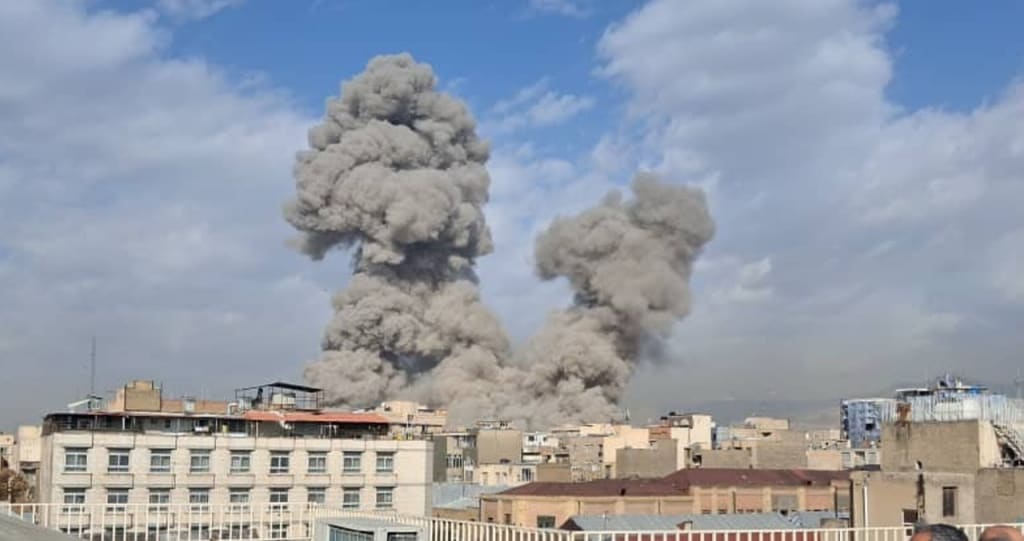
The decision by the United States and Israel to plunge into a new war with Iran has pushed the global landscape toward extremely dangerous and unpredictable consequences. Israel has attempted to justify its attack by describing it as a “preemptive action.”
However, evidence suggests that this strike was not carried out in response to an imminent threat, as the term “preemptive” implies.
In reality, they chose to fight this war a war of choice.
The United States and Israel likely calculated that Iran’s Islamic government is currently extremely weak. The government is not only facing a severe economic crisis but is also dealing with the aftermath of a harsh crackdown on Iranian protesters. Additionally, Iran’s defense system was reportedly badly damaged following last summer’s conflict with Israel.
The United States and Israel appear to have concluded that this opportunity should not be wasted.
This action is also another heavy blow to the already fragile structure of international law. In their statements, President Donald Trump and Prime Minister Benjamin Netanyahu said that Iran poses a threat to their countries (the United States and Israel), while Trump even described Iran as a “global threat.”
Certainly, Iran’s Islamic government is their staunch adversary, but it is difficult to understand how the legal justification of self-defense applies in a situation where two major powers (Israel and the United States) stand on one side and Iran on the other.
War is a political act. Once armed conflict begins, it becomes extremely difficult to control. That is why leaders must have clear objectives.
Netanyahu has, for decades, viewed Iran as Israel’s most dangerous enemy. For him, this is a major opportunity to inflict maximum damage on Tehran’s government and military capabilities.
General elections are scheduled in Israel later this year, and Netanyahu believes that whenever Israel chooses the path of war, it strengthens his political position.
On the other hand, Donald Trump’s objectives tend to shift over time.
Last January, he assured Iranian citizens protesting in Iran that “help is coming.” However, at that time, much of the U.S. Navy was engaged in efforts to remove Venezuelan leader Nicolás Maduro from power and arrest him, limiting Trump’s military resources and options.
A few weeks ago, when the United States was deploying two aircraft carriers to the Middle East, Trump spoke extensively about the dangers of Iran’s nuclear ambitions — despite having declared last summer, following U.S. bomber strikes on Iran, that Iran’s nuclear program had been “wiped off the face of the earth.”
The Iranian government has consistently denied seeking nuclear weapons. However, it has enriched uranium to levels that have no use in a peaceful nuclear power program.
At the very least, it appears that Iran wants to keep the option of building a nuclear bomb open. Nevertheless, Israel and the United States have not presented any evidence that Iran was on the verge of doing so.
In a video message, Trump told the Iranian people that their “time for freedom” is near. Netanyahu made a similar statement on Saturday, suggesting that the current war could provide the Iranian people with an opportunity to overthrow their government. But that is far from certain.
There is no precedent for regime change being achieved through airstrikes alone. In 2003, Saddam Hussein’s government in Iraq was toppled only as a result of a large-scale ground invasion led by the United States not merely airstrikes.
In 2011, Muammar Gaddafi’s government in Libya fell only because rebel forces received sustained air support from NATO and several Arab states.
In both cases, however, the outcome was state collapse. Civil wars erupted, and thousands were killed. Libya remains a failed state, while Iraq is still grappling with the consequences of the U.S. invasion and the widespread bloodshed that followed.
Even if this were to become the first instance in which the United States successfully topples a government using air power alone, there is no reason to believe that Iran’s current Islamic government would be replaced by a liberal democracy that respects human rights. No credible alternative government in exile currently exists.
Over nearly half a century, Iran’s ruling system has developed a complex political structure based on a mixture of ideology, corruption, and the ruthless use of force when necessary.
Last month, the Iranian government clearly signaled that it was prepared to kill protesters. Iran’s hardline security forces have previously complied with orders to shoot and kill hundreds of their own citizens for challenging the existing system and demanding freedom.
Perhaps the United States and Israel are attempting to assassinate Iran’s Supreme Leader, Ayatollah Ali Khamenei. Israel views its capacity for targeted killing as a strategic tool.
But Iran’s Islamic government is a different matter. It is not merely an armed group or movement; it governs a state. It is not a one-man show. Even if Supreme Leader Khamenei were killed, he would be replaced immediately — most likely by another cleric backed by Iran’s Revolutionary Guards, who would continue defending the government against domestic and foreign threats with a clear strategy.
Trump reportedly offered them immunity in exchange for surrender, but otherwise threatened certain death. There is little chance that the Revolutionary Guards would be tempted by such an offer. In the ideology of the Islamic Republic and within Shiite Islam, “martyrdom” is regarded as a form of enduring life.
Trump tends to see politics and everyday life primarily through the lens of transactions and business, as described in his book “The Art of the Deal.” However, when dealing with Iran, the power of ideology and belief cannot be ignored and that is a force that is extremely difficult to measure.
The current crisis has been unfolding since the beginning of this year, when the United States began shifting its military focus toward the Middle East. At that time, there were indications that Iran’s Islamic leadership believed war might be inevitable, prompting them to initiate indirect talks with Washington.
Iranian leaders do not trust the United States or Israel. During his first term, Trump unilaterally withdrew from the Iranian nuclear agreement — the Joint Comprehensive Plan of Action (JCPOA) which had limited Iran’s nuclear program and was considered a major achievement of the Obama administration.
Recently, there were signs that Iran might be willing to accept a “JCPOA II”-type agreement to buy time. However, it appears that the United States was also demanding strict limits on Iran’s missile program and an end to its support for regional allies opposed to Israel and the United States.
For Iran, these demands were unacceptable, as they would amount to surrendering to the United States and Israel. Abandoning its missiles and regional allies would effectively pave the way for regime change.
Iran’s leaders are now likely calculating how to survive this war, how to emerge from it, and how to manage its consequences. Meanwhile, neighboring countries — including Saudi Arabia — are deeply concerned about the uncertain and potentially far reaching outcomes of today’s events.
Given the Middle East’s capacity to generate instability, and with the outbreak of yet another intense conflict, the existing instability in the region and the wider world — already turbulent, violent, and dangerous — is likely to deepen further.
About the Creator
Keep reading
More stories from Real content and writers in Chapters and other communities.
Will Pakistan be able to achieve its goals by attacking Afghanistan, or will further concerns arise?
Pakistan carried out airstrikes on Friday in Afghanistan’s capital, Kabul, as well as in the key cities of Kandahar and Paktia near the Pak-Afghan border. Pakistani officials claimed that defensive targets were struck in these locations.
By Real contentabout 15 hours ago in Chapters
The Cave Part 6
If you have ever heard a tale about yourself that you cannot remember and doubtless think is made up, you will know how I felt when Tharkin related all that the eagle had seen of me before my memories were scattered. Of far distances and traveling companions that I did not recall, camping out under the stars and making our way to the mountains with deliberate purpose. The great bird had lost contact with my party once we entered the forests, and the seven other members were not seen again by him or his brethren since.
By Jamye Sharp13 days ago in Chapters
Sparrow on a Plank Chapter 18: Of Wild Parties and Annoyed Predators
The trip home was blessedly uneventful. There were sharks, whales, and the occasional seagull, but nothing attacked them or even appeared to follow them. Hajime and the other mages did a thorough search of the ship, looking for anything that didn't belong. They couldn't find anything, but that didn't mean that there wasn't anything there; it just meant that it was hidden rather well. Although they were sure that there was something hidden, they lacked the immediate means to deal with it.
By Jamais Jochim6 days ago in Chapters
Flower Bloom 369
FLOWER Bloom 2/25/26 Wednesday By Mariann Carroll Karen had been with Tony for 7 years. Tony started acting strangely after her surgery. He would mow the lawn in the rain and be on his cellphone. He started pushing Karen away. Tony came clean about seeing someone. Karen moved out two months later. Karen moved in with a friend. She felt betrayed.
By Mariann Carroll2 days ago in Fiction



Comments
There are no comments for this story
Be the first to respond and start the conversation.