
Tragic Mid-Air Collision Over Washington, D.C.: American Airlines Jet and U.S. Army Helicopter Crash into Potomac River
Fatal aviation accident near Reagan National Airport claims multiple lives, prompting investigations into air traffic safety.
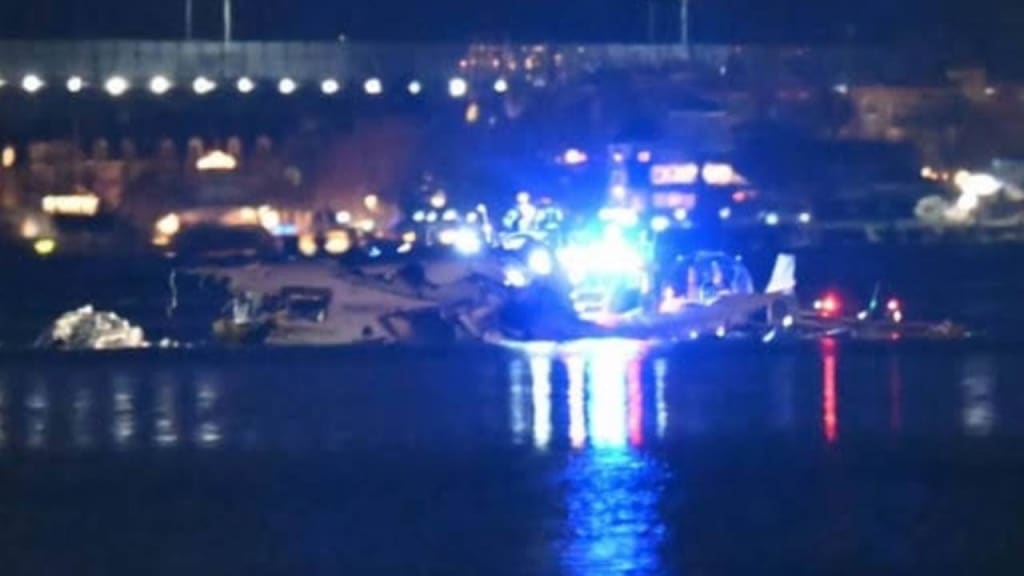
On the evening of January 29, 2025, a tragic mid-air collision occurred over Washington, D.C., involving an American Airlines regional jet and a U.S. Army Black Hawk helicopter. The accident resulted in both aircraft crashing into the Potomac River, leading to significant loss of life and raising concerns about aviation safety.
Details of the Collision
The American Airlines flight, operated by PSA Airlines, was a Bombardier CRJ700 carrying 60 passengers and four crew members. It was approaching Ronald Reagan Washington National Airport (DCA) around 9 p.m. local time when it collided with a U.S. Army UH-60 Black Hawk helicopter conducting a training mission. The helicopter had three soldiers on board. The collision occurred as both aircraft were nearing Runway 33 at DCA.
Immediate Aftermath and Rescue Efforts
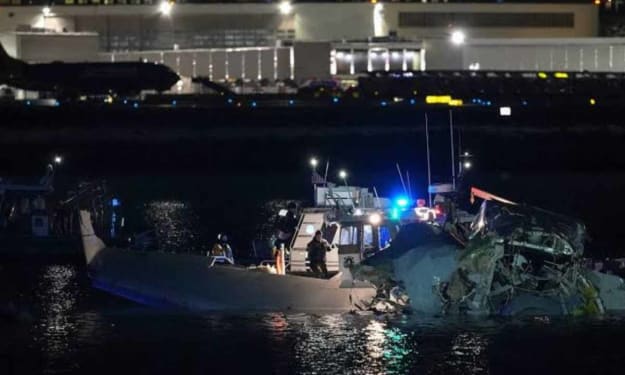
Following the collision, both the plane and the helicopter plunged into the Potomac River. Emergency response teams, including units from the District of Columbia Fire and Emergency Medical Services Department and Maryland State Police, were quickly dispatched to the scene. Fireboats and divers were deployed to search for victims and survivors. However, rescue efforts were hampered by cold temperatures, strong winds, ice, and murky water conditions. The water temperature near the crash site was recorded at 35°F (1.6°C).
Despite the challenging conditions, at least 18 individuals were rescued and transported to local hospitals. Tragically, 19 bodies were recovered from the river, and hopes for finding additional survivors diminished as the night progressed.
Impact on Air Travel
In response to the accident, Ronald Reagan Washington National Airport suspended all takeoffs and landings, diverting flights to nearby airports, including Dulles International Airport, Baltimore/Washington International Airport (BWI), and Richmond International Airport. The airport remained closed until at least 11:00 a.m. on January 30.
Investigation Underway
The Federal Aviation Administration (FAA) and the National Transportation Safety Board (NTSB) have launched a comprehensive investigation into the cause of the collision. Investigators are examining various factors, including potential lapses in air traffic control communications and the flight paths of both aircraft. One of the plane's black boxes has been recovered, which is expected to provide crucial data to determine the sequence of events leading up to the crash.
Community and Government Response
The tragic event has elicited an outpouring of grief and support from the community and government officials. President Donald Trump and other leaders have expressed their condolences to the families of the victims and have emphasized the importance of a thorough investigation to prevent future incidents.
The Washington Metropolitan Area Transit Authority extended Silver Line service and dispatched "warming buses" to assist relief efforts. Additionally, several commercial yachts from CityCruise sailed from Washington Sailing Marina to aid in search and rescue operations.
Remembering the Victims
Among the passengers on the American Airlines flight were members of the U.S. figure skating community, including coaches and skaters returning from an event in Wichita, Kansas. Notably, Russian figure-skating champions Inna Voliánskaya and Maxim Naúmov were also on board. The loss of these talented individuals has deeply affected the sports community and their families.
Aviation Safety Concerns
This incident marks the first fatal accident for American Airlines since Flight 587 on November 12, 2001, and the first fatal crash of a U.S.-registered civilian airliner in the United States since Colgan Air Flight 3407 on February 12, 2009. It has reignited discussions about aviation safety, particularly concerning air traffic control protocols and the management of military and civilian air traffic in shared airspace.
Moving Forward
As the investigation continues, authorities are committed to uncovering the factors that led to this tragic collision. The goal is to implement measures that will enhance aviation safety and prevent similar incidents in the future. The aviation community, along with government agencies, is focused on learning from this tragedy to ensure the safety of all who travel by air.
In the wake of this disaster, the resilience and solidarity of the Washington, D.C., community have been evident. Support for the victims' families and a collective commitment to improving safety protocols underscore the community's dedication to preventing future tragedies.
About the Creator
Fair Exchange, No Robberies
Dark Memoirs - Index There are at least two kinds of people in the world: those who write this half-arsed kind of intro to a story that looks to separate the rare and the norm, and those who realise it's an overused framing device and don't.
By Paul Stewart14 days ago in Chapters
Not an Exception
Dark Memoirs - Index "For writers who knowingly lie, for those who substitute unbelievable human behavior for the way people really act, I have nothing but contempt. Bad writing is more than a matter of shit syntax and faulty observation; bad writing usually arises from a stubborn refusal to tell stories about what people actually do—to face the fact, let us say, that murderers sometimes help old ladies cross the street.
By Paul Stewart5 days ago in Chapters
Miss Persephone's Manual to a Seemingly Ordinary Life
Miss Persephone was found at the dining table, her blue eyes swollen, her tears arriving and retreating like the tides of the ocean. Earlier that day, her family had visited her in the retirement home where she had lived for eight years. It was her eightieth birthday.
By Imola Tóth4 days ago in Fiction


Comments
There are no comments for this story
Be the first to respond and start the conversation.