
The U.S. Annexation of Hawaii
The story of Hawaii's Evolution in chapters

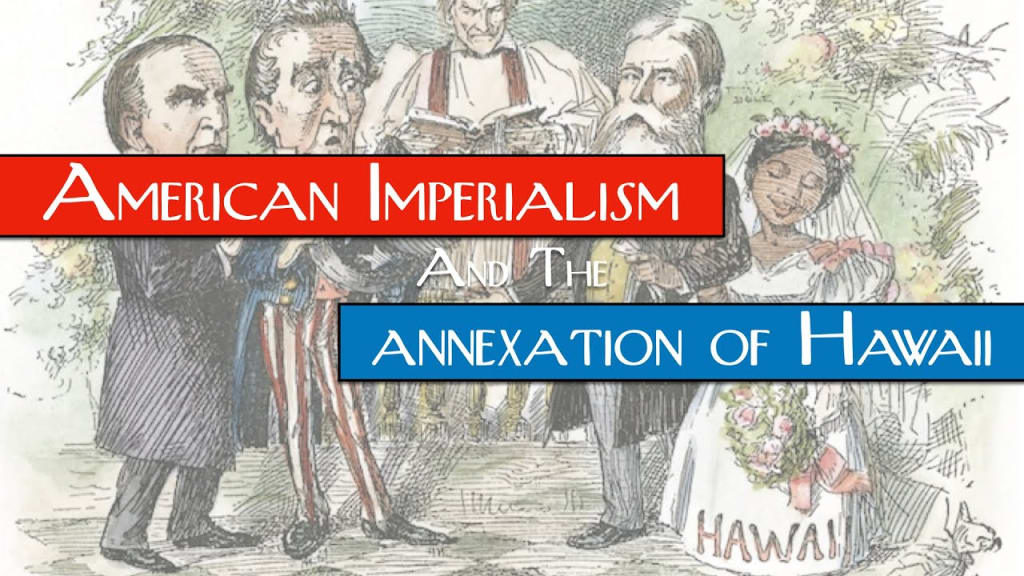
In the warm embrace of the Pacific Ocean, Hawaii, a group of lush, volcanic islands, lay as a jewel waiting to be discovered. For centuries, these islands were a haven for Polynesian voyagers, a sanctuary of vibrant cultures and traditions, untouched by the outside world. However, the 19th century marked a turning point in the history of Hawaii as it became embroiled in the complex web of geopolitics, economics, and colonial ambitions. This is the story of the U.S. annexation of Hawaii, a tale of paradise lost.
Chapter 1: The Discovery of Hawaii
Hawaii, a land formed by volcanic eruptions millions of years ago, was first discovered by Polynesian navigators who set sail in sturdy outrigger canoes. They brought with them the essence of their Polynesian culture: hula, luaus, and a deep spiritual connection to the land. Hawaii thrived in isolation for centuries, with a unique way of life that would soon be threatened by external forces.
Chapter 2: Western Influence
In the late 18th century, Western explorers, including Captain James Cook, stumbled upon Hawaii, bringing diseases, firearms, and Western ideals. The Hawaiian monarchy, led by Kamehameha I, recognized the need to adapt to the changing world and established trade relations with Europe and the United States. By the mid-19th century, Hawaii had become a global hub for sugar production.
Chapter 3: Sugar and Plantations
Sugar became Hawaii's golden crop, attracting waves of immigrants from around the world. These laborers, primarily Chinese, Japanese, Filipino, and Portuguese, toiled in the sugarcane fields under harsh conditions. The sugar plantations, owned by a few wealthy elite, became the economic backbone of the islands. However, as sugar profits grew, so did the influence of these plantation owners over Hawaiian politics.
Chapter 4: Queen Lili'uokalani and the Overthrow
In 1891, Queen Lili'uokalani ascended to the Hawaiian throne. She was determined to regain power for the monarchy and to challenge the dominance of the sugar oligarchs. The queen proposed a new constitution that would restore power to the monarchy and restrict the voting rights of non-Hawaiians. This move was met with strong opposition from the foreign businessmen and the U.S. government.
Chapter 5: The U.S. Response
The U.S. government, led by President Benjamin Harrison and later Grover Cleveland, closely monitored events in Hawaii. At the time, American interests were firmly rooted in Hawaii's sugar production and its strategic location in the Pacific. American diplomats and naval personnel stationed in Hawaii actively supported the overthrow of Queen Lili'uokalani.
Chapter 6: The Overthrow of Queen Lili'uokalani
On January 17, 1893, a group of American and European businessmen, backed by American troops, overthrew Queen Lili'uokalani. They established a provisional government with Sanford Dole as its president. Queen Lili'uokalani, surrounded by the U.S. military, yielded her throne under protest, with a fervent hope that the U.S. government would rectify the injustice.
Chapter 7: Annexation Attempts
Despite widespread opposition from Hawaiians and objections from Queen Lili'uokalani herself, the provisional government sought annexation by the United States. President Grover Cleveland, however, was hesitant to support the annexation, recognizing the dubious circumstances surrounding the overthrow. He commissioned James Blount to investigate the situation in Hawaii, and Blount's report supported the queen's reinstatement.
Chapter 8: Cleveland's Efforts
President Cleveland sought to restore Queen Lili'uokalani to the throne and withdraw the treaty of annexation from the U.S. Senate. He believed in self-determination and wanted Hawaiians to determine their own future. However, his efforts faced opposition from American business interests and expansionist politicians who saw Hawaii as a crucial strategic outpost in the Pacific.
Chapter 9: McKinley's Annexation
With the election of President William McKinley in 1897, the annexationists found a sympathetic ear in the White House. The new president actively supported annexation and pushed for a treaty to make Hawaii a U.S. territory. On July 7, 1898, the U.S. Congress passed the Newlands Resolution, which authorized the annexation of Hawaii, and McKinley signed it into law.
Chapter 10: Hawaii as a U.S. Territory
With the stroke of a pen, Hawaii became a U.S. territory, and its fate as an independent nation was sealed. The islands' resources were increasingly exploited by American corporations, and the indigenous Hawaiian population found themselves marginalized in their own homeland. The once-thriving Hawaiian culture was further eroded as English became the dominant language, and traditional customs faced suppression.
Chapter 11: Legacy of Annexation
The annexation of Hawaii had far-reaching consequences. It marked a turning point in American imperialism, as the U.S. expanded its reach across the Pacific. The overthrow of the Hawaiian monarchy and the subsequent annexation remain a source of controversy and pain for many Hawaiians to this day.
Chapter 12: Modern Hawaii
In 1959, Hawaii finally achieved statehood, becoming the 50th state of the United States. Today, Hawaii is celebrated for its unique blend of cultures, stunning landscapes, and vibrant traditions. While the scars of annexation still linger, Hawaiians continue to fight for the preservation of their culture and environment.
The story of the U.S. annexation of Hawaii is a complex and often tragic tale of power, greed, and cultural upheaval. It serves as a reminder of the impact of colonialism on indigenous peoples and the enduring struggle for self-determination. Paradise was lost for Hawaii, but its spirit endures in the hearts of its people and the beauty of its islands.
About the Creator
Joshua Adebanjo
Hi there, I am Joshua, a writer who is hungry for Knowledge and also loves to share them and have other's insights. Subscribe and do not miss out on daily dose of Knowledge.
Keep reading
More stories from Joshua Adebanjo and writers in Chapters and other communities.
Top 10 Biggest Scientific Discoveries Of The 21st Century
Unraveling the Cosmos: 10 Mind-Blowing Scientific Discoveries of the 21st century Hold on tight, because this century is unleashing an unprecedented wave of scientific breakthroughs that left us utterly astounded. From groundbreaking discoveries spanning various disciplines to mind-bending explorations of far-off worlds, these awe-inspiring findings have revolutionized our perception of not just our own little planet, but the entire universe itself. Brace yourself, for we are about to embark on a thrilling journey through the ten most mind-blowing scientific revelations of the intense 2000s.
By Joshua Adebanjo3 years ago in Education
Valentine's Dates Over the Years
Colin grinned as Brooklyn slipped into the living room. “Is it all set?” he asked. The twenty-one year old grinned. She was in her last year of college and Colin knew that Lincoln was proud of her. Although she had been away at college, she’d eagerly helped Colin plan his surprise for Lincoln. “I’m so glad you’re finally doing this,” she said.
By Reb Kreyling28 days ago in Chapters
Tattoos and Rail Guns Chapter 19: Cavetown Orphans and Water Usage
Kev and the two lieutenants had been following the cavern for a few miles. The cavern may have been natural but had been reinforced over time. The supports were ramshackle at best but seemed to be doing the job. They did seem to be a little dustier than a cavern should be; there was no visible water either, which was weird considering that the cavern was obviously caused by erosion.
By Jamais Jochim7 days ago in Chapters
Early March 2026: 4 Goals Accomplished
It's early March and I've now accomplished my 4th writing goal for the year of 2026. Before diving into the behind-the-scenes of it... why not tell you up front what that accomplishment was? I was published in a 2nd publication for this year. Published in Helix Literary Magazine out of Central Connecticut State University. You can read it for free right now!
By Stephen Kramer Avitabile7 days ago in Writers




Comments
There are no comments for this story
Be the first to respond and start the conversation.