
The Man Who Married a Turnip
A Tale Too Soiled to be Toiled


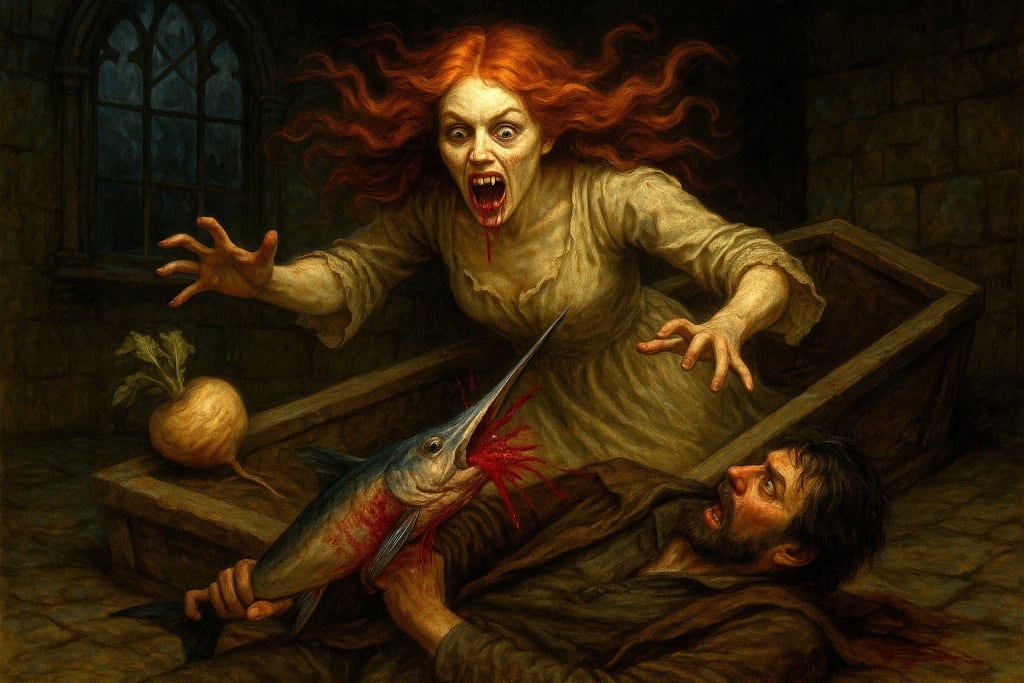
Once, in the long-ago time, when the world was younger, but still far from its childhood, a man, a lowly cotter, lived in the crumbling remains of an old keep, which had looked out over the hills and valleys since time out of mind.
No one now remembered the people who had once occupied this crumbling, cold old pile of stones, except that they had once been very great. Now, they were all but forgotten, and the villagers shunned the place, thinking it was either haunted, or, worse, cursed.
Now, cottars are usually wont to live in cottages on their master’s land, and toil from sunup to sundown in their master’s fields. But our cottar had long ago given up such foolishness, and abided in the crumbling keep, and worked not so bitterly nor so long as might be imagined.
One day, The Giant who lived in the forests pulled a turnip from the ground. He said, “This turnip can’t keep me company, so I’ll pitch it in the river.” On his way to do so, he was met by a witch, a crooked-nosed old thing that crept to The Giant’s boots, and whispered:
“Don’t throw away that turnip! Why, if it’s a child you’re wanting, it would be a perfect fit!”
And with that she raised her arms and—presto!—the turnip began to cry, and turned into a little baby, which the big stupid oaf cradled in his arms, tears streaming down his face.
“Oh, bless me! The Lord has smiled upon me and given me a baby girl, perhaps the finest little girl in all the whole wide world. Why, I need to name her! I think I’ll name her Twolip. For, certainly, even if she is bereft of everything and naked before the sun, she has two fine lips!”
And The Giant was so pleased with himself that he danced and kicked up great mountains of earth, so that the roads became impassable, and his tears of joy flowed like rain, and the people of the valley thought a flood must be coming, and fled to higher ground.
Now it came to pass that Twolip the Turnip Child grew to womanhood, and soon The Giant (quite old by then, but giants live a very, very long time) realized it was time for her to seek a husband.
“For,” said he, “I cannot marry her to a spider, a fly, a dray horse, an antelope, tree monkey, snail, or raccoon—so I must marry her to a living, breathing man.”
And so the Giant Twolip to go to yonder crumbling castle, where the lazy Cottar was idling, trying to figure out a way to get his bread and butter without breaking his back. Suddenly, outside, he heard a plaintive wail. Looking out the window, he saw in the castle courtyard the pale, beautiful figure of Twolip.
“Oh, sir,” she cried, “It is so cold, and the weather so foul, and I am so thin, and the storm surely approacheth. Could I not come indoors and warm myself by your fire, and be off in the morning, with none but ourselves and God any wiser?”
And so it was. Upon seeing his pale, freckled bride-to-be in the flesh, seated before him by the roaring blaze, he exclaimed:
“My! You are the prettiest thing of all the pretty things that ever were pretty! I shall marry you tonight!”
And so he summoned the Priest, and they summoned the Clerk, and he summoned the church (although that may seem out of order), and a wedding was had.
For many long nights and strange days, the happy couple happily went about their happy business. Twolip was neither a scold nor a layabout, but the Cottar was lazy as ever. One day, while she slaved over a hot stove, Twolip lamented:
“Oh, woe is me! It is my sorry fate to have such a lazy, good-for-nothing wastrel for a husband! He sleeps all day, his feet thrust upon the barrel, while I bake his bread, shine his shoes, iron his pot, and polish his cloak! Why oh why must he drain me so, squander our money, and be so utterly useless?”
The husband, being roused by his wife’s lament, went to her gingerly and said, “How art thee today, oh prettiest pet?”
And she replied, “Aye, I toil in the brambles, and thirst for a drop.”
The Cottar, not half liking this strange reply, asked again: “Oh, how art thee today, oh finest of wives?”
And she churned the butter and wept, saying, “I labor in the trenches, and hunger for hope!”
Now truly disturbed, the Cottar sidled up to her like a cautious cat and asked: “Oh, how art thee today, oh most lovely of ladies?”
And, a mad gleam glowing in her golden gob, she cried: “I uplift a broadaxe, and swipe at thee from Hell!”
With that, she produced an axe she had hidden in her skirts and swept the air before the Cottar. He fell back in terror and shock. She chased him round the room, up and down, under each window and over each lintel, until finally, seeing his opportunity, he grabbed a swordfish reeking on the counter, swooshed away a volley of flies, and impaled Twolip on the razor end.
She gasped, groaned, twitched, gulped, spat blood, spat bile, spat curses to an angry, unjust God, and, tearing out huge clumps of her hair with both hands, expired in a bloody heap.
And do you know what?
He slowly approached the bundle of bloody skirts. Amid the debris he saw no body—at least, no human body. Instead, he saw a single turnip. Curious, he thought.
And you may think this the end of the story. But you, dear reader, would be wrong. Wrong. Wrong.
The Old Witch (call her Malabog, perhaps, though she went by many names) was kissing the Devil’s ass one Walpurgisnacht evening, secure in the vast aerie of the Harz Mountains, on a night when the wind was bitterly cold. Then the Devil—Nick Scratch, Mephisto, call him what you will—told her:
“That turnip girl Twolip is no more. Aye, she’s been slain by her husband, the Cottar! Come, let us away, and we’ll bring her back from the worlds beyond, and have our revenge, a cold dish yet savory.”
So they went—Malabog, the Old Witch, cursing the Cottar, tearing her hair, letting out blasts of stinking wind—until they reached the graveyard where the remains of the turnip that was Twolip were interred.
The Devil commanded:
“Arise, arise, Little Sister, and shake the dream of death from your hair! Vengeance calls you from the river of time!”
The grave fell in, the coffin opened, and the clothes stood up—but only half the turnip was there (the foul Cottar had eaten the other half). Twolip flew forth on the night wind, her arms outstretched, her eyes gleaming wildly.
She flew to the crumbling keep, where the Cottar lay asleep. She tapped on the window so tippety-tight.
And the Cottar stirred, and he felt such a fright.
The windows were covered with sash, don’t you know,
And he faintly could see by the moonlit glow.
And Twolip was licking her lips from without,
And the Cottar felt terror and started to shout.
Round windows and doors she chased him three times,
Until, finally, she rose up through floorboards and rimes.
And leaping astride him, she sank in her fangs,
And drained him of blood from the depth of his veins.
And so the old saw was proven as true:
You can’t get blood from a turnip—
But it can get blood from you.
Later, The Giant took the body of the Cottar and, having stripped down the branches and leaves from an old dead tree, sharpened the trunk to a razor point, and thrust the Cottar’s body atop it. There it sank, inch by miserable inch, until the crows came and pecked out its eyes.
Unhappily Ever After.
About the Creator
Tom Baker
Author of Haunted Indianapolis, Indiana Ghost Folklore, Midwest Maniacs, Midwest UFOs and Beyond, Scary Urban Legends, 50 Famous Fables and Folk Tales, and Notorious Crimes of the Upper Midwest.: http://tombakerbooks.weebly.com
Allocating for Prosperity: How Strategic Asset Allocation Fuels Enduring Wealth
Strategic asset allocation forms the foundation of long-term wealth creation because it determines how investors distribute capital across major asset classes. Rather than chasing short-term market trends, this approach establishes a structured mix of equities, fixed income, real assets, and other investments that aligns with clear objectives. Therefore, investors who commit to strategic allocation create a roadmap that guides decisions through changing economic conditions.
By Winston Feng3 days ago in Chapters



Comments (3)
Beautiful piece!
This piece masterfully explores transformation and retribution, using absurdity to reveal deeper truths about greed, laziness, and the uncanny nature of consequence. The turnip becomes an unforgettable symbol, both comic and horrifying.
Very disturbing...horror for the appreciative...i avoid it at all cost...mostly. read with one eye closed.