
The Raging Sea
Poe, Shelley, Stevenson, and the Tumult Within the Shadow-Self

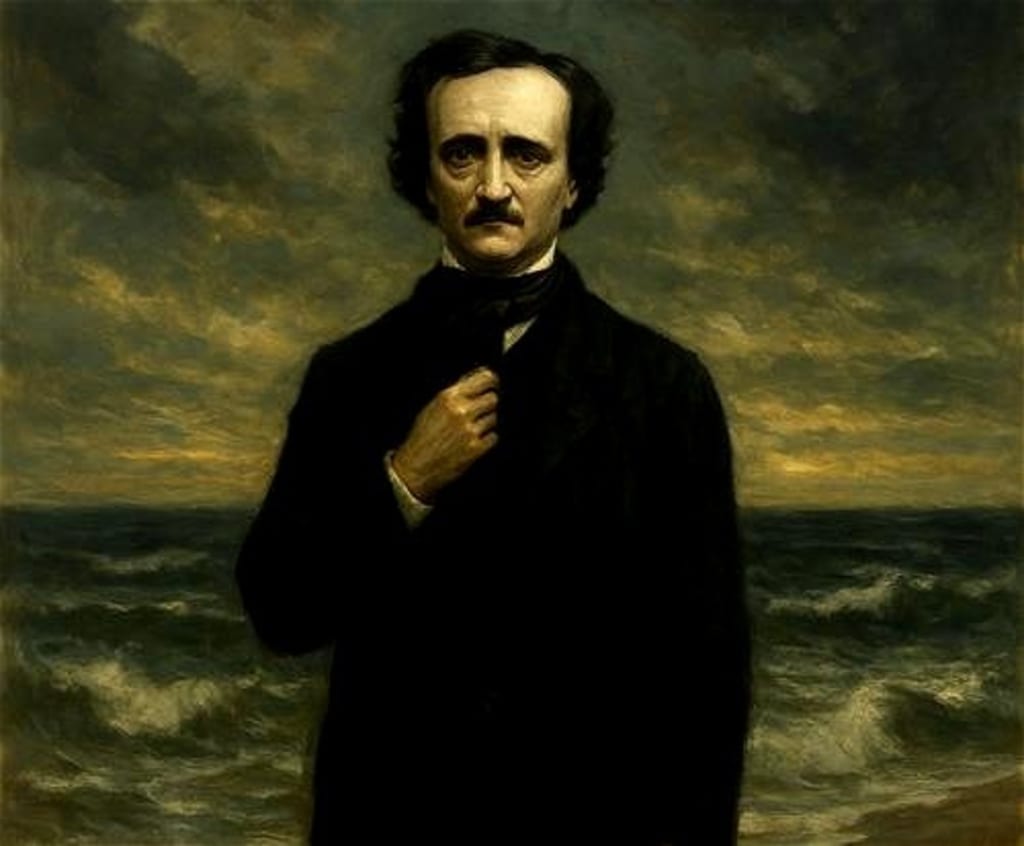
Note: Below is the foreword to a book of literary essays on Poe.
What Waits Below
Robert Walton looks out upon the raging sea, willing it to deliver him to its final bosom of truth: that a sea lane can be forged to the South Pole, to Antarctica, amid the deep and limitless fields of deathlike, slumbering ice.
To this end, in Frankenstein, he communicates with sister Mrs. Saville (the initials of Mary Shelley) and speaks of childhood cantrips and deep desires to learn and know the secret, hidden things that lurk beneath the "truths" we miscall our lives. Something burns within him, a fire that Prometheus and the gods themselves forged in black, perhaps forging together the avatar, image, effigy of burnished bronze amid the fiery forges of Mulciber, Hephaestus who hammered together an image of man called Talos... who cursed his fate for being not one of us.
But all of that is a bit much, perhaps.
What's Done in the Dark
All horror is done in darkness. We drench our shadow-selves in the blood of our victims, imagining vast murders and fields of broken forms. The grave yawns like an all-consuming mouth below us. Our realization that we live on the cusp of eternal night—that the shadow, the darkness, can descend not even slowly, but instantaneously, in the literal "blink of an eye," seeing this "real world" blink out as unconsciousness or the Void consumes us—well, that is a realization few like to contend with. It emerges, like a zombie creeping from a vaulted tomb, in our nightmares: the submerged bestial that dwells within us, hungry; never sated. Mired in ignominy and cast away from Jehovah God, our cosmic father, the Center of All That Is.
Dracula drinks blood because he cannot attain salvation—human blood is digestible for a creature who is eternally thirsting for the Blood of Christ, which he has been denied. So he navigates a "living death," a state of spiritual suspension, as a predator, battening on men and women in an eternal half-life wherein no salvation can be accorded him.
By contrast, in Frankenstein, the Creature is born from the bits and pieces of death—the mockery of birth and life apparent in the motherless bastard who seeks woman, woman, everywhere as companion. He is denied this, for he is a thing reeking of death, consumed by hate, and malignant. Not born of the womb of earthly woman, he is a soulless living revenant; alienated from Father Victor, and fueled by the fury of his godless form, he attempts to forestall and then destroy the happiness of Victor—to erase his symbiotes and finally to terminate his marriage, his transformative ritual of selfhood.
This is Victor's beast nature, born of death, stinking of rot, brought forth by the Promethean god-fire. In the film version of Frankenstein (1931), it is the lightning bolt of Jove—who birthed Pallas Athena from his head—the splitting paramecium of thought, the divided self of an Ego, or the dissolution of same.
Frankenstein, Dracula, the triumvirate completed by Mr. Hyde, and our legends of the Werewolf—the beast within. Mankind is filthy, his fingers stink of death. The Creature is born of death, and Dracula is awash in death, swimming in an ocean of blood to seek the salvation he will never find. For Dracula, each gallon of human blood quaffed forestalls the doom that is his curse and comeuppance; it wards off the veil of decay from his ancient, undead form.
Mr. Hyde is the collision of science and bestial demonolatry: bridging the "gap in man's divided nature" (a line from the popular occult-themed television show Dark Shadows, from the 1960s), he emerges as a detestable being who is described as hideous for a reason others cannot quite isolate or determine. His cursed lack of salvation, the concentration of his evil, is like an aura or scent that others detect, but can never quite identify.
He emerges from a back entrance to Jekyll's home (subconscious), is first identified by Enfield, the friend of Utterson (duality of intellect), and tramples in the street a child (innocence, virginal purity) without a fillip of remorse. He's all Id, and the bestial rears its head in this gothic trope as the shadow-self emerges from its subterranean swim.
Our werewolves wear the form of man, but howl at the primal Moon and emerge in fur and fangs to go about the night as upright predators, consumed by the beast nature, raging within—their turbulent malice giving vent to murder. In history we have the examples of Peter Stubbe, Sawney Beane, Peter Kürten, and our modern spate of serial killings as what happens when the beast within springs without. It lurks in a world of shadow; of dying, dead illusion, darkness, and dreams.
What Waits Below
And then we turn to Edgar Allan Poe, whose melancholy, grim shadow presages the multifarious scribblings of so many dark and troubled dreamers striding gloomily across the floorboards of time.
Like Frankenstein's Robert Walton, Poe also stared out at "the raging sea," but saw a very different image—one wherein what waited below was the maelstrom-inducing pandemonium of accursed spirits, the "demons down under," who waited, brooded, representative of that dark, accursed place mankind dare not look, lest he see the withered, stitched-together form of the Death Man, the Creature, the bloodsucking nightmare of the royal and damned Count Dracula; the odiousness of Hyde or the hairy hides of so many snarling, growling Men Into Wolves.
All men are killers, or potential killers. To survive life is to partake in death, as all things must consume other things to preserve themselves. Our time upon this Earth is temporary, and, as far as we know, for some, can blink out in an instant. An instant—and, such as Poe's "Conqueror Worm" suggests, "the play is the tragedy, Man, and its hero..." But you must know the rest, otherwise you would not be here.
"The Conqueror Worm" brings us the world in the metaphorical dream-state of a theater piece, expositing our cosmic and comic tragedy as we see the "Mimes, in the form of God on high, mutter and mumble low," and the final act of the black drama ends in the belly of a monstrous worm—the last cruel jest of a shadowy, inscrutable and capricious God.
By contrast, in "Annabel Lee," the narrator laments the loss of the innocent, virginal "Fair One," whose youth and beauty represent an ideal state, her decaying body a gateway of unification with the cosmic center of rebirth, renewal—the Universal Father, perhaps. Poe, who, by modern standards, would be considered a sexual deviant or even pedophile, was eternally searching in death—in his succession of deathlike and dead women, revived (Madeline Usher, Annabel Lee, Berenice, Morella, Ligeia, on and on)—a gateway to the Sacred Place of purity, the healing dissolution of shadow and death, an escape from the falling curtain of blackness promised by the corruption of the grave, the shadow of The Raven, from whose soul the narrator of that particular poem shall be lifted, "Nevermore!"
"The Premature Burial" opens wide the charnel houses and deep, stinking burial vaults of the world, and reveals for the Reader the hungry, gnawing worms and flyblown forms in their damp, stinking shrouds. "The Red Death held sway over all," as Prince Prospero is brought down to his much-deserved, self-created end. All revelry ceases, and the partiers "perforce cease their perambulations."
Inside the tomb, the mind of man that reels from the thought of his own inevitable, inexorable extinguishment is The Beast. It is the killer of "The Black Cat" and "The Imp of the Perverse." The Raven (Death) is born from the bust of Pallas, who was likewise born from the head of Zeus. Is life, and by extension, death, born from the mind of man, a product of his self-deluded consciousness? Who is the Perceptor, and who is the Perceived? Could they be not one and the same?
A Dream Within
In "A Dream Within a Dream," Poe laments the passage of time, comparing his fingers and the sands of the beach flowing forth, obliquely, to an hourglass, and noting that, as time runs out, as the ocean churns, the tide rolls in, and death awaits, he must ask: "Is all that we see, or seem, but a dream within a dream?"
If the lights can be extinguished suddenly, then what "reality" can we rely upon? What can be said, with certainty, to be a stable, safe, sound, and tranquil harbor wherein we can moor our vessels? Annabel Lee and Poe's child-bride Virginia Clemm must have loomed, as ghosts of a bright and airy yesterday, as large as sunrises against the encroaching night—his own dissolute soul mired in the impoverished, terminal, self-destructive spiral that was his fate.
His shadow-self roared beneath the rising tide—his self-destructive demon "down under the sea," surfacing above the water like H. P. Lovecraft's Great Cthulhu, the demon from angled spaces between, the place hauntings emerge from with ghostly tread, to trouble the mind of the dreamer out of time.
But we've said enough. The sands have crept through the fingers of Poe, and Time has revealed itself as the wanting, weeping illusion of our own damnable will toward annihilation—to be free of the guilt.
Exploring the seas we are, such as Walton, to find ourselves, our death, and our damnable beast, amid the dark and troubled waters of the soul.
***
Edgar Allen Poe Audio Playlist
Connect with me on Facebook
About the Creator
Tom Baker
Author of Haunted Indianapolis, Indiana Ghost Folklore, Midwest Maniacs, Midwest UFOs and Beyond, Scary Urban Legends, 50 Famous Fables and Folk Tales, and Notorious Crimes of the Upper Midwest.: http://tombakerbooks.weebly.com
The Cave Part 6
If you have ever heard a tale about yourself that you cannot remember and doubtless think is made up, you will know how I felt when Tharkin related all that the eagle had seen of me before my memories were scattered. Of far distances and traveling companions that I did not recall, camping out under the stars and making our way to the mountains with deliberate purpose. The great bird had lost contact with my party once we entered the forests, and the seven other members were not seen again by him or his brethren since.
By Jamye Sharp14 days ago in Chapters
What impact could the death of Iran's Supreme Leader have on the Muslim world?
Following the killing of Iran’s Supreme Leader Ayatollah Ali Khamenei in US and Israeli attacks, Iranian President Masoud Pezeshkian said in a message that “this great crime will be answered” and that “with all our strength and determination, and with the support of the Muslim Ummah and the free people of the world, we will make those responsible for this great crime regret their actions.”
By Real contentabout 19 hours ago in Chapters
Flower Bloom 369
FLOWER Bloom 2/25/26 Wednesday By Mariann Carroll Karen had been with Tony for 7 years. Tony started acting strangely after her surgery. He would mow the lawn in the rain and be on his cellphone. He started pushing Karen away. Tony came clean about seeing someone. Karen moved out two months later. Karen moved in with a friend. She felt betrayed.
By Mariann Carroll4 days ago in Fiction


Comments (1)
You've got some deep stuff here. The bit about horror in darkness really hits home. I've felt that unease when the shadow seems to close in. And Dracula's plight adds another layer of creepiness.