
The German Gold Miner
A Journey of Greed, War, and Redemption

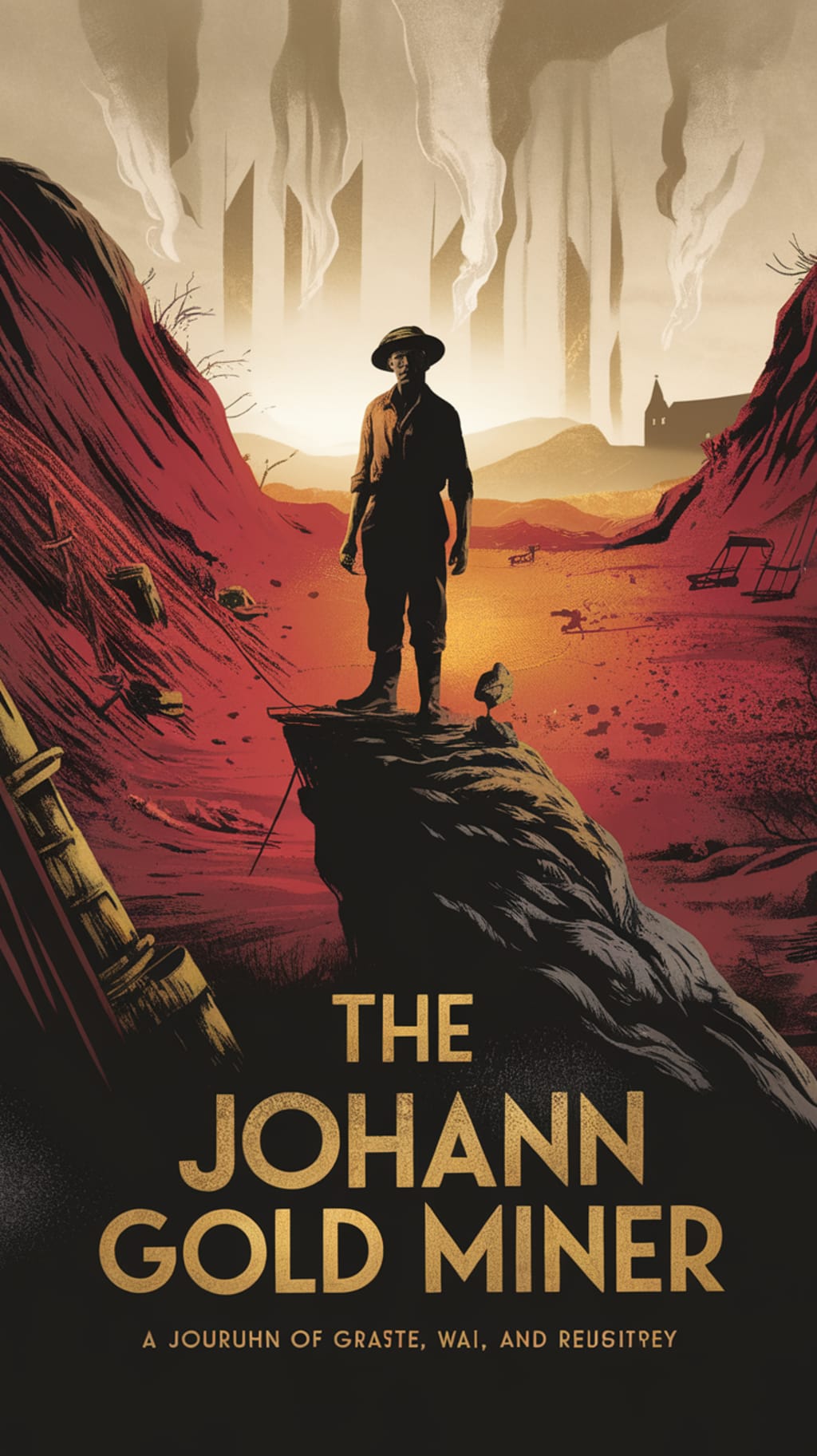
In the shadowed years following the First World War, a man named Johann Richter boarded a rusting steamer bound for South Africa. He carried with him a single trunk, a weathered leather journal, and a dream that glittered like the gold he sought beneath the African soil.
Back in Germany, Johann had been a mining engineer—precise, disciplined, and respected. But the war had changed everything. His brothers were buried under foreign soil, his family estate reduced to ashes, and his country crumbled by debt and division. There was nothing left for him but a promise he had made to his father on the man’s deathbed: “Find something worth living for, Johann. Don’t let war define you.”
He followed the whispers of fortune to the rugged hills of the Transvaal, where the mines were rich and deep and the rocks held the dreams of desperate men. There, in a makeshift mining camp, Johann began his search—not just for gold, but for something that might anchor him to life again.
The sun beat down without mercy, and the land was wild, beautiful, and unforgiving. Every day, Johann descended into the earth, following seams of quartz and listening to the walls of rock like a man listening for secrets. The work was brutal—hands blistered, lungs choked with dust—but he worked with the precision of a soldier and the silence of a ghost.
The camp was filled with men like him: broken, ambitious, and afraid to go home empty-handed. Among them was a young British orphan named Elias Quinn, barely eighteen, with a crooked smile and a silver tongue. Elias attached himself to Johann, offering help with supplies, watching how Johann worked, and slowly becoming the closest thing to a friend Johann had allowed himself in years.
“You don’t talk much, Herr Richter,” Elias said one evening over a fire. “But you mine like a man with a purpose.”
“I mine like a man who has nothing else,” Johann replied.
As weeks turned to months, Johann and Elias dug deeper into the belly of the earth, and their partnership grew. One evening, Elias stumbled upon a vein of gold so rich it shimmered even in the weak candlelight. They stared at it in silence—awed and terrified.
“This is it,” Elias whispered. “We’re rich.”
Johann nodded slowly, but he felt no joy. Only dread. He knew too well what gold did to men.
They kept the discovery a secret, returning night after night to extract it quietly, hiding their yield in an abandoned shaft Johann had reinforced years ago. But gold, like blood, has a way of seeping into the air. Others began to notice their absences, the nervous energy that clung to Elias, the new tools Johann purchased in town.
One night, their secret died with a scream.
A fellow miner, driven by suspicion and greed, had followed Elias into the mine. What happened in that darkness remained unknown, but Elias returned alone—blood on his shirt, panic in his eyes.
“I didn’t mean to,” he gasped. “He saw the gold. He pulled a knife. I—I pushed him. He fell. I think he’s dead.”
Johann stared at him, heart pounding. They were no longer just miners. They were fugitives.
They buried the gold in a series of oil drums sealed with pitch and hidden beneath the floorboards of Johann’s shack. Then they waited. But justice in the camp was swift and lawless. Within days, suspicion grew. Someone had seen the blood, someone had heard voices.
By the end of the week, Elias was gone. He vanished in the night, leaving only a note scrawled on a torn page from Johann’s journal:
“I’m sorry. I can’t live like this. I’m going to Rhodesia. Keep my share safe.”
Johann didn’t sleep for days. He burned the note, buried the rest of the journal, and sat by the drums of gold like a sentry.
Years passed. The camp thinned out, and new faces came. Johann remained, aged and silent, known only as the strange German who never left the hills. He refused to sell the gold. He never mined again. People said he had lost his mind—or worse, that he had found something in the earth that had cursed him.
But the truth was simpler. Johann had realized the gold was cursed not by magic, but by memory. Every ounce reminded him of a boy’s panicked eyes and a body buried in darkness. The treasure he once saw as salvation had become his prison.
Then, one cold morning in 1935, a man walked into the camp.
He was older now, weathered by time and distance, but Johann recognized him immediately—Elias. He wore a worn jacket and carried a heavy rucksack.
“You kept it,” he said, quietly.
Johann didn’t reply. He simply pointed to the trapdoor under the stove.
They sat in silence, the gold between them like a ghost.
Elias spoke first. “I’ve done things I regret, Johann. But I came back to do one thing right. Let’s dig it up, divide it, and bury the past.”
Johann looked at him with tired eyes. “There’s no dividing guilt. I stayed to carry mine.”
But in the end, they unearthed the drums. The gold had not tarnished. It gleamed like it had the day they found it. Together, they loaded it onto a mule cart and brought it to the nearby mission church. There, under the eyes of a stunned priest, Johann made the decision that had eluded him for years.
“We want this gold to build something. A school. A hospital. Anything but graves.”
The priest nodded slowly, hands trembling.
Word of the donation spread. No one quite believed it. Some said Johann had lost his mind. Others said he’d found his soul. But the mission was built, and the school followed, and the gold that had once divided men began to unite lives.
Johann never left the hills. He died quietly years later, buried beneath a stone that bore no dates—only the words:
"He found something worth living for."
About the Creator
Keep reading
More stories from Muhammad Asad and writers in Chapters and other communities.
Together We Live
The world had never felt smaller, yet more connected, than it did in the small, tucked-away town of Ansel’s Grove. It wasn’t a place most people had ever heard of. A quiet, almost forgotten part of the world, it was tucked between a range of towering hills and endless stretches of forest, the kind that seemed to swallow up any sound or sign of life. The town’s population hovered around three thousand, a place where everyone knew everyone, and life moved at a pace that allowed you to breathe, to think, to really live.
By Muhammad Asad11 months ago in Chapters
Valentine's Dates Over the Years
Colin grinned as Brooklyn slipped into the living room. “Is it all set?” he asked. The twenty-one year old grinned. She was in her last year of college and Colin knew that Lincoln was proud of her. Although she had been away at college, she’d eagerly helped Colin plan his surprise for Lincoln. “I’m so glad you’re finally doing this,” she said.
By Reb Kreyling25 days ago in Chapters
“Boots” — The Hidden History of Gay Soldiers in the U.S. Military
For much of American history, gay men and women have worn the uniform of the United States with courage and distinction — yet in silence. Their stories, often erased or deliberately concealed, form a powerful and complex chapter in the evolution of both the U.S. military and LGBTQ+ civil rights. From criminalization and dishonorable discharges to the controversial “Don’t Ask, Don’t Tell” policy and eventual full inclusion, the hidden history of gay service members reflects a broader struggle for dignity, recognition, and equality.
By Irshad Abbasi 7 days ago in Chapters




Comments
There are no comments for this story
Be the first to respond and start the conversation.