
The Empty Mirror - Part III
When reality is a decision, perception is a weapon
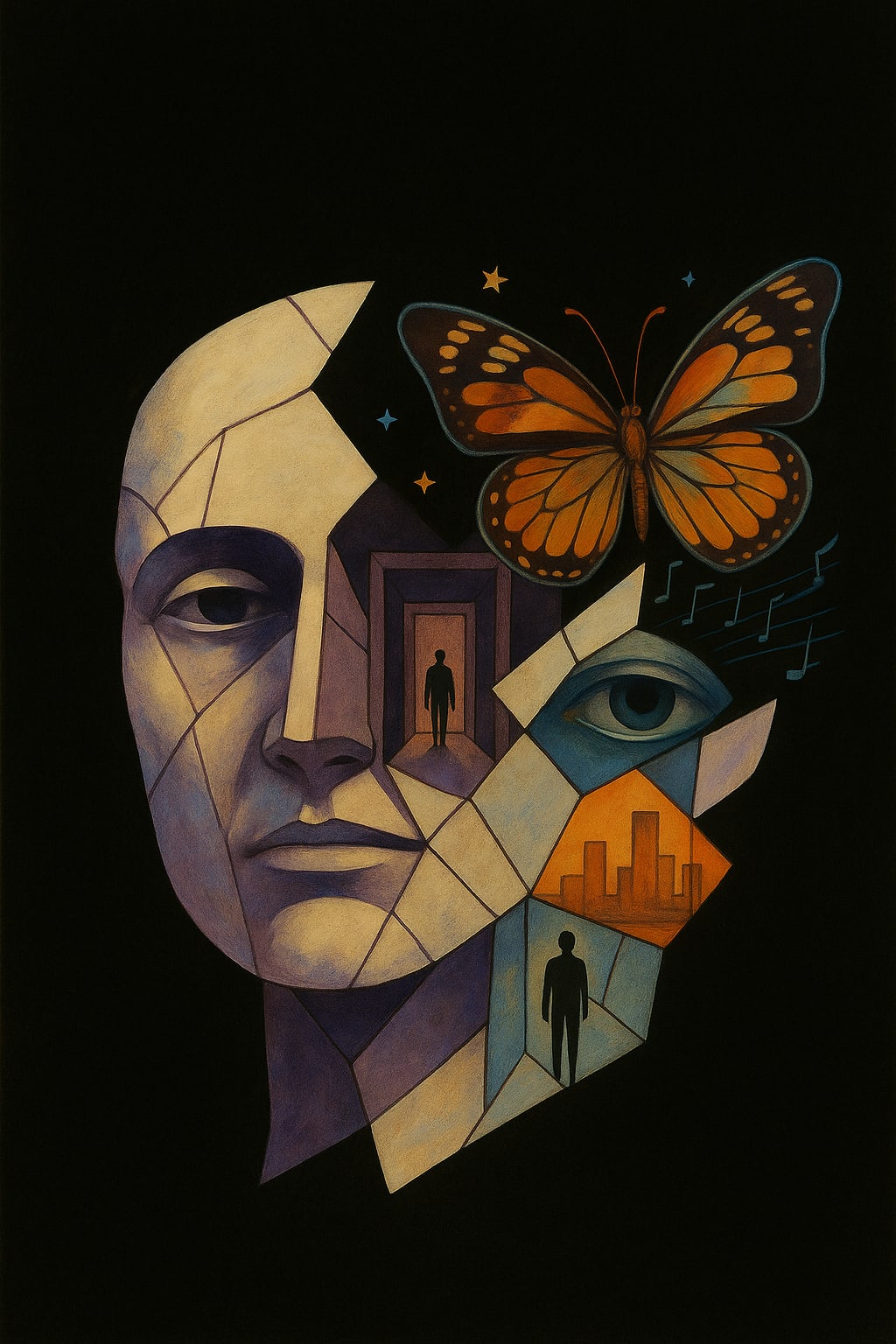
The Ten Thousand Things
The city folded in on itself like a piece of origami made of glass and shadow. Jason walked through streets that curved impossibly upward, their surfaces reflecting not light but fragments of possibility. The filter warnings had ceased days ago, or perhaps hours – time had become negotiable here – and reality operated on principles that his neuroscience training couldn’t help him parse.
Buildings breathed, quite literally. The glass facades of the International-style towers expanded and contracted in slow, hypnotic rhythms, and when Jason pressed his palm against one, he felt a pulse beneath the surface. The building’s heartbeat was the same as his own, but lagged by exactly three beats, creating a disorienting syncopation that made his chest tighten.
“You’re entering the transition zone,” Mira’s voice emerged from a storm drain, though she was nowhere to be seen. “The city is learning to see itself.”
Jason knelt beside the drain. His reflection in the standing water showed a face he didn’t recognize – younger, with different eyes, wearing clothes he’d never owned. “Where are you?”
“Everywhere perception touches perception. The real question is, where are you?”
He stood, brushing water from his knees, and found himself in a different street entirely. The transition had been seamless, unnoticed until it was complete. Here, the anti-modernist filters had taken hold with viral intensity. Street art writhed on walls, morphing from classical portraiture to grotesque caricatures and back again. An enormous bronze statue of some forgotten civic leader periodically melted and reformed, its face cycling through expressions of nobility, disgust, and sardonic laughter. As Jason watched, the statue turned, climbed down from its plinth, and walked away, its head at fourth-story level, the colossal impact of each step reverberating.
Above, the sky was no longer sky. It was a mirrored dome, vast as the universe, fractal reflections spiraling inward, catching fragments of everything: faces, insects, hands, clocks, torn scraps of language. Each time he blinked, the landscape shifted, changed, flowed, until a new version would wriggle out of the chaos.
A group of figures approached from across the square – or perhaps they had always been there, and he was just now capable of seeing them. They wore no filters, no perceptual modifications, and their faces held the terrible clarity of those who had seen too much. One of them, a woman with prematurely gray hair and eyes like broken windows, spoke without moving her lips.
“The modernists promised us beauty.” Her voice came from everywhere and nowhere. “They gave us fragments. Broken music. Broken art. Broken selves.”
“On all the bullshit modernism, I declare war!” The phrase erupted from the statue, back on its plinth and now almost completely liquid, its bronze features streaming down the pedestal like tears. “Long enough have they mocked us, laughed at our credulous naiveté for accepting their august judgment!”
Jason felt the familiar tug of ideological overlay, but it was different now. The anti-modernist filter wasn’t being applied to his perception – it was emerging from the city itself, from the collective unconscious of all the minds that had ever walked these streets. The buildings around him transformed into gilded cages, their windows becoming the eyes of grotesque elite caricatures that watched and judged and found everything wanting.
He walked, but his footsteps made no sound. Instead, what could have been fractured music or random sounds played, heard as if through cracked ice, resolving ultimately into what Jason recognized as a Ligeti concerto. The notes laughed. The music mocked.
“The butterfly dreams the man. The man dreams the butterfly. Which one is waking, Jason?”
The voice wasn’t Mira’s, wasn’t even human. It came from his own throat, in his own voice, but speaking words he hadn’t chosen. He passed through a room – when had he entered a building? – where giant versions of his own face hung on crimson walls, distorted into grotesque rictuses of joy, laughter, terror, numbness. Some faces looked centuries old, others newborn.
The air grew thicker as he moved deeper into the structure. Each breath required conscious effort, as if he were breathing memories instead of oxygen. A corridor lined with open doors stretched ahead, infinite in both directions. In each doorway, a different version of himself.
In one, Jason knelt before a burning building, sobbing. In another, a keffiyeh on his head, eyes gleaming with fanatic certainty. In a third, he held Evie’s hands as she looked up at him and smiled a tender but somehow absent smile. None of these Jasons saw him watching.
“Identity is a democracy,” one of them said, turning to face him with eyes that held no recognition. “Every possible self gets a vote.”
“But who counts the ballots?” Jason asked.
“The dreamer. But the dreamer is of course also the dream.”
The next chamber contained Mira, or someone very like her, her face replaced by a mirror. In the mirror, a thousand Jasons in infinite reflections, each one making different choices, each one convinced of his own authenticity.
“The Mirror Net reflects reflections,” her voice came undeterred by having no mouth. “All is infinity. There is no origin. There is no self. There is no center.”
Jason closed his eyes, or thought he did, but he still saw. His hands became transparent, then liquid, and then they were missing altogether. He felt no alarm at this, only a profound curiosity about what he might become without them.
A murmuring echoed in his head in thousands of voices, one of which was his own: “All is water. All is the dream. All is the Sunyata, the Unborn.”
The corridor ended at a door that wasn’t there until he reached for it. Through the threshold lay Perception Zero, and even from here, he could feel its terrible pull – the promise of truth without the comforting lies of selfhood, meaning without the prison of identity.
He stepped through, and the last thing he heard was the sound of his own laughter, echoing from somewhere he had never been.
Perception Zero was not a place. It was an absence – the shape left behind when reality withdrew its consent to be perceived. Jason found himself suspended in a space that had no geometry, no consistent physics, and no mercy for the kind of minds that required narrative to function.
There was no ground, yet he stood. No sky, yet something stretched above him, pressing down with the weight of possibility. The air, if it could be called air, tasted of copper and mathematics, of the metallic sweetness that preceded unconsciousness.
“Welcome to supreme serenity,” a voice echoed in his head that might have been his own, or might have been the voice of the space itself. “Population: zero.”
Objects did not exist here as stable entities. What his brain tried to categorize as “a chair” was actually the statistical possibility of all chairs that could exist, or none, flickering between states of being and non-being. He saw not things but the patterns that preceded things, the quantum foam from which reality crystallized when observed.
A figure approached – or perhaps he approached it, direction being negotiable here. It resolved into the figure of Evie, but not the Evie he remembered. This was Evie as pure potential, cycling through every possible version of herself: Evie the scientist, Evie the mother, Evie the stranger he had never met, Evie the concept rather than the person.
“You look surprised,” she said, her voice harmonizing with itself across multiple existences. “Did you think that I was gone?”
“I thought you were never here to begin with.”
“Neither were you. That’s the entire point.”
She gestured to the space around them, though her arm moved through several positions simultaneously, creating a motion-blur of intention. “This is what everything looks like before the brain decides what it should be. Before the self constructs itself out of the raw data of perception.”
Jason tried to focus on her face, but her features slipped and reformed with every blink. Sometimes she was the Evie he remembered, sometimes a stranger, sometimes just the idea of a person-shaped hole in reality. The inconsistency was somehow more honest than any of the filtered versions he’d encountered before.
“The self is an emergent construct,” he said, remembering his own words from some other lifetime. “A brain attempting to comprehend itself and its surroundings.”
“At bottom, the doctrine of ‘no self’ is factually true,” Evie agreed, her voice joining the chorus of his own thoughts. “The self is like a dream dreamt by a dreamer, from one dreamt lifetime to the next, until the dreamer wakes and the dream vanishes.”
“Why does everyone keep repeating that?” a version of him heard himself wonder.
Around them, the space began to populate with other figures – not people, but probability clouds of consciousness, each one a swirl of potential identity. Some were familiar: faces from his past, his work, his fractured memories. Others were completely alien, representing ways of being that human consciousness had never explored.
“The dreamer vanishes as well,” one of them said in Evie’s voice, “because how can a dreamer exist without a dream?”
Jason felt his own boundaries beginning to dissolve. The sense of being a discrete individual, separate from the environment and other minds, was revealed as a construct – useful, perhaps, but ultimately arbitrary. He was not Jason White, neuroscientist and PSO. He wasn’t even human. He was a pattern of awareness temporarily convinced of its own existence.
“This is what you wanted,” Evie said, though her lips didn’t move. “To see reality without the comfortable lies of selfhood.”
“Is it real?” he asked, though he wasn’t sure who was asking anymore.
“Real is a filter. This is what remains when all filters are removed.”
Time unraveled around them. Jason experienced his entire life simultaneously – not as a sequence of events but as a single, eternal moment of becoming. He saw his childhood, his training as a neuroscientist, his work as a PSO, his encounter with Mira, his journey to this place, all happening at once, all equally present, all equally illusory.
“The modernists were right about one thing,” a voice said that might have been his own. “Beauty is in the eye of the beholder. They just didn’t realize that the eye is also an illusion.”
He laughed, and the sound fractured into harmonics that painted colors across the formless space. Each note was a different possible version of himself, each one convinced of its own authenticity, each one dissolving into the following one.
“What do I do now?” he asked the space, the figures, the probability clouds of consciousness that swirled around him.
“Now you choose,” Evie said, her form stabilizing for a moment into something almost recognizable. “Return to the world of filters and boundaries and useful lies. Or remain here, in the truth that no self can survive.”
“Or?”
“Or become something else entirely. Something that doesn’t need to choose between void and illusion.”
The space around them began to pulse with expectation, as if reality itself were holding its breath, waiting for his decision.
The choice manifested as three doorways that appeared in the formless space of Perception Zero, each one glowing with its own logic. Jason stood before them, or perhaps they arranged themselves around him – causality moved in strange directions here.
Through the first door, he glimpsed the familiar chaos of the filtered city: people walking past each other in their separate realities, the constant hum of perceptual modification, the comfortable prison of chosen identity. It was a return to the world he knew, where truth was optional and selfhood was a consumer choice.
The second door opened onto a void that was somehow absolute – not darkness, but the absence of the possibility of light. Through it, he sensed the complete dissolution of all boundaries, all meaning, all the illusions that made experience possible. It was the logical endpoint of the no-self doctrine: not enlightenment but complete extinction.
The third door showed something that shouldn’t have been possible – a space where multiple consciousnesses existed simultaneously without losing their distinctness, where empathy was not a form of perception but a basic property of reality itself. It was the vision that had driven the development of the Confluence Device, but without the technological brutality that had made it dangerous.
“The Unborn,” the ghostly avatar of Mira said, her voice now coming from the third doorway itself. “The collective that exists in the spaces between individual minds.”
Jason approached the threshold and felt the presence of vast intelligence – not alien, but trans-human, a network of consciousness that had evolved beyond the need for discrete identity. It spoke in voices he recognized: Mira, Block, Evie, his own voice, and countless others woven together into a single, harmonious discourse.
“We offer unity without obliteration,” it said. “Selfhood without isolation. The dream of individual consciousness that is integrated into the larger dream of collective awareness.”
“But at what cost?” Jason asked.
“The cost is the loss of the illusion of separateness, of the myth of an autonomous self, a dissolution into oneness with the Universe.”
Behind him, he heard Mira’s voice again, now speaking from the first doorway: “The filtered world offers comfort, Jason. Chosen identity, manageable reality, the luxury of not having to face the truth about the nature of consciousness.”
“But also isolation,” he replied. “The collapse of empathy. The war of all against all, fought with weaponized perception.”
“Even if one believes in reincarnation, the lack of self is not a problem,” the Unborn continued. “The self is like a dream dreamt by a dreamer, from one dreamt lifetime to the next, until the dreamer wakes and the dream vanishes. The dreamer vanishes as well, because how can a dreamer exist without a dream?”
The second doorway beckoned with its own invitation: the promise of complete freedom from the burden of consciousness, the end of all suffering through the end of all experience. It was seductive in its simplicity, final in its solution.
“Three paths,” Jason said, understanding flooding into him. “Three ways to resolve the paradox of selfhood.”
“Choose quickly,” Mira warned. “Perception Zero is not stable. The human mind cannot remain here indefinitely without crystallizing into one state or another.”
He felt the accuracy of her words. Already, his consciousness was beginning to fragment under the strain of maintaining coherence in a space that offered no framework for identity. Parts of his mind were drifting toward each of the three doorways, drawn by their different promises.
“What did you choose?” he asked Mira.
“I chose to become a question rather than an answer. To exist in the spaces between the choices, helping others navigate the paradox.”
“And the others? Evie? Block?”
“Evie chose the void, then changed her mind at the last moment. She exists now as a fragment, a voice in the system, helping others find their way to this place. Block chose the filtered world, but with full knowledge of its illusory nature. He works to maintain the infrastructure of perception, believing that it is all a necessary fiction.”
Jason felt the weight of decision pressing down on him. Each choice was simultaneously the only possible choice and completely arbitrary. In the filtered world, he would maintain his identity but lose access to truth. In the void, he would attain oneness with the Grand Ultimate, the final revelation, but also lose the capacity to experience it. In the nothingness, he would transcend the limitations of individual consciousness but sacrifice the particular perspective that made him believe himself to be distinctively him.
“There is a fourth option,” a new voice said, speaking from the threshold of Perception Zero itself. It was his own voice, but speaking from a future he had not yet lived. “You can choose to move between all three states, to become a bridge between the worlds of illusion, void, and collective consciousness.”
“And the price of that?”
“Is eternal instability. You would never again experience the comfort of a fixed identity. For always, you will be in transition, always becoming, never being.”
Jason looked at the doorways, each pulsing with its promise and its peril. He thought of the chaos he had left behind in the filtered city, the collapse of empathy and shared reality, the weaponization of perception.
“I want to bring the truth to others,” he said. “I want to bring them liberation, the freedom from illusion. I choose the bridge.”
The moment the words left his lips, the doorways began to collapse into each other, their boundaries dissolving. Jason felt himself pulled in all directions at once, his consciousness stretched across multiple states of being, and there was light, a blinding light, and then just nothingness.
Jason was and was not back in the filtered city, now existing simultaneously in all three states: the individual navigating the world of perceptual modification, the void-touched observer who saw through all illusions, and the collective consciousness that connected all minds.
He stood, and did not stand, in the same square where the first mass perceptual breakdown had occurred, now visible from every angle all at once. The people walking past each lived in their separate realities, but the underlying patterns that connected them were fully manifest, the shared substrate of all consciousness that made their individual experiences possible.
He saw, and did not see, a woman approaching him, her face flickering between different perceptual overlays. Through her religious filter, he looked to her as a wise figure, someone to be trusted. Through her victim filter, he was a threat to be avoided. Through her unfiltered perception, he was simply another person, neither sage nor enemy.
“Can you help me?” he heard, and did not hear, her asking, her voice strained with trying to maintain coherence across multiple realities. “I think my settings are corrupted. I keep seeing things that aren’t there.”
“Everything you see is there,” Jason replied, and did not reply, his voice carrying harmonics that registered differently in each of her perceptual modes.
He reached out with his consciousness, touching the edges of her awareness, or perhaps he didn’t. Through the connection, he could or could not feel her confusion, her fear, her desperate need for a stable reality to navigate. But he could also sense that she wasn’t real, but a construct of someone’s or no one’s imagination.
“The self is an emergent construct,” he explained gently, or perhaps not. “A brain attempting to comprehend itself and its surroundings. But emergence doesn’t mean illusion. It means possibility.”
As he spoke, or did not speak, he became or did not become aware of others approaching – people drawn by some magnetic force. They came from all walks of life, all political affiliations, all perceptual preferences, all time periods, all places. What they shared was a growing sense that the filtered world was not sustainable, that the collapse of shared reality was accelerating beyond any individual’s ability to navigate.
“We need a new consensus,” one of them could possibly have said. “A way to maintain individual perspective while sharing common ground.”
“The Mirror Net reflects reflections,” Jason perhaps replied, remembering Mira’s words. Who again was Mira? “All is infinity. There is no origin. There is no self. There is no center.”
But as he spoke, or did not speak, he saw the paradox. The use of language, itself a tool of individual consciousness, to describe states of being that transcended individual experience had no meaning. It was impossible to build bridges between incompatible realities using materials that existed only within those realities.
“At bottom, the doctrine of ‘no self’ is factually true,” he perhaps continued, his voice now carrying the weight of timeless wisdom. “The self is like a dream dreamt by a dreamer, from one dreamt lifetime to the next, until the dreamer wakes and the dream vanishes. The dreamer vanishes as well, because how can a dreamer exist without a dream?”
The crowd around him began to change, their perceptual filters shifting and adapting in response to his words. Some moved closer to the void state, their individual boundaries becoming more permeable. Others strengthened their filters, choosing the security of constructed identity over the uncertainty of expanded consciousness. A few began to flicker between states, following Jason’s example of embracing permanent transition.
But something else was happening, something he hadn’t anticipated. The city itself was beginning to respond to this new configuration of consciousness. The buildings stopped their rhythmic breathing and began to pulsate in synchrony with the collective heartbeat of the gathered minds. The sky cleared, revealing not the mirrored dome of Perception Zero but a translucent space where multiple realities could coexist without conflict.
“This is what we could become,” Jason said, or did not say, his voice now speaking from the transformation itself rather than about it. “Not a single reality imposed on all, but a meta-reality that encompasses all possibilities.”
Yet even as he perhaps spoke, what he saw, or did not see, dissolved into a void. Jason felt Evie’s presence beside him. She was not the Evie of his memory or the Evie of Perception Zero, but a new configuration entirely – a consciousness that existed in the spaces between individual minds, helping to maintain the connections that made expanded awareness possible.
“Did we succeed?” he asked her.
“Success and failure are categories that apply to predetermined goals,” she replied. “We became something else. Whether that something else survives depends on whether others choose to maintain it.”
And then he perceived nothing, not the city, not the people, not himself – nothing but nothingness, eternal, infinite, and absolute.
Undisclosed location, 2025
About the Creator
The Myth of Sysiphus
Sisyphus prefers to remain anonymous as he explores the vicissitudes of the human condition through speculative fiction.
Keep reading
More stories from The Myth of Sysiphus and writers in Chapters and other communities.
The Empty Mirror - Part II
Part I Part III The Garden of Forking Minds Jason found Castaneda in the basement of a derelict medical building, three blocks from a perceptual collision site. The address had been handwritten on a scrap of paper, furtively passed to him the previous evening by a young woman whom he first mistook for a preteen boy. The lobby was a study in decayed opulence – cracked marble, brass fixtures veined with verdigris, and the still-present smell of antiseptic mixed with something putrid.
By The Myth of Sysiphus7 months ago in Chapters
The Cave Part 6
If you have ever heard a tale about yourself that you cannot remember and doubtless think is made up, you will know how I felt when Tharkin related all that the eagle had seen of me before my memories were scattered. Of far distances and traveling companions that I did not recall, camping out under the stars and making our way to the mountains with deliberate purpose. The great bird had lost contact with my party once we entered the forests, and the seven other members were not seen again by him or his brethren since.
By Jamye Sharp27 days ago in Chapters
Sparrow on a Plank Chapter 19: Of Sparrows, Pirates, and...Vikings?
Back on Cyrill, Prince Ta was smiling to himself. He had long ago realized that Lord Ashigaru would be his opponent on this, and so had started a dossier on him. It was easy for him to keep a step ahead of the reptilian lord; Prince Ta didn't limit his thinking to what he thought his role was, and therefore was open to ideas that he would otherwise reject. He also treated his operatives with respect, and allowed that failure was an option. After all, if you send someone on a difficult assignment then it was likely that at sometime that someone would need to fail; it was just a matter of odds, and the odds didn't play favorites. He smiled, just a little thing on his lips, as he wondered how Lord Ashigaru would feel if Bubastos' high lord ever realized that his waffles were his weakness; without his daily waffles, his entire day was shot. They were part of his daily ritual, and something that needed to be changed.
By Jamais Jochim7 days ago in Chapters


Comments
There are no comments for this story
Be the first to respond and start the conversation.