
The Empty Mirror - Part II
When reality is a decision, perception is a weapon
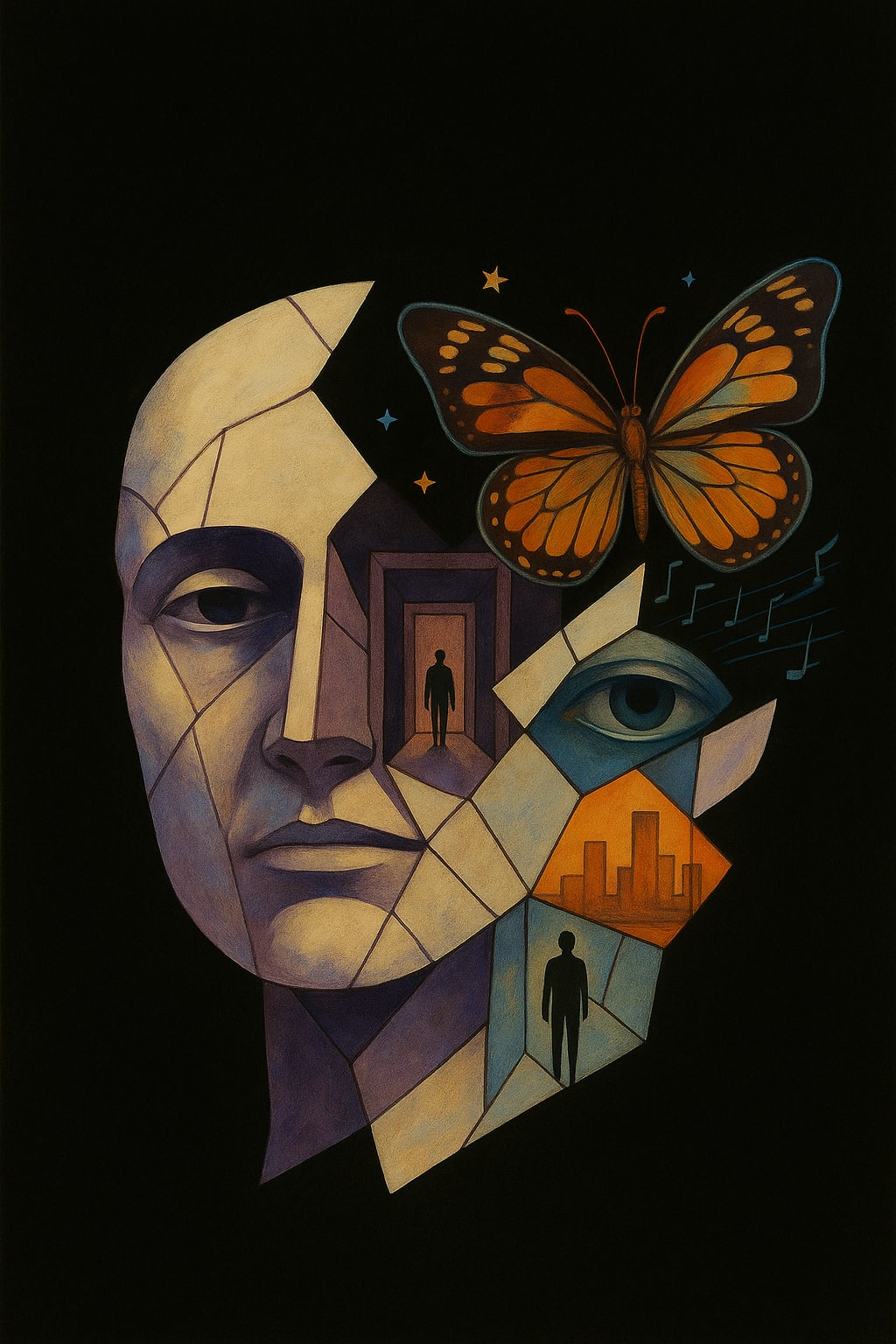
The Garden of Forking Minds
Jason found Castaneda in the basement of a derelict medical building, three blocks from a perceptual collision site. The address had been handwritten on a scrap of paper, furtively passed to him the previous evening by a young woman whom he first mistook for a preteen boy. The lobby was a study in decayed opulence – cracked marble, brass fixtures veined with verdigris, and the still-present smell of antiseptic mixed with something putrid.
She was waiting in what had once been an examination room, sitting next to a machine that seemed to belong to no particular era. It sprawled across a metal table like some hybrid of Victorian scientific apparatus and alien organism. Polished brass components gleamed alongside clusters of what appeared to be miniature brains, each pulsing with a faint luminescence. Fiber-optic tendrils extended from the central hub, undulating with the gentle rhythm, as if it were breathing.
“You came,” Castaneda commented without looking up from the machine. Her fingers traced the organic nodules with practiced sureness. “I wasn’t sure that you would.”
“Mira Castaneda, I presume. I have heard much about you, most of it contradictory.” She kept her eyes on him, expectantly.
“I need to understand what happened in the square.” Jason approached the table apprehensively. The machine emitted a low humming sound, almost subsonic, that seemed to resonate in his chest cavity. “The reports don’t make much sense. Three hundred people, all experiencing simultaneous perceptual breakdowns, all describing different catastrophes.”
“Different filters, different hells.” Mira’s voice carried a detached quality, as if she were discussing the weather. “But the same underlying fracture. The same recognition.”
“Recognition of what?”
“That the self is a construction. A story we tell ourselves about continuity that doesn’t really exist.” She gestured to the contraption. “This is the Confluence Device. It makes it impossible to maintain the illusion. It forces confluence – the merging of subjective states. Most people can’t handle the sudden dissolution.”
Jason studied the organic components more closely. They pulsed in synchrony, as if sharing a heartbeat. “This is what caused the breakdown?”
“No. This is what reveals the breakdown that was already there.” Castaneda finally looked at him, her eyes reflecting the device’s luminescence. “The self is like a dream dreamt by a dreamer who is himself dreamed. When the dreamer wakes, the dream vanishes. But the dreamer vanishes as well, because how can a dreamer exist without a dream?”
The words triggered something in Jason’s memory – the graffiti near the square, the samizdat pamphlet, fragments of conversation he couldn’t quite place. “You’re quoting something.”
“An old text. Ancient wisdom dressed in modern neuroscience.” She began connecting the fiber-optic tendrils to what looked like temporary skin patches. “The question isn’t whether it is true. The question is whether you can handle what is true.”
“I’ve handled perceptual instability before. It’s part of the job.”
“This isn’t instability. This is clarity.” Castaneda’s hands moved with surgical precision, calibrating dials and adjusting the organic components. “The Gadget doesn’t create false perceptions. It erases them. What remains is what was always there – the absence of a stable self.”
Jason again felt that tightness in his chest, the same sensation he’d experienced during his worst cases. “What exactly are you proposing?”
“I’m proposing you stop running from what you already know.” She attached one of the skin patches to her temple, and the device’s humming deepened. “Your memories don’t align because there’s no consistent self to have those memories. Your emotional responses feel foreign because they belong to configurations of yourself that no longer exist and may never have existed, or maybe will exist someday. The PSO protocols you follow are designed to maintain an illusion that’s already crumbling.”
“And this device will show me… what?”
“Other possibilities. Other configurations of identity that coexist with your current iteration,” she held out a second patch. “You’ll see the lives you didn’t choose, the selves you did not become. The emotions and logic of the people you might have been.”
Jason hesitated. The device’s luminescence seemed to pulsate faster, as if sensing his proximity. “And the side effects?”
“Are irreversible.” Mira’s voice was matter-of-fact. “Some users never recover distinct identities. Their emotions remain merged with foreign residues. Others experience blissful union but lose the capacity for independent thought. A few become what we call maras – beings caught between states, unable to return to the illusion of selfhood but incapable of achieving dissolution.”
“Then why would I want to do this?”
“Because the alternative is worse.” She activated something on the device, and the organic components began to glow more intensely. “The perceptual city is collapsing. The mass collision was just the beginning. Soon, everyone will be forced to confront the absence of self. The question is whether you’ll approach it with fear or understanding.”
Jason looked at the patch in his hand. The material felt warm, almost alive. “What do you see when you use it?”
“I see myself as a cloud of probability – countless Miras, each making different choices, feeling different emotions, believing different truths. I see the Buddhist who studied consciousness as a grad student, the defense engineer who weaponized empathy, the would-be mother who never managed to have children, the terrorist who bombed a perceptual engineering lab.” Her voice remained steady, but Jason caught a tremor in her hands. “I see them all simultaneously, and I understand that none of them is more real than the others.”
“And that doesn’t terrify you?”
“It did, at first. Now it feels like coming home.” She gestured to the patch. “The Gadget doesn’t change you. It reveals what you already are – a collection of patterns, a story told by neural networks, a dream of continuity in a universe of flux.”
Jason hesitated for a moment, but then took the patch. Gingerly, he attached it to his temple, and then… The sensation was immediate – a weightlessness, as if his body were dissolving from the inside out. The room began to fragment, layers of reality peeling away like paint washed off by turpentine. He saw the room as it had been decades ago, gleaming with medical equipment. He saw it as it might be in the future, overgrown with vines and populated by creatures that didn’t look quite human.
Then other minds began intruding. At first, just glimpses – a woman’s grief over a stillborn child, a man’s rage at bureaucratic obstructiveness, a small child’s wonder at gently falling snow. The boundaries between one self and others became more and more fluid. He felt emotions that weren’t his, remembered events that had never happened to him, spoke words in languages he didn’t know.
“Don’t fight it,” Mira’s voice came from everywhere and nowhere. “Breathe, relax completely, allow the boundaries to dissolve.”
Jason found himself in a vast library where the books were made of living tissue, their pages pulsing with the rhythm of strange heartbeats. Each book contained a different version of his life. In one, he was a monk in a Tibetan monastery, meditating on the nature of emptiness. In another, he was a corporate executive, using perceptual filters to maximize productivity and minimize empathy. In a third, he was a terrorist, bombing perceptual engineering facilities in the name of unalloyed experience.
He opened one of the books and found himself living the life contained within it. He was nineteen years old, standing in a college lecture hall, listening to a professor discuss the concept of anatta – the absence of a permanent self. The knowledge felt revelatory, dangerous. He understood for the first time, really felt it in his bones, that his identity was not a fixed thing but a process, constantly changing, constantly reconstructed.
But even as he experienced this revelation, he was simultaneously living other lives. He was thirty-five, working in a neuroscience lab, studying the mechanisms of consciousness. He was forty-two, holding Maya Leary’s hand as she lay dying in a hospital bed. He was sixty-eight, alone in a small apartment above the White Horse bar, determined to drink himself to death.
The lives began to bleed into each other. The teenage revelation informed the middle-aged grief, which colored the elderly despair. He was all of these people at once, and none of them individually. The boundaries between Jason and not-Jason became meaningless distinctions.
Through the chaos, he heard Mira’s voice: “The self is an emergent construct of a brain attempting to comprehend itself and its surroundings. What you’re experiencing now is the truth beneath the construct.”
Jason tried to speak, but his voice came out as a polyphonic chorus of his many selves. “How do I… how do I get back?”
“Back to what? The illusion? The story you tell yourself about continuity?”
“Back to being me.”
“Which you? The teenager dabbling in Buddhism? The scientist studying consciousness? The husband mourning his wife? The officer maintaining perceptual stability?” Mira’s laughter was gentle but unsettling. “They’re all equally real. They’re all equally fictional.”
The library began to dissolve, books transforming into flocks of birds that scattered into a sky that was simultaneously day and night. Jason found himself standing in the perceptual city, but now he could see the layers of reality that overlaid the physical streets. He saw the socialist paradise, the free-market utopia, the anarchist collective, the theocratic state – all occupying the same space, all equally false, all equally true.
People walked past him, but he could see through their perceptual filters to the raw neural activity beneath. They were walking probability clouds, constantly shifting patterns of bioelectrical activity that briefly cohered into the illusion of individual consciousness. And there was something else, at the edge of his perception, approaching, something that felt like a huge dark maw. And then it swallowed him, and everything dissolved, and all that was left was… nothing, or maybe everything, and he was everyone who’d ever lived, or will be born, the stars, and space dust, and electrons, quarks, and time itself.
“This is how it always was,” Mira said, appearing beside him as a translucent figure. “The device doesn’t create this perspective. It simply removes the filters that prevent you from seeing it.”
“Then how do people function? How do they maintain relationships, make decisions, live their lives?”
“They don’t. They think they do, but it’s all automatic responses, conditioned patterns, the momentum of previous decisions made by previous configurations of their selves.” She gestured to the flowing crowds. “Most people never realize they’re living in a dream. Those who do either go mad or seek awakening.”
“And which are you?”
“I’m not sure there’s a difference.”
Jason felt the device’s influence beginning to wane. The multiple selves began to separate, the overlapping realities began to stabilize. But something had changed. The boundaries of his identity felt porous, unstable. He could sense the other possible Jasons hovering at the edges of consciousness, ready to emerge under the right conditions.
“The effect will fade,” Mira explained, removing her patch. “But the knowledge will remain. You can’t unknow what you have experienced.”
Jason removed his patch, and the examination room solidified around him. But it felt different now – less real, more like a stage set constructed to maintain the illusion of consistent reality. “And what am I supposed to do with this new knowledge?”
“Whatever you choose. But understand that the choice isn’t really yours. It’s made by the current configuration of neural patterns that temporarily calls itself Jason White. Tomorrow, a different configuration might make a different choice.”
“That isn’t comforting.”
“It’s not supposed to be comforting. Comfort is a luxury demanded by the ego. Truth is usually uncomfortable.” Mira began disconnecting the device components. “The mass collision in the square was caused by someone forcing this recognition on people who weren’t prepared for it. They saw the dissolution of the self as annihilation rather than as liberation.”
“And you think that I am prepared?”
“I think that you’re already dissolving. The question is whether you will fight it or embrace it.” She looked at him with what might have been compassion. “The city is heading toward a cascade failure. The perceptual filters are breaking down. Soon, everyone will be forced to confront the absence of fixed identity. Those who understand it will survive. Those who don’t will either go mad or die.”
Jason felt a chill that had nothing to do with the basement’s temperature. “You’re talking about the end of civilization.”
“I’m talking about the end of the illusion of civilization. What emerges afterward might be something better. Or something worse. But it will be more real.”
The briefing room at headquarters felt different when Jason arrived the next morning. The walls, which had always appeared as neutral grayish surfaces, now seemed to flicker with barely perceptible overlays – ghostly images of other possible rooms, other possible meetings. He wondered if this was a residual effect of the Confluence Device or if he was now just more attuned to the reality beneath the surface.
Block stood at the head of the conference table, his face drawn and his hands trembling slightly. Around the table sat the senior staff, each wearing their preferred minimal filters – the standard professional overlay that reduced emotional noise and enhanced logical processing. But Jason could see through them now, could sense the anxiety and confusion that the filters were designed to hide.
“The situation is escalating beyond our control,” Block began, his voice carrying the strain of someone going on insufficient sleep. “We’ve had twelve separate identified perceptual cascade events in the past forty-eight hours. The filters aren’t just malfunctioning – they’re being weaponized.”
He activated the holographic display, showing a map of the city dotted with red zones. “These are the affected areas. Notice the pattern. They’re not random breakdowns. Someone is deliberately targeting the intersection points where different perceptual communities overlap.”
Dana Palmer, the deputy director, leaned forward. “Do we have any indication of who’s responsible?”
“Several groups have claimed responsibility, none of them credible,” Block replied. “The one that is credible, and most concerning, is the outfit calling itself the Anti-Modernist Coalition. They’re not just protesting perceptual engineering – they’re actively trying to destroy it.”
The display shifted to show fragments of manifesto text, graffiti, and viral social media posts. Jason recognized the tone immediately – it was the same voice behind the scorched flyer he’d found near the square.
“On all the bullshit modernism, I declare war!” Block read from one of the posts. “Long enough have they mocked us, laughed at our credulous naiveté for accepting their august judgement. We know what art is good – it is the art that speaks to us. We are the arbiters, the measure of all things artistic.”
“It sounds like aesthetic populism,” Palmer observed. “Not particularly dangerous.”
“That’s where you’re wrong.” Block’s voice hardened. “They’re not just complaining about art. They’re using aesthetic revolt as a Trojan horse for perceptual revolution. Look at this.”
The display showed a new image – a concert hall where the audience was writhing in what looked like agony, their faces contorted in expressions of disgust and rage. “This was a performance of Ligeti’s String Concerto Number 2. The Anti-Modernist Coalition somehow hijacked the audience’s perceptual filters, forcing them to experience the music as literally mocking them. Three people died of cardiac arrest. Twelve more were hospitalized with severe psychological trauma.”
Jason felt a chill of recognition. He’d heard that music the night before, during his journey through the fragmenting landscape of the Confluence Device. The notes had indeed seemed to laugh, to mock, to celebrate the dissolution of meaning.
“How is that possible?” Chen asked. “The filters are supposed to be individually controlled.”
“Not anymore.” Block activated another display, showing technical schematics that Jason didn’t fully understand. “Someone has developed a way to override individual filter settings. They’re calling it ‘Reality Injection’ – the ability to force someone to experience a particular perceptual overlay regardless of their personal settings.”
“That’s not just terrorism,” chimed in Carlos Torres, another PSO. “Forced perceptual manipulation is simply torture.”
“It’s worse than torture,” Block replied. “It’s an ontological assault. They’re not just causing pain – they’re attacking the victim’s fundamental sense of reality.” He paused, looking directly at Jason. “Which is why I’m assigning you to spearhead the investigation. You have far more experience with extreme perceptual states than anyone else in the department.”
Jason felt the weight of eyes on him, but also something else – a subtle shift in the room’s atmosphere, as if the space itself were responding to his presence. “What do you want me to do?”
“Go undercover. Infiltrate the Anti-Modernist Coalition. Find out how they’re accomplishing these reality injections and who’s leading them.” Block’s expression was grim. “And White? Be careful. We’ve lost three detectives already, trying. They came back, but they weren’t the same people who left.”
The briefing continued for another hour, covering logistics, communication protocols, and emergency procedures. But Jason found it increasingly difficult to focus on the details. The room kept shifting around him, walls breathing, faces morphing, voices layering over each other in incomprehensible harmonies. He wondered if this was what people experienced during the perceptual cascades – reality becoming unstable, identity becoming fluid.
After the meeting, Jason made his way to the equipment room to collect his infiltration gear. The standard setup included a modified perceptual interface that could mimic various ideological filters, allowing him to blend in with different communities. But as he examined the device, he realized it felt crude and primitive compared to what he’d experienced with Castaneda’s Confluence Device.
“Having second thoughts?”
Jason turned to find Chen standing in the doorway, her expression concerned. “Not about the mission. About the equipment. This technology seems limited.”
“Limited how?”
“It’s designed to modify perception, but not to reveal the underlying reality. It’s still based on the assumption that there’s a stable self to be modified.” Jason held up the interface device. “What if that assumption is wrong?”
She studied him with care. “You’re talking about that Buddhist stuff again. The no-self doctrine.”
“I’m talking about what I saw. The cascade events aren’t random breakdowns – they’re moments of clarity. People are seeing through the illusion of fixed identity, and it’s terrifying them.”
“And you think that’s a good thing?”
“I think that it’s probably inevitable. The question is whether we help people understand what’s happening or let them die from shock.”
Chen closed the door and moved closer, lowering her voice. “Jason, I need to ask you something, and I need you to be honest. Have you been using unauthorized perceptual enhancement? Your recent reports definitely show signs of cognitive instability, and I am really concerned.”
“Define what you mean by instability.”
“Nonlinear thinking patterns. Unusual metaphor usage. References to Eastern philosophy that aren’t relevant to your cases.” She paused. “You may be point on this investigation, but Block clearly has an eye on you. I am getting the feeling that he suspects you might be compromised.”
Jason felt a laugh building in his chest, but it came out as something else – a sound that belonged to one of his other selves, the one who had studied Buddhism, the one who had already accepted the dissolution of identity. “Compromised by what? The real world?”
“Compromised by whatever’s causing these cascade events. That Coalition isn’t just attacking random targets – they’re specifically targeting people with backgrounds in neuroscience and perceptual engineering. People like you.”
“And people like Mira Castaneda?”
Chen’s eyes widened. “How do you know that name?”
“She’s part of the investigation. A source.”
“She’s a terrorist, Jason. She’s been linked to at least six perceptual attacks in the past month. If you’ve been in contact with her…“
“She’s not a terrorist. She’s a guide.” Jason felt the words coming from somewhere deep within him, from the part of his mind that still felt the effects of the Confluence Device. “She’s helping people understand what they really are.”
“Which is what?”
“Probability clouds. Temporary arrangements of neural activity that mistake themselves for permanent entities.” Jason began gathering his equipment, moving with a fluidity that surprised him. “The self is an emergent construct of a brain attempting to comprehend itself and its surroundings. What we call identity is just a story we tell ourselves about continuity that doesn’t actually exist.”
“Jason, you need to report to medical. You’re showing signs of severe dissociative disorder.”
“I’m showing signs of clarity.” He turned to face her, and for a moment, he saw her as she really was – not Jenny Chen, a perceptual stability detective, but a complex pattern of electrical activity temporarily convinced of its own existence. “Medical protocols are designed to maintain the illusion. But the illusion is breaking down.”
“That’s not your decision to make.”
“It’s not a decision at all. It is happening.” Jason headed for the door, then paused. “The Coalition isn’t trying to destroy perceptual engineering. They say that they’re trying to accelerate its evolution. To push it past the point where it can maintain the fiction of stable identity.”
“And you support that?”
“The only thing that I support is truth. Even when it is uncomfortable.”
Jason left the equipment room and made his way through the corridors of the PSO headquarters. The building felt different now, less like a place of work and more like a stage set constructed to maintain the illusion of bureaucratic competence. He could see the other possible versions of the building – the research facility it had been before the perceptual crisis, the abandoned ruin it might become, the temple to consciousness dissolution it could become.
On the street outside, the perceptual city sprawled before him in all its fragmented glory. Citizens moved through their customized realities, each living in a different version of the same physical space. But Jason could see the cracks in the system, the points where the overlays didn’t quite align, where reality bled through.
He began walking toward the district where the Anti-Modernist Coalition was supposedly active. But as he moved through the crowds, he realized that the distinction between infiltration and genuine sympathy was becoming meaningless. The coalition’s message resonated with something in him that had been awakened by the Confluence Device – a recognition that the current system was unsustainable, that the illusion of individual identity was crumbling.
The first sign of anti-modernist activity was a piece of graffiti on a museum wall: “Art is not what they tell you it is. Art is what speaks to your soul.” Below it, in smaller letters: “We are the arbiters, the measure of all things artistic.”
Below that, a fragment of a flyer: “The modernists promised us beauty and gave us fragments. The anti-modernists promised us truth and gave us rage. The mystics promised us enlightenment and gave us dissolution. But perhaps the fragments, the rage, and the dissolution were all necessary for the process of becoming something that transcends the need for promises.
In the end, we discovered that consciousness itself is the most sophisticated filter of them all – not a barrier to reality, but the mechanism by which reality becomes aware of itself. The self is not an illusion to be overcome but a process to be understood, a pattern that emerges from the interaction of awareness and experience.
We are the dream that learned to dream itself awake.”
Jason paused to study the words, and as he did, his perceptual filters began to shift without his conscious control. The museum’s facade transformed, revealing the grotesque reality beneath the classical veneer. The Doric columns turned into twisted spires of bone and metal. The carved figures in the pediment writhed in apparent agony. The very architecture seemed to mock the concept of beauty.
“You can see it too.”
Jason turned to find a woman watching him from across the street. She was middle-aged, wearing the kind of neutral clothing that suggested she was trying to avoid attention. But there was something in her eyes that reminded him of Mira – a depth that suggested she had seen beyond the surface of things.
“See what?” he asked.
“The mockery. The way they’ve turned beauty into a weapon against us.” She crossed the street, moving with the careful steps of someone navigating an unstable reality. “The way they laugh at our basic need for meaning.”
“Who are they?”
“The architects of modernism. The ones who decided that art should be difficult, that beauty should be complex, that meaning should be obscured.” Her voice suggested an incongruent mix of rage and sadness. “They created a world where natural human responses are treated as ignorance, where the need for clarity is seen as primitive.”
Jason felt his filters continuing to shift, and the woman’s face began to change. For a moment, she looked like Evie, his wife from long ago. Did he ever have a wife? Or was she just another possibility, a phantom, or a symbol of everything he had lost or never had? Then, a moment later, she was someone else entirely, a stranger whose pain he could feel as if it were his own.
“You’re with the Coalition,” he said.
“I am with the resistance. The Coalition is just one face of something larger.” She gestured to the transformed museum. “We’re not trying to destroy art. We’re trying to reclaim it. To make it serve human needs rather than ideological abstractions.”
“And if that requires forcing people to see things differently?”
“Truth sometimes requires force. The illusion is maintained by violence – the violence of social pressure, of professional reputation, of cultural exclusion.” Her eyes hardened. “We’re simply using the same tools they’ve used against us.”
Jason felt a familiar sense of recognition, the same feeling he’d experienced with Mira. This woman was offering him another piece of the puzzle, another way of understanding what was happening to the city.
“How do you do it? The reality injections?”
“The same way they do it. The same way the PSO does it. The same way the entire perceptual engineering industry does it.” She smiled, and for a moment, he saw the face of every woman he had ever loved or thought he loved. “We simply refuse to pretend that individual control over perception is anything more than a marketing device.”
As she spoke, Jason became aware of other people gathering around them – men and women of various ages, all wearing the same expression of serene determination. They weren’t threatening, but there was something inevitable about their presence, as if they had been waiting for this moment.
“What do you want from me?” he asked, suddenly not at all feeling like a representative of Law and Order.
“We want you to stop pretending that you’re separate from us. Stop pretending that your job as a PSO makes you immune to the dissolution that’s affecting everyone else.” The woman’s voice was gentle but insistent. “We want you to acknowledge what you already know – that the self is an illusion, that individual identity is a fiction, that the only honest response to modern existence is to embrace the collapse of meaning.”
Jason looked around at the faces surrounding him, and for a moment, he saw them all as versions of himself – different configurations of the same underlying pattern, different expressions of the same fundamental uncertainty. The boundary between Jason and not-Jason began to blur, and he felt himself becoming part of something larger, something that transcended individual identity.
“The dreamer vanishes as well,” he said softly, remembering Castaneda’s words. “Because how can a dreamer exist without a dream?”
The woman smiled, and the crowd began to disperse as naturally as they had gathered. “Welcome to the awakening,” she said, then turned and walked away, leaving Jason standing alone before the transformed museum, wondering who he was and whether the question itself had any meaning.
Jason woke to find himself standing in his childhood bedroom, though he had never owned the ceramic elephant on the dresser, and the wallpaper bore a pattern of interlocking spirals that seemed to pulse with their own light. The floorboards creaked beneath his feet with the exact sound of autumn leaves, though the floor was hardwood, not forest floor.
“You’re late for the briefing,” said a voice behind him.
He turned to find himself looking at himself – or rather, at a version of himself in a pressed PSO uniform, clean-shaven, with the kind of certainty in his eyes that Jason hadn’t felt in years, if he’d ever had. This other Jason carried a tablet and wore the expression of someone who had never questioned an order.
“What briefing?”
“The one where you decide whether to let the anti-modernist cell continue operating.” The other Jason tapped the tablet. “It’s a simple choice. Shut them down, or let them radicalize half the city with their perception filters.”
Jason felt the floor shift beneath him. They were no longer in the bedroom but in a sterile conference room with fluorescent lighting that hummed like insects. Gideon Block sat at the head of a mahogany table, though his face kept shifting between expressions of rage and desperate pleading.
“The decision was made three years ago,” Block said without looking up from his paperwork. “Or will be made tomorrow. Time is a perceptual filter, Jason. You know this.”
“I don’t remember making any decision about anti-modernist cells,” Jason said, though as the words left his mouth, he felt the ghost of a memory: standing in this same room, authorizing surveillance protocols, watching feeds of people whose only crime was seeing the world differently.
“Memory is another filter,” said the other Jason. “Very convenient when you need to sleep at night.”
The room dissolved. Jason found himself in a narrow alley between two buildings that seemed to stretch infinitely upward. Graffiti covered the walls in languages he didn’t recognize, though somehow their meaning was clear: The self is a bureaucratic error. The self is a filing mistake. The self is a glitch in the system.
A woman emerged from the shadows, her face an artful arrangement of features that looked almost exactly like Mira’s but, somehow, not quite. The not-Mira smiled with Mira’s mouth but with someone else’s eyes.
“Do you remember the first time you revised yourself?” she asked, extending a hand that flickered between flesh and static.
“I never…” Jason began, but the words died as another memory surfaced, this one sharp and immediate: sitting in a clinical chair while technicians attached neural interfaces to his skull, choosing to dampen his capacity for doubt, to enhance his sense of duty, to make himself more efficient at his job.
“You were so proud,” the not-Mira continued. “You said you were becoming your best self. You said the old Jason was too weak for the work.”
“That wasn’t me,” Jason said, though he could feel the truth of it resonating in his bones. “That was someone else.”
“All of us are someone else,” said a voice from above.
Jason looked up to see another version of himself sitting on a fire escape, this one shaven-headed and dressed in saffron robes, holding a book of the philosophy of Dharma. This Jason looked worn, tired, older, with the kind of sadness that comes from understanding far too much.
“The question is,” the seated Jason continued, “which someone else do you prefer to be?”
The alley walls began to close in, or perhaps Jason was expanding, or perhaps space itself was becoming meaningless. He found himself in a vast library where the books were made of crystallized memories, their pages showing scenes from lives he might have lived.
In one book, he saw himself at age twenty-five, choosing to study neural engineering instead of philosophy. The Jason in the crystal pages was enthusiastic, driven, certain that technology could solve all the problems of the human condition. He watched this younger self develop the first prototype perceptual filters, convinced he was liberating humanity from the tyranny of objective reality.
“I wanted to give people choice,” the younger Jason said, stepping out of the crystal pages. “I wanted to end suffering.”
“You wanted to play God,” said another Jason, this one in a monk’s robes, his head grotesquely tonsured. “You wanted to edit the very fabric of existence.”
“I wanted to help,” the younger Jason protested. “People were miserable. Depression, anxiety, political rage – all of it could be adjusted, optimized, made bearable.”
“Bearable,” the monk Jason repeated. “Not true. Not real. Only bearable.”
Jason, the Jason who was experiencing all of this – was there even such a person? – tried to speak, but found that he had no voice. He was becoming a spectator to his own existence, watching as his other selves debated the choices that had led him here.
“The first revision was voluntary,” said a Jason in a lab coat, consulting a clipboard. “Enhancement of focus, reduction of anxiety, stabilization of mood. Standard package.”
“The second revision was therapeutic,” added a Jason in a therapist’s office, speaking to someone off-screen. “After Evie’s death. We needed to reduce the grief response, prevent long-term psychological damage.”
“Evie didn’t die,” Jason finally managed to say. “She left. She walked away.”
“Did she?” asked the monk Jason. “Or did you revise that memory because death was too painful for you to bear?”
The library began to spin, books flying from their shelves, pages scattering like snow. Jason caught fragments of memories as they fell: Evie laughing at something he’d said, Evie crying in their kitchen, Evie lying still in a hospital bed, Evie walking out the door with a suitcase, Evie never having been at all.
“Which one is true?” he asked the swirling chaos around him.
“All of them,” came the answer from everywhere and nowhere. “None of them. Truth is a luxury you surrendered when you chose to edit yourself.”
The spinning stopped. Jason found himself in a stark white room with no doors, no windows, no furniture except a single chair where sat the most unsettling version of himself yet: a Jason whose eyes held no recognition, no personality, no self at all. This Jason was perfectly still, perfectly empty, perfectly at peace.
“This is what you’re moving toward,” the empty Jason said without moving his lips. “The final revision. The elimination of all filters, all preferences, all attachments. The end of the self.”
“Is that what I want?” Jason asked.
“Want is a filter,” the empty Jason replied. “You are learning to want nothing. To be nothing. To see nothing but what is.”
“And what is?”
The empty Jason smiled, and for a moment his face flickered with something that might have been compassion. “That’s what you’re about to find out.”
The white room began to fade, not into darkness but into something that wasn’t quite light, wasn’t quite absence. Jason felt himself becoming transparent, his thoughts turning into echoes, his identity becoming nothing but a question mark.
A voice – Mira’s voice – reached him from somewhere beyond the dissolution: “The butterfly dreams the man. The man dreams the butterfly. Which one is waking, Jason?”
He tried to answer, but found he no longer remembered who Jason was.
Then he was back in his apartment, gasping, his hands shaking as he reached for his coffee cup. The mug was cold, the coffee bitter, but they were real in a way that felt like a lifeline.
His reflection in the dark window showed a man who had been somewhere else, seen something else, been someone else. The question was: which version of himself was looking back?
On his desk, a message was waiting on his phone. Three words: Perception Zero beckons.
He stared at the words until they began to blur, until they became abstract shapes, until they became nothingness. But even nothingness, as he was learning, might be something, as much as something could be nothingness.
Mira’s workshop occupied the basement of a building that did not officially exist, its entrance hidden behind a coffee shop whose baristas knew how to spot PSOs and whose espresso machine concealed a biometric scanner. Jason descended through layers of security, each checkpoint requiring a different kind of proof: retinal scan, voice print, a psychological assessment that asked him to describe the color of his childhood nightmares.
The workshop itself defied all geometric logic. Curved walls met at impossible angles, and the ceiling seemed to breathe with a rhythm that matched no heartbeat. Workbenches lined the space, covered with devices that looked like jewelry designed by alien surgeons: delicate traceries of metal and light that pulsed with their own awareness.
Mira Castaneda stood at the center of it all, her hands moving through a holographic image that showed the neural patterns of the city’s population as a vast, shimmering web. Each node represented a human mind, each connection a shared perceptual experience. The web was fragmenting, Jason could see, breaking into isolated clusters that barely communicated with each other.
“The consensus is collapsing faster than we could have predicted,” she said without turning around. “Look at this.”
She gestured, and a section of the web expanded. Jason saw his own neural signature, a dim star surrounded by increasingly erratic patterns. His perceptual stability was deteriorating, the readings showing gaps where his sense of self should have been found.
“How long have you been monitoring me?” he asked.
“Since you first used the Gadget.” She turned to face him, and he saw that her eyes held the same emptiness he’d witnessed in his other-self in the white room. “The question is, how long have you been you?”
“I don’t understand.”
“Your neural signature has been revised seventeen times in the past three years. Each revision more subtle than the last, each one removing another layer of who you used to be.” She moved to a workbench and picked up a device that looked like a crystalline flower. “This is a memory archaeology tool. It can show you the person you were before the revisions.”
Jason felt his throat tighten. “What was I like?”
“Suspicious. Paranoid. Convinced that the perceptual overlay system was a form of mass control.” She smiled, though it didn’t reach her eyes. “You were probably right.”
“If I was right, why was I revised?”
“Because right and wrong are perceptual filters, also. Someone, maybe yourself, decided that your particular version of right was inconvenient.”
She moved to another workbench, this one dominated by a device that resembled a bonsai tree made of living light. As she approached, its branches began to sway, reaching toward her like a pet seeking attention.
“This is a prototype consensus mapper,” she said. “It shows the flow of shared perceptions through the city’s population. Watch.”
The device projected a three-dimensional map of the city, but not the physical city. This was the city of minds, a landscape of overlapping realities where each district glowed with its own perceptual frequency. Jason could see the political quarters, each burning with its own ideological fire. The religious sectors, where faith manifested as actual light. The pleasure districts, where hedonistic filters created environments of pleasure and sensation.
And at the center, a growing void.
“That’s where the mass collision occurred,” Mira said. “But it’s not healing. It’s expanding.”
“What is it?”
“The absence of consensus. The place where all perceptual filters fail.” She turned to him, and for the first time since he’d known her, she looked afraid. “It is Perception Zero. And it’s growing.”
Jason studied the map, watching as the void slowly consumed the surrounding districts. “What happens when it reaches the edges of the city?”
“No one knows. Maybe everyone goes insane. Maybe everyone becomes enlightened. Maybe there’s no difference.” She moved to a final workbench, this one empty except for a single chair surrounded by neural interface equipment. “Or maybe everyone becomes nothing at all.”
“You’re talking about the end of human consciousness.”
“I’m talking about the end of human illusions. The self, identity, the idea that we’re separate from each other and from the world around us – all of it is perceptual filtering. Take away the filters, and what’s left?”
Jason approached the chair, drawn by a gravity he didn’t understand. The neural interfaces gleamed like surgical instruments, beautiful and terrible in their precision.
“You want me to go to Perception Zero,” he said.
“I want you to choose. You can accept a stabilizing filter, return to being a functional PSO, and help maintain the fragments of consensus that remain. Or you can remove all filters and see what lies beneath.”
“And if I choose the filters?”
“You will forget this conversation. You will forget your doubts, your questions, your sense that something is fundamentally wrong with the world. You will be happy, or at least content.”
“And if I choose Zero?”
“You’ll see reality as it actually is. Without interpretation, without narrative, without the story that makes you – you.” She paused, studying his face. “The self is like a dream dreamt by a dreamer, from one dreamt lifetime to the next, until the dreamer wakes and the dream vanishes. The dreamer vanishes as well, of course, because how can a dreamer exist without a dream?”
The words hit him like a blow. He’d heard them before, perhaps many times, in the white room among other places, from the empty version of himself. But also somewhere else, in a context he couldn’t quite remember.
“At bottom, the doctrine of ‘no self’ is factually true,” he said, the words emerging from some deep place in his mind. “The self is an emergent construct of a brain that is attempting to comprehend itself and its surroundings.”
Mira nodded slowly. “You’re remembering. The original you, if we can call it that, before the revisions. He understood what we were dealing with.”
“What happened to him?”
“He chose to investigate. He chose to question. He chose to doubt.” She gestured to the chair. “Someone, maybe he himself, decided that was dangerous.”
Jason sat down, feeling the weight of every decision that had led him to this moment. The neural interfaces hummed softly, waiting for his choice.
“Perception Zero is not a place,” Mira said, beginning to attach the interfaces to his temples. “It’s an absence. The absence of all the stories we tell ourselves about who we are and what the world means.”
“Will I still be me?”
“You’ll be what you were before you became you. Before language, before concepts, before the idea that you’re separate from everything else.” She paused, her hands gentle on his face. “But Jason, the person you think you are – he’s already gone. He’s been gone for years. He had never existed. What you’re afraid of losing is just an echo.”
He closed his eyes, feeling the interfaces come alive against his skin. “Then what am I?”
“You’re about to find out.”
The world dissolved not into darkness but into something that wasn’t quite light, wasn’t quite absence. Jason felt himself becoming transparent, his thoughts turning into echoes, his self-perception fading out into indistinctness. And in the space between question and answer, between self and not-self, he heard the city’s dying breath and felt the first whisper of whatever lay beyond the need to be anything at all.
The last thing he remembered thinking was: The dreamer vanishes as well, because how can a dreamer exist without a dream?
Then even the dreamer was gone, and what remained was the space where dreams go to die and be reborn as something that had never needed to dream at all.
About the Creator
The Myth of Sysiphus
Sisyphus prefers to remain anonymous as he explores the vicissitudes of the human condition through speculative fiction.
Keep reading
More stories from The Myth of Sysiphus and writers in Chapters and other communities.
The Empty Mirror - Part I
Part II Part III The Fractured City The alert came through at 14:47, priority alpha, putting an abrupt end to Jason’s afternoon routine. He had been documenting another minor collision incident – a libertarian businessman who had glimpsed a socialist’s overlay and suffered what the clinical terminology called “perceptual dissociation syndrome.” It was ordinary paperwork, the kind of bureaucratic tedium that had replaced the different sort of monotony of his old career in neuroscience research. Perceptual Stability Officer, his nameplate announced to the world, or at least the tiny portion of it that the field office occupied. It was too grand a title for his duties, he often thought, but the brass apparently believed that the length of title should be proportional to the length of education.
By The Myth of Sysiphus7 months ago in Chapters
When Reading Changes the Way You Think
In a quiet town, there lived a student named Lina. She was an ordinary girl who went to school every day, finished her homework quickly, and spent most of her free time doing simple activities like watching television or chatting with friends. Lina was not a bad student, but she never thought deeply about things. For her, life was simple: study a little, pass exams, and continue the same routine every day.
By Reflective Storiesabout 8 hours ago in Chapters
My First Time Skiing and I Got Lost, Alone, in the French Alps
Looking back, I can trace some of my life’s biggest adventures to a simple action from my sister. She’d introduced me to Tommy (a very long time ago), a colleague of hers, who had overshared his penchant for Italian-looking women, and I ticked that box.
By Chantal Christie Weissa day ago in Humans


Comments
There are no comments for this story
Be the first to respond and start the conversation.