

In a previous incarnation, I worked as a hotel concierge. Although it’s a divisive topic in Australia, tipping is definitely part of this industry. Armed with the inside knowledge, through years of personal experience, I understand and often embrace the power of tipping when travelling. Unlike an exploitative bribe, it is best viewed as an exchange for above average service. If executed right, tipping is mutually beneficial for both the customer and worker. In saying that, it is more of an art than a strict set of guidelines. Our trip to Pakistan was a great real-world example of this craft in action.
When tipping, good practice is to find someone early and grease their palms with a nice bit of “baksheesh*.” Think of this as a pre-emptive strike that shows you are prepared to reward good service. Like building an innings when batting, getting off the mark early should be one of the main priorities. So, being a nervous starter, upon initial arrival at the hotel I was already scanning for helpful staff. It quickly became apparent that there were far too many staff to tip them all. These were the kind of numbers you could only have dreamed about during the Sunday morning rush back in the day. I would have loved to sling them all some spondulix+ but unfortunately, as a chemist, my vocation is more about a passion for science than collecting fat pay checks.
Based on this, I needed to stay patient and wait for the field to spread a bit. Taking my own bags up to the room, I missed another key opportunity to tip one of the bell staff. From experience, starting out as a porter, a well-timed tip will open up a wealth of on-ground, local knowledge. Depending on one’s predilection, this could have either been construed as a play and miss or a good leave. They do say there are only two types of leaves, good or bad. In reality, the quality of a tip can be far more nuanced than such a black and white classification. In this case my early play and miss would end up falling into the category of a good leave.
Soon after arrival to my room, as I was just getting settled in, an employee came past to “see if everything was OK.” Like a juicy half tracker sitting up to be dispatched, this was the perfect opportunity to open my account. Now you don’t just throw money at someone because it can come across a bit rude. You also need to keep the power balance in check, as they have no obligation to go above and beyond their role description. It’s salient to create an exchange by at least letting the staff do something before you give them the cash. Money being thrust straight into their face is not only awkward, a well timed delivery is also important for building respect with your fellow humans.
Arriving in a country where we were advised that the tap water wasn’t potable, I was acutely aware of the need for bottled water. Moments after asking where I could source some, he diligently hurried off and came back with three large bottles of water. In return, I duly tipped one hundred rupees, which is about fifty Australian cents. Now on the surface, this may seem like a simple transaction, but this is where the long game kicks in. Just like you don’t make a century off the first ball faced, you need to understand the conditions and set up for the lengthy innings ahead. If you go too hard, too early it is impossible to sustain the pace and if you never get going, we all know how that ends. Now off the mark, I potentially had a local to turn to but would have to wait and see how conditions prevailed.
Next morning, down at the breakfast buffet in Marco Polo, I shared this information with a few of the guys. Some weren’t interested in tipping and I totally understood that, it’s their money and ultimately their decision. Of the guys that were interested we dug deeper into the discussion on a fair price. My read on the conditions was that if I stuck around runs would become easier later on. So, I held firm with my one hundred rupee decision, while a few suggested they would try a bit more and see what happened. This is where the tug of war between how much money you have and how much of it they need really begins. Tipping, like legspin, is an art that most can dabble in. However, it can easily be fruitful, disastrous or a mixture somewhere in between.
One of the main guys intent on tipping, was my good mate Simon Fahey. He is also known as Rodger or Starcy, for his solid jaw line and huge stature. As the sole ACT representative on the tour, this big frame came in handy for carrying the hopes of the territory on his back. My first meeting with Rodger came at the 2022 Over 40s National Championships. He was on fire with the bat, smashing us to all parts of the ground. Struggling for ideas, I decided to slip him a slower ball that he didn’t pick, but still proceeded to follow through and smash high towards long on. For a moment I was certain I had him, but sadly the wind carried it for six over the rope and, despite not being in control, it was round one to Rodger.
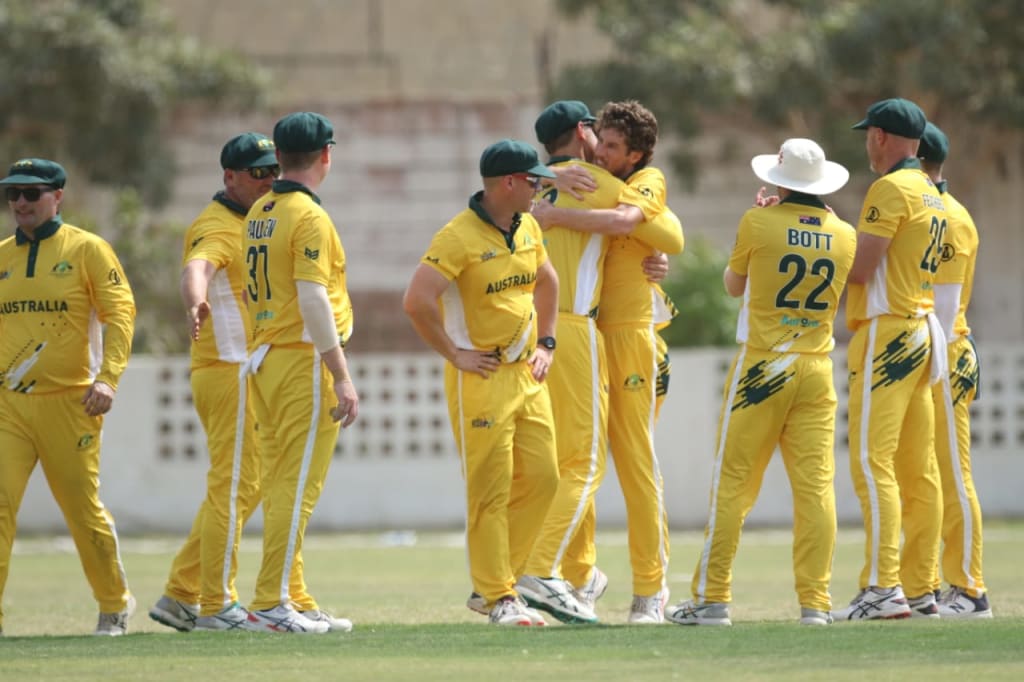
Fortunately, to date this is the worst thing Rodger has done to me. On debut against Hong Kong at the National Bank Stadium practice fields, Starcy and I got to open the bowling together. Just being there, a stone’s throw from the main Karachi field taking it all in, was goose bump territory. Things escalated even further, when I struck in the third over for my first international wicket. During the celebrations, Rodge charged in and grabbed me in a massive bear hug. He knew how much getting my first pole meant and you really must respect it when someone is so happy for you in such a huge moment. Everyone knows I love a good wicket but with him pumping me up even more, I felt about ten feet tall.
Back at the hotel, Rodge being the generous bloke he is, decided to kick off the tipping at one thousand rupees or five Australian bucks. For perceptive, that was a full ten times my meagre, standard gratuity. Initially, this paid dividends, as his room was basically paved in gold. There were wall to wall towels, oceans of water, mountains of toilet paper and other assorted treats to boot. On the surface this appeared a stroke of genius and the strategy would probably have been enough if we were staying for only a few days. Unfortunately, keeping up this pace over three weeks, requires stamina not speed.
Just like his destructive batting, he’d left more of a mark on proceedings in the early overs than most of us did all trip. However, Rodger didn’t take long to find out that once the tap is turned off things disappear quicker than a tight-arse when it’s their turn to shout. While I don’t want to divulge too much here, lets just say the tipping didn’t stop even when it stopped. Meanwhile, my test match knock continued with a reserved one hundred rupees on the pillow each morning for the housekeeper and one hundred rupees for my main man each evening.
On the occasions I was out late due to functions or day-night games, my mate would diligently knock on the hour, every hour. He would eventually get the tip, which further shows that consistency breeds consistency. On occasions, when required, I upped the run rate with the odd three to five hundred rupee tip for an engineer fixing my shower or someone locating my lost laundry. However, consistency was the key and I rarely played a false shot staying patient and mainly working singles. For the full three week knock, I just kept continuously peeling off the one hundred rupee notes.
Eventually, on the last night my innings needed to come to an end. Time and energy levels had expired and we were ready to call stumps. This is where the final and I think most significant stroke was to come. Although a promising tip at the start of a stay can be important in currying up favour, a rewarding tip for a job well done is the staff’s ultimate goal. As was the case for Rodge, going all out early leaves you in the position to be left indebted and towel-less in the middle of the night, when the rewards are dolled out too soon. So after a gruelling and patient knock, this was the time to cash out and end the innings with a flurry.
Gauging the appropriate amount is where the art comes in again. This is by far easier in your home country because you have a better feel for the value of things and understand the pay conditions. In this case I asked one of the Canadian players of Pakistani origin to check how much my main helper made. It turned out to be about one thousand rupees per day. Accordingly, I decided to give a tip of five thousand rupees and said this is a thank you from my family to yours. Although not necessarily life changing money, it was a just reward for being made to feel so welcome in an unfamiliar port. Even though I could have just left, from my experience playing for the other team, this is when I received most of my memorable and satisfying tips.
After carrying my (tipping) bat through the whole tour, this resulted in probably my longest innings. Having spent years on either side of the equation, I felt like my experience had come in handy. While I have no way to gauge if the amount of money I gave was truly sufficient, I’m sure it would have made some difference. Beyond the transactional side of tipping, I also spent a great amount of time learning about life in Pakistan from the fantastic staff we encountered. Hopefully this experience can serve as a game-plan for future travellers.
*Baksheesh - originating from the Persian word bahkshesh meaning tip. This was a word for tipping we used in my workplace, which was introduced from a Turkish colleague. Not to be confused with the use by beggars who often ask for money by saying “baksheesh, baba!”
+ Spondulix - 19th century slang for money.
About the Creator
S. J. Leahy
Love writing about travel, random happenings and life in general. Many different muses, from being a conflicted skateboarding scientist to living in Japan and touring Pakistan with the Australian Over 40s Cricket Team.
Keep reading
More stories from S. J. Leahy and writers in Chapters and other communities.
Karachi Chronicles Chapter 1
Years ago, returning from Europe, I was stopping over in Dubai airport. Exploring the cavernous terminal, I found myself needlessly gliding along a travelator, when something abruptly commanded my attention. Drifting across my field of vision, like a cloud blocking the sun in an otherwise vacant sky, was a group of guys draped in flowing white robes. Clad in black and sporting a large, messy afro, I was the shade behind the cloud. On the outside, we shared no resemblance.
By S. J. Leahy7 months ago in Chapters
Tattoos and Rail Guns Chapter 19: Cavetown Orphans and Water Usage
Kev and the two lieutenants had been following the cavern for a few miles. The cavern may have been natural but had been reinforced over time. The supports were ramshackle at best but seemed to be doing the job. They did seem to be a little dustier than a cavern should be; there was no visible water either, which was weird considering that the cavern was obviously caused by erosion.
By Jamais Jochim6 days ago in Chapters




Comments
There are no comments for this story
Be the first to respond and start the conversation.