
Journal of Mohandas K. Gandhi
Chapter 11 : Charkha in the Dark

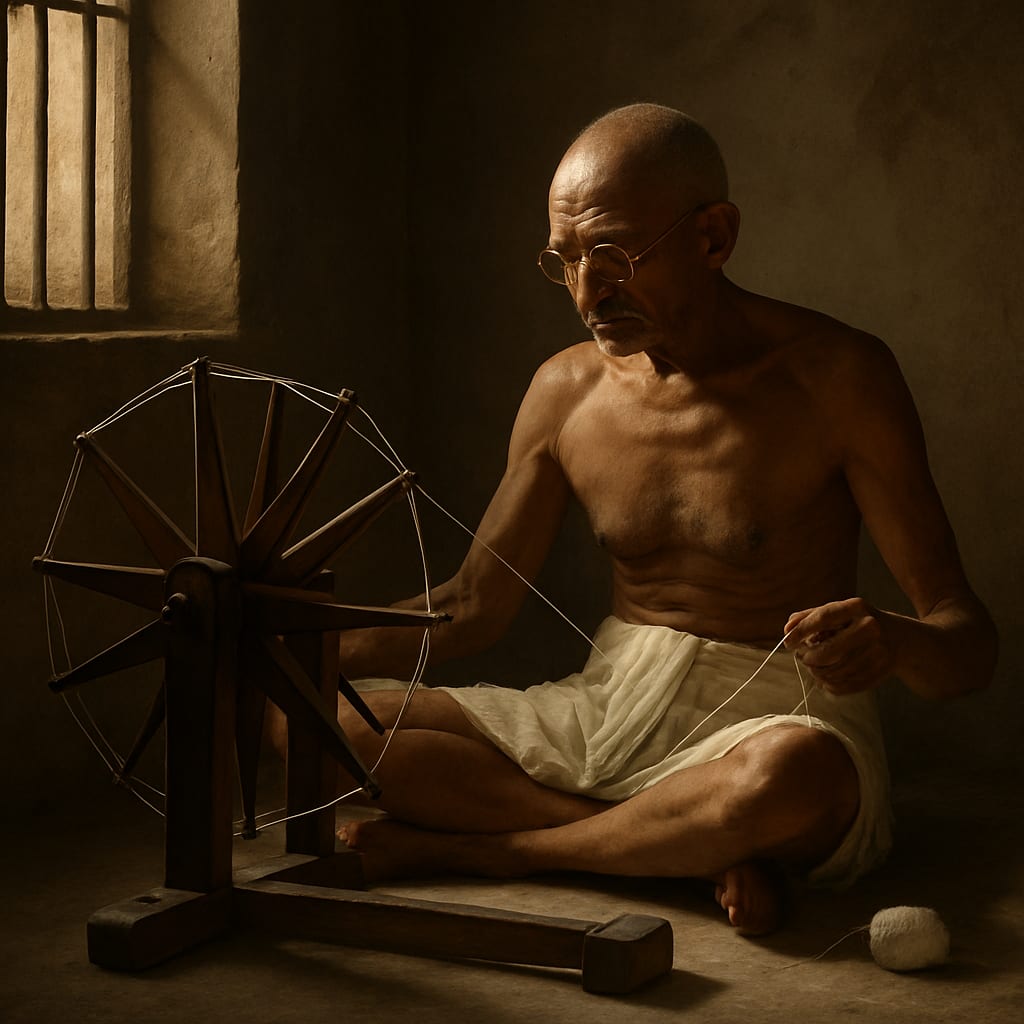
May 19, 1930 – Yerwada Jail, Pune
Charkha in the Dark
Today, they brought my spinning wheel.
It arrived without ceremony, tied with a coarse rope and bearing the dust of some forgotten storeroom. Yet when I touched it, I felt a pulse — not of wood, but of memory. This charkha has turned in my hands through seasons of both freedom and captivity. Now, it waits again to sing.
The guards looked at it with curiosity, as though it were a relic or a puzzle. But they allowed it. Perhaps they see it as harmless. Perhaps they think I will wear myself out with its repetition. They misunderstand. The charkha does not tire me. It steadies me.
I placed it on the stone floor of my cell. A bird cried outside. The air was still thick with the last of yesterday’s rain. As I sat cross-legged before it, the wheel whispered of homes I have known — modest huts in Gujarat, cool verandas in Sabarmati, the warm laps of grandmothers humming as they spun.
The act of spinning is intimate. Thread slips through the fingers like breath. And as the wheel turns, it holds my thoughts in rhythm. I thought today of the women of Dharsana. I hear they continue to protest, even as the salt laws are enforced with fresh brutality. They do not flinch. They march barefoot. They carry no banners, only quiet resolve. The British call this madness. But it is courage in its purest form — quiet, persistent, woman-shaped.
If the world is changed by men in parliament, it is steadied by women at the wheel.
A message hidden in the lining of a cap came to me today — passed from prisoner to prisoner until it reached my hands.
It read:
"Ahmedabad textile mill closed. Workers refuse to touch imported cloth. Singing Kabir."
I closed my eyes and imagined them: the looms silent, the factory echoing with old bhajans, hands folded in prayer rather than labor for empire. That silence, like my spinning, is not emptiness. It is presence. It is refusal. It is the refusal to be tools of injustice.
One thread pulled from the cloth of empire may seem like nothing. But if thousands pull — it unravels.
As I turned the wheel again, I found myself humming an old tune. One my mother used to sing when she spun late into the evening. It had no name, only rhythm. I do not know if she ever thought of it as resistance, but it was. She was making homespun cloth in a time when Manchester called the tune.
I wonder if she knew that one day, I would sit in jail, still spinning.
A guard, not unkind, leaned into the bars this afternoon.
“Why spin cloth no one will wear?” he asked.
I replied:
“Perhaps no one will wear it. But someone may wear the idea.”
He laughed softly and walked away. But I saw the hesitation in his step.
In the evening, a gust of breeze entered my cell. It stirred a scrap of cotton lying near my foot. The wheel creaked once, as if sighing. And in that moment, I thought of all the unseen hands that spin across this country — hands blistered, hands trembling with age, hands of children who now spin as play. I imagined their thread reaching me here, winding through bars and courtyards, binding us in invisible unity.
We do not need rope to tie ourselves together. We have thread.
I end this entry with stained fingertips, slightly blue from the thread I spin. The dye will wash off. But what remains is what matters.
As long as the wheel turns, I am free.
M.K. Gandhi
About the Creator
Alain SUPPINI
I’m Alain — a French critical care anesthesiologist who writes to keep memory alive. Between past and present, medicine and words, I search for what endures.
Keep reading
More stories from Alain SUPPINI and writers in Chapters and other communities.
Mastering French Without Losing Your Sanity: A Realistic Guide for Beginners
Learning French can feel like solving a Rubik’s Cube blindfolded. The tricky pronunciation, the never-ending grammar rules, and the surprising exceptions make it seem impossible. But don’t worry—equipping yourself with key expressions and effective strategies can turn frustration into fluency. Let’s simplify French and make learning enjoyable.
By Alain SUPPINIExclusive • 11 months ago
What Gives Life Variety For Living The Way People Do
When we look at our lives and how we live them, what is the first thing that comes to mind? Is it what we do for work or how we spend time with family or how we relax at the end of a long day? Life is not all about work, sure we need to make money but relaxing is part of living too. So sure we might work throughout the week, but weekends are meant for relaxing and doing the hobbies we enjoy and spending time with friends and family. When we put the way we live our lives into the hobbies we enjoy, that is where the variety comes into play. The variety that comes into play, can be either, watching television, or making friendship bracelets while watching television or gardening while listening to music or working out while listening to music. Or cleaning up your house, and re-arranging things to give it a different look or re-folding your clothes to make them neater, or cleaning up your bookshelf to make it neater. Do the different hobbies you enjoy. When we do the hobbies you enjoy and change them up with the seasons how does that make you feel?
By Louise Barraco7 days ago in Chapters


Comments
There are no comments for this story
Be the first to respond and start the conversation.