
Journal of Mohandas K. Gandhi
Chapter 10 : Rain on the Ashes

May 10, 1930 – Yerwada Jail, Pune
Rain on the Ashes
Today, the monsoon arrived.
From the narrow window of my cell, I watched the first fat drops fall on the scorched courtyard, turning dust to paste, softening the world. There is a smell that only comes with the first rain—wet stone, broken soil, and something like release. The rains do not ask who is free and who is captive — they fall upon us all. And as they fall, I remember once again: nature itself is never colonized.
Even behind these iron bars, I can feel it. Freedom has a scent.
News reached me — smuggled in the hem of a prisoner’s kurta — that a fire was lit last night in Champaran.
But this was no riot. No looting. No panic.
It was a fire of refusal. A circle of peasants gathered in silence around a clay pot. They brought forth their British-issued contracts — crumpled deeds, tenant records, receipts — and one by one, fed them to the flame. They watched the ink curl, the parchment darken, the empire turn to ash. No slogans were shouted. No fists were raised. Only the sound of paper surrendering to truth.
A girl, blind in one eye, stood up to speak. She knew no letters, but she knew the verse by heart:
“You may own the fields, but not the seed.
You may write the law, but not the rain.”
When the fire died, they buried the ashes under a neem tree. That, too, was prayer.
In this jail, the walls do not keep out the whispers. They slip through gaps in stone, passed from mouth to mouth, cloth to cloth. Today’s whisper was strange and sweet: a woman in Madras was arrested for selling payasam — sweetened rice — to workers for a single grain of salt. Not money. Salt.
She called it her “currency of defiance.” She said, “If they tax it, we will trade in it. If they forbid it, we will bless it.”
That is India now: turning law into offering, turning penalty into power.
The guards left yesterday’s newspaper in the latrine pile. A headline caught my eye:
“Salt Madmen Multiply — Gandhi’s Spell Still Holding.”
They do not see it clearly, and that is their tragedy. They think this is a spell I have cast — some conjuring. But I have done nothing but reflect what was already there: a people’s hunger for dignity.
Let them mock us. Madmen build the new world while the sane defend the crumbling old.
I remember now the weaver from Ahmedabad, whose fingers moved like prayer across the loom. He said to me, years ago:
“The British do not fear bullets. They fear thread. Because we do not shout when we make it — we hum.”
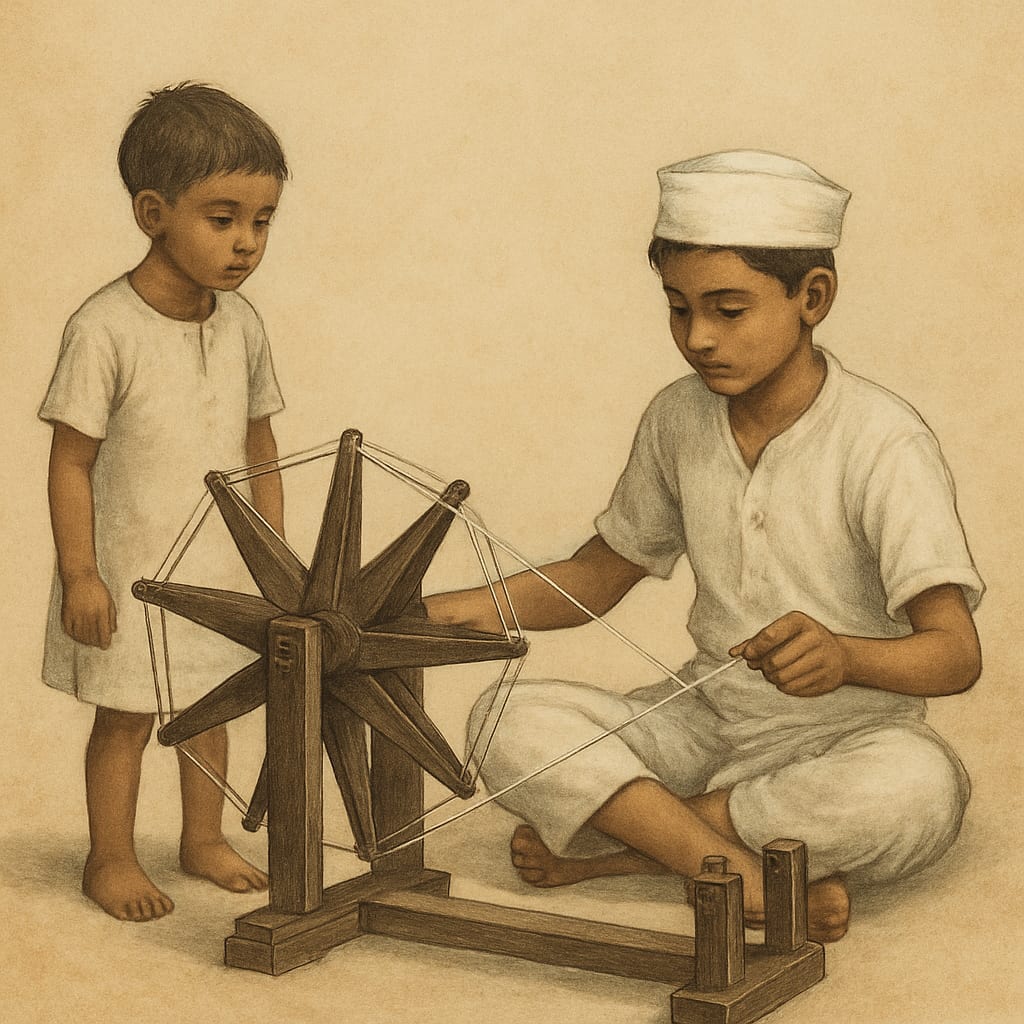
The movement we build now is a tapestry: each act of refusal a strand, each arrest a knot, each child who chants “Swaraj!” another thread woven into the whole. And it grows stronger with every tug.
You may cut one thread. The pattern remains.
A boy named Ravi — eleven years old — wrote to me through his uncle, a sanitation worker:
“Bapu, they say you are in jail. But I think jail is inside you, and you carry it until it breaks.”
The innocence of this boy pierces me deeper than any police baton ever could. Yes, child. Jail is not made of brick. It is made of silence. And when we speak — even in whispers — it cracks.
I carry the cell with me, not as burden, but as drum.
The monsoon is steady now. The courtyard has turned to mud. I imagine seeds under that surface, sleeping. And I imagine ash — from burnt papers in Champaran — washing into the fields with the rain. That ash is sacred. It is not the end. It is what remains when lies are burned away.
And from it, something will grow. Something not ordained by viceroys or censuses. Something ancient and newborn.
Let the Empire write its proclamations. Let them outlaw the wind, the sea, the sky. Let them chain salt and tax silence.
But the rain will not wait.
And neither will we.
M.K. Gandhi
About the Creator
Alain SUPPINI
I’m Alain — a French critical care anesthesiologist who writes to keep memory alive. Between past and present, medicine and words, I search for what endures.
Keep reading
More stories from Alain SUPPINI and writers in Chapters and other communities.
Mastering French Without Losing Your Sanity: A Realistic Guide for Beginners
Learning French can feel like solving a Rubik’s Cube blindfolded. The tricky pronunciation, the never-ending grammar rules, and the surprising exceptions make it seem impossible. But don’t worry—equipping yourself with key expressions and effective strategies can turn frustration into fluency. Let’s simplify French and make learning enjoyable.
By Alain SUPPINIExclusive • 11 months ago
Fair Exchange, No Robberies
Dark Memoirs - Index There are at least two kinds of people in the world: those who write this half-arsed kind of intro to a story that looks to separate the rare and the norm, and those who realise it's an overused framing device and don't.
By Paul Stewart13 days ago in Chapters
Sacrifices For The Balance Chapter 8: The Investigations Get Serious
Lady Astor parked her electric SUV just outside the dog rescue. She had decided to start with Maddy Tennyson; even if she couldn't get her to commit to her cause, she could be useful in gauging the political environment. She had decided to go with the jeans and boots look; she was as ready to work as she was to talk.
By Jamais Jochim37 minutes ago in Chapters
A Dart at Dusk
Seconds ago, the sullen sun set on the two of us… my exuberant furry companion and me. A fresh breeze embraces us, delivering welcome relief from the day’s oppressive heat. His typical stumbling and staggering along — apace with a sloth — has turned into trip-trapping, high-stepping, almost skipping along.
By Angie the Archivist 📚🪶4 days ago in Petlife


Comments (1)
The description of the rain and the acts of defiance like the Champaran fire and the woman selling payasam for salt are powerful. It shows the spirit of resistance in simple yet impactful ways.