
Journal of Mohandas K. Gandhi
Chapter 12 : Letters Through Stone

May 22, 1930 – Yerwada Jail, Pune
Letters Through Stone
The wall speaks.
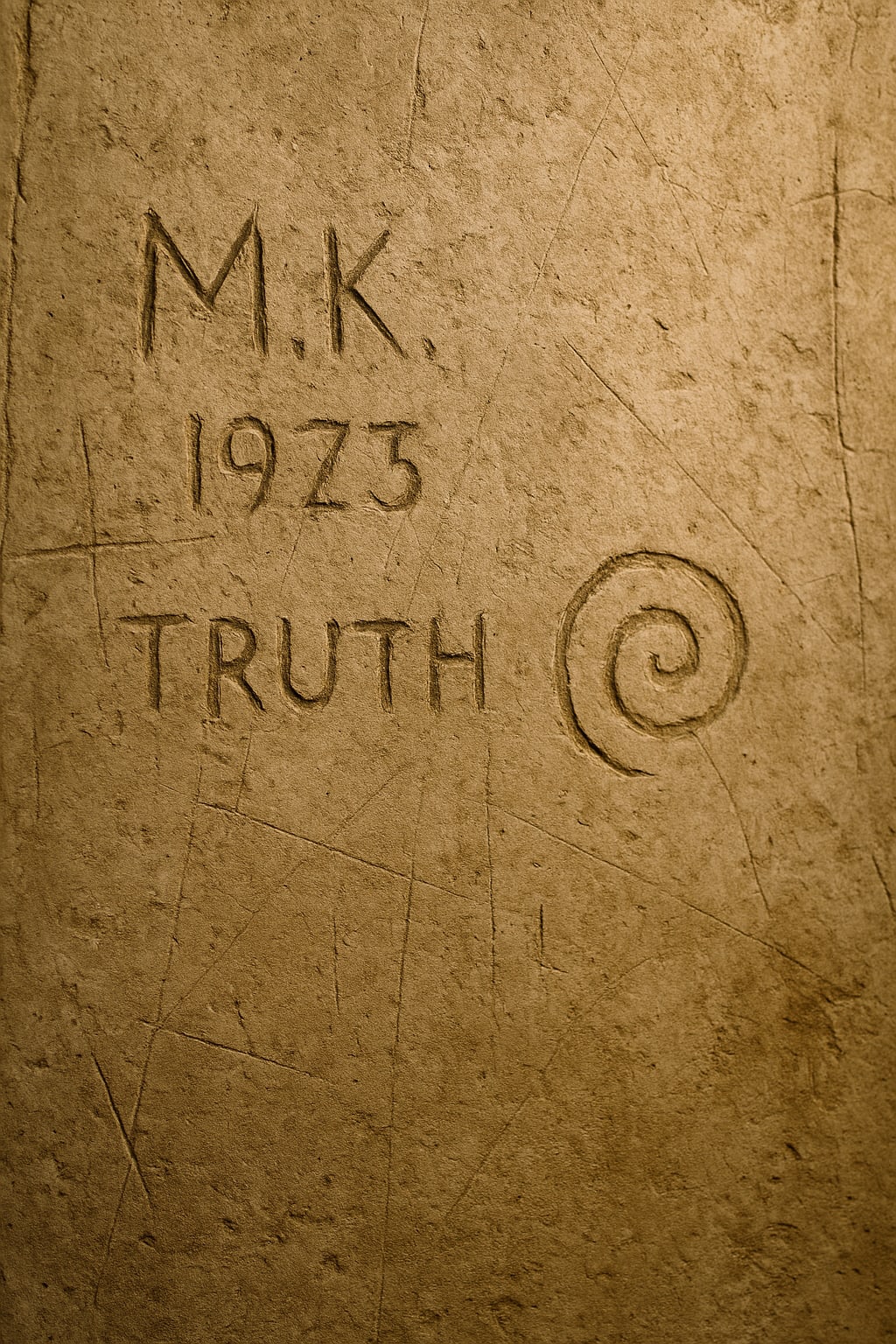
Not in words, but in tiny scratches — the slow script of silence. I found them this morning, behind my cot, where the damp meets the mortar: initials, dates, nameless prayers etched with nails or fragments of metal. Some are just lines, some letters faded into shadow. One reads “M.K. 1923.” I do not remember carving it, but I believe it was mine. Another says simply: “Truth.” One is shaped like a river, looping, as if it refuses to flow straight under any authority.
I sat and traced them with my fingers, wondering who came before me. Revolutionaries. Salt rebels. Teachers. Weavers. Each left behind the barest sign: I was here. I did not break.
Today I added my own — not a name, not even a word. Just a spiral, the symbol of the charkha. Small, barely visible. But if one day, a prisoner finds it, may they remember that resistance turns, again and again, like a wheel.
The morning light was soft. Through the bars, I watched dust motes rise and fall as if stirred by breath. A young jail worker — no more than seventeen — passed with a broom. He kept his eyes low, but just before he turned the corner, he dropped a ball of cotton on the ground. It rolled toward my cell. I waited. When the corridor emptied, I picked it up.
Inside, tightly wound, was a scrap of handmade paper. On it, in careful Devanagari script:
"Children at school refuse British anthem. Teachers sing Vande Mataram."
How powerful the simplicity. A child, standing tall, refusing to sing praise to the very force that would break their spirit. A teacher, with trembling voice, offering another song — one of land and mother and love. The anthem of power replaced by the anthem of belonging.
It reminded me of the Ashram mornings. The children would sing under the neem tree, barefoot in the dew. “Vande Mataram” was always soft on their tongues — reverent, never shouted. And now, that softness travels like a fire.
Later in the day, a guard — not the usual one — brought a folded envelope with no stamp. He didn’t speak. His fingers trembled slightly as he passed it through the bars. I nodded. When he left, I opened it. There was no letter, only a single line in pencil:
"You were not marching alone."
Nothing more. No name. No date. But it brought tears to my eyes.
I remembered the long, salt-stung road to Dandi. The dust. The silence of those walking behind me. I had felt alone at times — surrounded, yet solitary. But this note told me what I now know: they were with me in thought, in fear, in courage. Some walked behind me in body. Others in spirit. Some marched across the pages of newspapers, others in the corners of factory floors, spinning cloth in defiance.
A cause justly held is never carried alone. It echoes in footsteps we cannot hear.
As the sun faded, I returned to the charkha. The wheel turned slowly. I spun not just thread, but thought. What if every act of defiance — every refusal to bow, every silent protest — left behind a trail? Not to glorify, but to guide.
I imagined a time, not far off, when another young soul — imprisoned, afraid — might sit in a dim cell like mine. They might reach behind their cot. Their fingers might find an etching: a spiral. They may not know my name. But they’ll know someone once sat where they sit. Spun where they spin. Endured what they now face.
Perhaps that is how revolutions survive. Not through violence, but through memory. Not by crushing walls, but by writing upon them.
Tonight, I prayed not for release, but for clarity. That the silence we leave behind be loud enough for the next to hear.
M.K. Gandhi
About the Creator
Alain SUPPINI
I’m Alain — a French critical care anesthesiologist who writes to keep memory alive. Between past and present, medicine and words, I search for what endures.
Keep reading
More stories from Alain SUPPINI and writers in Chapters and other communities.
Mastering French Without Losing Your Sanity: A Realistic Guide for Beginners
Learning French can feel like solving a Rubik’s Cube blindfolded. The tricky pronunciation, the never-ending grammar rules, and the surprising exceptions make it seem impossible. But don’t worry—equipping yourself with key expressions and effective strategies can turn frustration into fluency. Let’s simplify French and make learning enjoyable.
By Alain SUPPINIExclusive • 11 months ago
Fair Exchange, No Robberies
Dark Memoirs - Index There are at least two kinds of people in the world: those who write this half-arsed kind of intro to a story that looks to separate the rare and the norm, and those who realise it's an overused framing device and don't.
By Paul Stewart13 days ago in Chapters
ThunderCats Fanfiction Project (Ch 4 Episode 4)
Deep within the flagship’s wounded core, Tygra and Panthro descend into the dark to revive the ship’s failing heartline. As they navigate smoke‑filled shafts and failing conduits, the crew above clings to breath and hope. The first lights flicker back to life — but the silence of the void still surrounds them, and the cost of survival has only begun to reveal itself.
By Marcellus Grey6 days ago in Chapters



Comments
There are no comments for this story
Be the first to respond and start the conversation.