
Journal of Mohandas K. Gandhi
Chapter 8 : Salt in the Wind

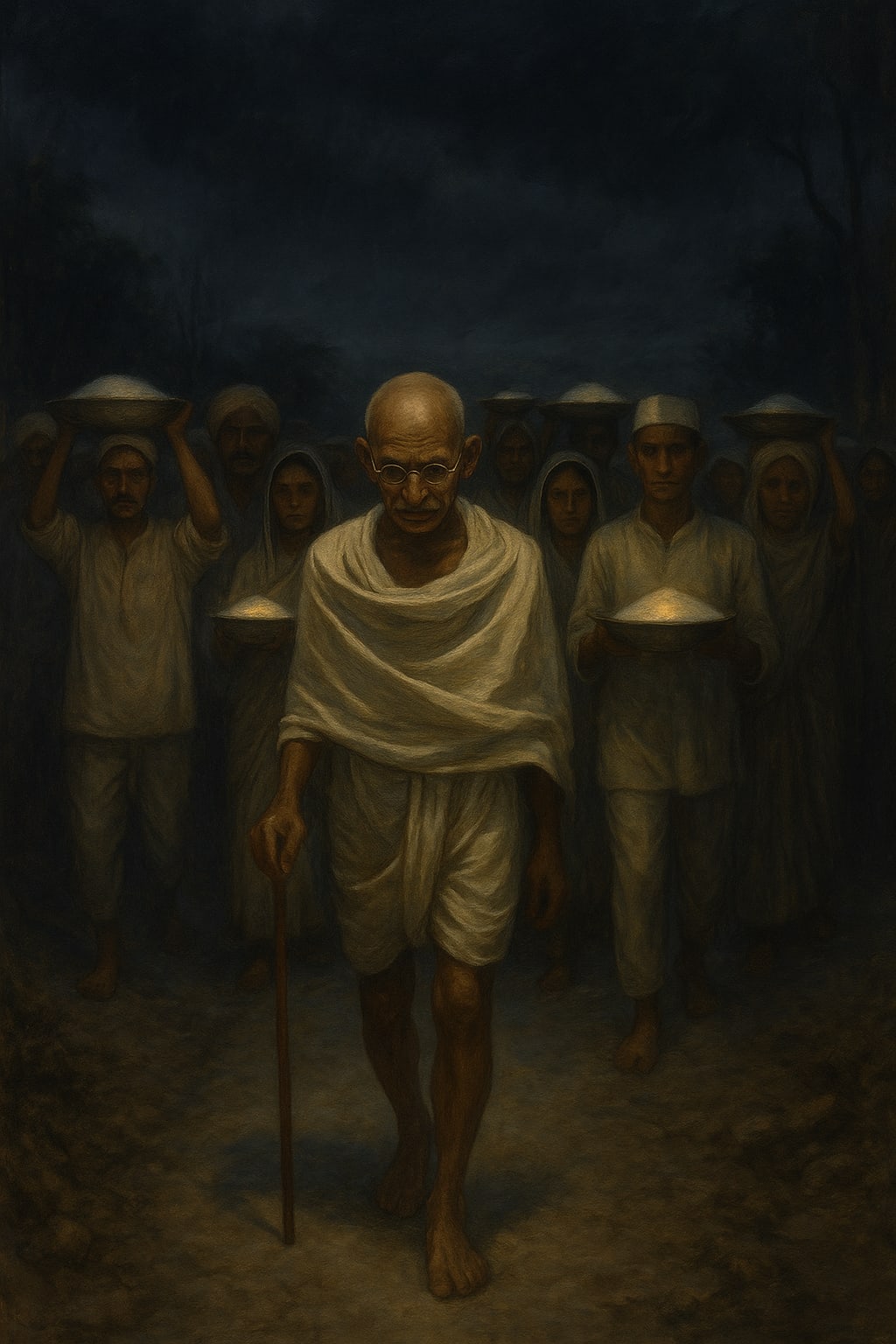
April 25, 1930 – Yerwada Jail, Pune
Salt in the Wind
This morning, a crow landed on the sill of my barred window. It did not caw, nor move quickly, but observed me as I turned the charkha. I greeted it softly. It remained, and we shared a few minutes of silence together. In some ways, I felt it was bringing a message — or perhaps simply bearing witness. Even the birds now seem to know that something is changing in the air.
The guards no longer laugh as they used to. They have become quiet, as though unnerved by the calm we carry in our protest. One of them brought my simple meal and lingered by the bars. “The newspapers call it a contagion,” he said. “But no one seems sick.”
I looked up at him and replied gently, “They are right. But it is not a sickness — it is awakening.”
He did not answer. He nodded and walked away slower than before.
Each day here passes slowly but with purpose. I rise before the sun and offer prayers not for release, but for clarity. In solitude, I have come to understand how deeply connected I remain to the people. Our struggle has no single leader, and I feel less like a figurehead, more like a thread in the larger fabric — stretched taut, but never broken.
The stories reach me even through walls. A message smuggled in a rolled scrap of cloth told me of a salt march led by children in Ujjain. They bore no banners, only handfuls of salted earth. At the gates of the British customs house, they stood silently, then scattered the salt on the ground, forming the shape of Bharat Mata. The constables did not know whether to laugh, scold, or weep. They did nothing.
The children bowed and left, barefoot and proud. That, too, is revolution.
Elsewhere, I am told, potters in Gujarat now fire their clay with salt added to the kiln — a symbolic gesture, fusing resistance into the ordinary. When customers ask why the clay has a strange white dust, they reply, “Because freedom tastes like this.”
Even our spices are changing. In kitchens from Bengal to Travancore, I hear women add a pinch of sea salt with reverence, murmuring blessings over the pot. “This is not for flavor,” one wrote, “but for memory.”
How strange and beautiful that salt, so humble and common, should carry the weight of liberty.
A British official once told me: “You mean to bring down an empire with salt?”
I smiled and replied, “Yes. And perhaps with silence, too.”
They do not yet understand. They seek to break bodies — not knowing that we have left those behind already. We are now breath and will and conscience. We are a people who will not raise a weapon, not because we fear punishment, but because we refuse to become what we resist.
I heard a new song has emerged in Tamil villages — a salt hymn sung at sunrise by women gathering water. No one knows who wrote it. That, too, is part of our strength: it does not matter who creates, but that it lives and spreads.
“We take the sea and boil it dry,
We take the sky and breathe it free,
With every grain, we sanctify,
The birth of what shall come to be.”
The rhythm of these lines matches the charkha. I have begun to hum it as I spin.
I do not ask what will come next. That is for the soil to know.
Repression is tightening. Arrests multiply. The British press tries to dismiss us, mock us, define us. They call us fools, mystics, rebels, saints.
But none of those words will hold the truth. The truth is that we are becoming ungovernable — not through violence, but through awakening. Our allegiance is no longer bought with fear. And without fear, power crumbles.
Somewhere in Bengal, a woman was arrested for placing salt outside a church. She was asked why she defiled the holy ground.
She answered: “I offered it for the wounds of this land.”
When asked if she was Hindu or Christian, she said only: “I am Indian. And I heal what I can.”
I dream of India, not as a nation in arms, but as a people walking with heads high, palms open, and eyes filled with truth. An India where no child must bow, where no woman is silenced, and where labor is honored rather than exploited.
That India is rising. Not from parliaments, but from villages. Not from decrees, but from prayers, gestures, and grains of salt offered to the wind.
We do not march to topple — we march to remind the world that power without ethics is dust.
And in that dust, we walk barefoot. Toward something greater than empire.
Toward each other.
M.K. Gandhi
About the Creator
Alain SUPPINI
I’m Alain — a French critical care anesthesiologist who writes to keep memory alive. Between past and present, medicine and words, I search for what endures.
Keep reading
More stories from Alain SUPPINI and writers in Chapters and other communities.
Mastering French Without Losing Your Sanity: A Realistic Guide for Beginners
Learning French can feel like solving a Rubik’s Cube blindfolded. The tricky pronunciation, the never-ending grammar rules, and the surprising exceptions make it seem impossible. But don’t worry—equipping yourself with key expressions and effective strategies can turn frustration into fluency. Let’s simplify French and make learning enjoyable.
By Alain SUPPINIExclusive • 11 months ago
Fair Exchange, No Robberies
Dark Memoirs - Index There are at least two kinds of people in the world: those who write this half-arsed kind of intro to a story that looks to separate the rare and the norm, and those who realise it's an overused framing device and don't.
By Paul Stewart14 days ago in Chapters
Center Stage with Paul Stewart
*** I'm keen to republish the interviews I did for my series with Vocal creators. It's been a few years and I thought it might be nice to revisit these wonderful conversations. I'll be releasing them one at a time for a few weeks/months.
By Heather Hubler4 days ago in Interview



Comments (1)
This is powerful stuff. The idea of the crow bringing a message really stuck with me. And those kids in Ujjain leading a salt march? That's amazing. Made me wonder what small acts of resistance we can start in our own lives today.