

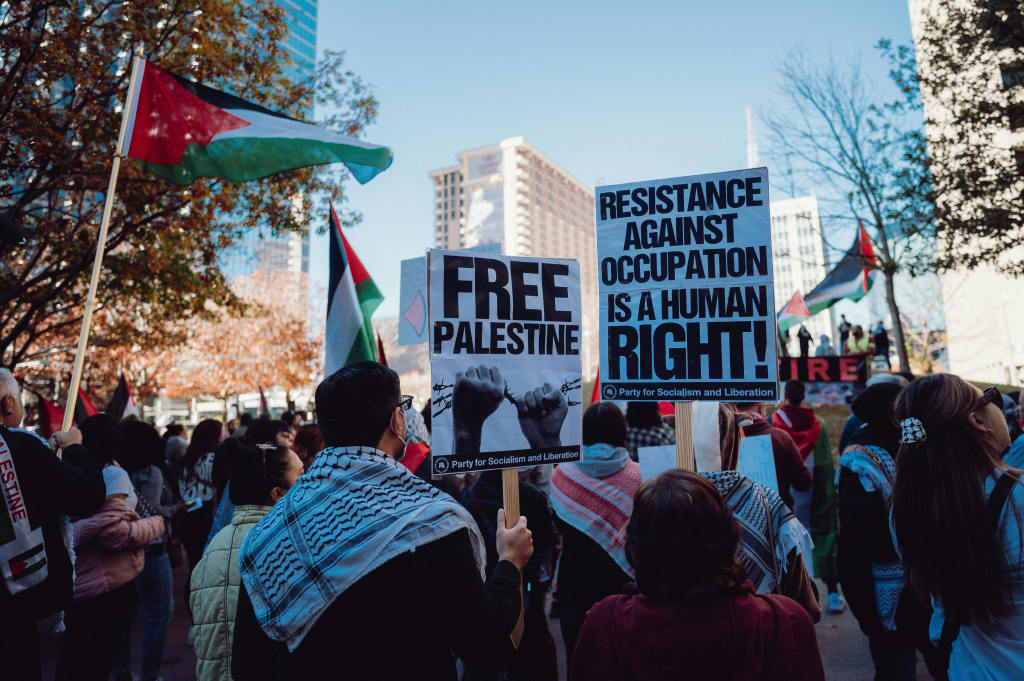
Free Free Palestine
Freedom is Our Life
The sun rose over Gaza with a defiance that mirrored the people beneath it. It pushed through smoke and shattered windows, poured over fractured homes and blood-stained alleyways, insisting—despite everything—that morning still had meaning.
Amina sat by the window of what was once her bedroom. The glass was long gone, replaced by a curtain of canvas, stitched together from old clothing and aid bags. Outside, the street was unusually quiet. The kind of quiet that hums with tension, where even the birds seem to hold their breath.
She clutched her younger brother’s hand—Yousef, only eight but with eyes older than many men. They hadn’t seen their father in weeks. He had gone to deliver medical supplies across the city and never returned. Her mother never spoke of it, but every time the door creaked, she turned her head too fast, too hopeful.
Amina, only seventeen, felt the weight of an entire country on her shoulders. Not just her family’s survival, but the duty to remember, to resist, to hope. Her name meant "safe"—a cruel irony in a land where safety was a luxury few could afford.
At night, stories became their only escape.
“Tell us about the olive trees,” Yousef would whisper under the thin blanket, his voice barely audible over the distant hum of drones.
Amina would close her eyes and begin. “The olives were as green as emeralds, the trees older than our ancestors. They lined the hills like an army of peace, their roots so deep not even tanks could shake them…”
She always ended her stories with the same line: “And one day, we will plant our own tree, on our land, under a sky without fire.”
Across the border, in a refugee camp in Jordan, an old man named Khalil opened a dusty suitcase. Inside were faded photographs, yellowed letters, and a key. The key was rusted but intact. It belonged to a home in Haifa he hadn’t seen since 1948.
Khalil had been a boy when his family fled, thinking they'd return in days. Days became decades. Generations. But he carried that key like a compass. A symbol. A promise.
His granddaughter, Layla, knelt beside him.
“Jiddo,” she asked softly, “do you really think we’ll ever go back?”
Khalil looked out toward the horizon. “I don’t just think it. I know it. Palestine lives in us. And one day, she will breathe again.”
Back in Gaza, Amina and Yousef walked to the school that still stood, despite the shelling. It had no roof, but the chalkboard remained. And somehow, that was enough. Their teacher, Mrs. Samira, had lost her husband and two children in an airstrike, but she taught every day as if it were her duty to defy despair itself.
She wrote on the board: "What does freedom mean to you?"
Amina stared at the words. Around her, the other children scribbled in silence.
She wrote:
“Freedom is not just the absence of bombs. It is the right to dream, to laugh without flinching, to build without watching it fall. Freedom is walking to school without fear. It is my mother smiling without hiding her pain. It is a future—ours to shape, not to survive. Freedom is our life. And it is coming.”
That night, planes flew low again, rumbling across the sky like monsters in search of prey. Amina didn’t sleep. She sat by the window, whispering stories to the stars, praying they’d carry her words beyond the walls.
In her heart, a fire burned—not of hatred, but of hope. It was the fire of generations who had suffered, yes, but never surrendered. From the stones of the first Intifada to the digital cries on social media, the message was the same:
“We are still here. And we will not be silenced.”
Thousands of miles away, in a bustling college campus in London, a group of students held a candlelight vigil. Layla, now a law student, stood before the crowd, her keffiyeh wrapped proudly around her shoulders.
“My grandfather kept a key,” she told them, her voice clear. “But we are the key. We unlock the stories, the truths, the cries they try to silence. Palestine is not a distant land—it’s a living wound on the conscience of the world.”
Candles flickered in the cold air, their flames dancing like tiny revolutions.
“Free, free Palestine!” someone chanted.
And others followed.
“Free, free Palestine!”
In Gaza, the sun rose again. And Amina, eyes tired but unbroken, stepped out into the street with Yousef. He carried a small sapling in a plastic cup.
“What are you doing with that?” she asked, smiling faintly.
“I want to plant our tree,” he said. “Just like in your stories.”
She knelt beside him, dug a shallow hole in a small patch of dirt between rubble and ruin, and together, they placed it there.
A tiny olive tree, fragile yet stubborn. Like them.
Above, the sky was gray. But beneath it, life dared to grow.
Because even in the darkest corners, freedom takes root.
And in the heart of every Palestinian beats a truth the world must hear:
Freedom is not a wish.
It is a birthright.
It is our life.
About the Creator
Keep reading
More stories from writers in Chapters and other communities.
Search for a Sister, Chapter Two
4-H-N heard not a word about her secret mission around Headquarters over the following days, so had to conclude either Mini-Flash Phytolith hadn’t been listening in after all, or she’d misjudged him. She hoped it was the latter, as she wanted the pair of them to get on, even if he wasn’t going out of his way to make it easy for her.
By Doc Sherwood20 days ago in Chapters
Brass Ring Chapter 11: When Bad Fights Happen to Good Stores
In the sauna back at CAPES headquarters, Oliver and Cass were enjoying the steam. “Having telekinesis means not having to move.” A dipper moved apparently of its own accord and splashed water on the rocks. As the steam went up the dipper went down.
By Jamais Jochimabout 7 hours ago in Chapters
How, Too
Many people wonder how, too. You are not alone, and I am an expert. I will teach you how, too! First, you need to remit a small application fee and fill out an application describing the nature of your financial situation and how often payments will be made, as this will have great bearing on how well I teach you how, too.
By Harper Lewis3 days ago in Fiction


Comments
There are no comments for this story
Be the first to respond and start the conversation.