

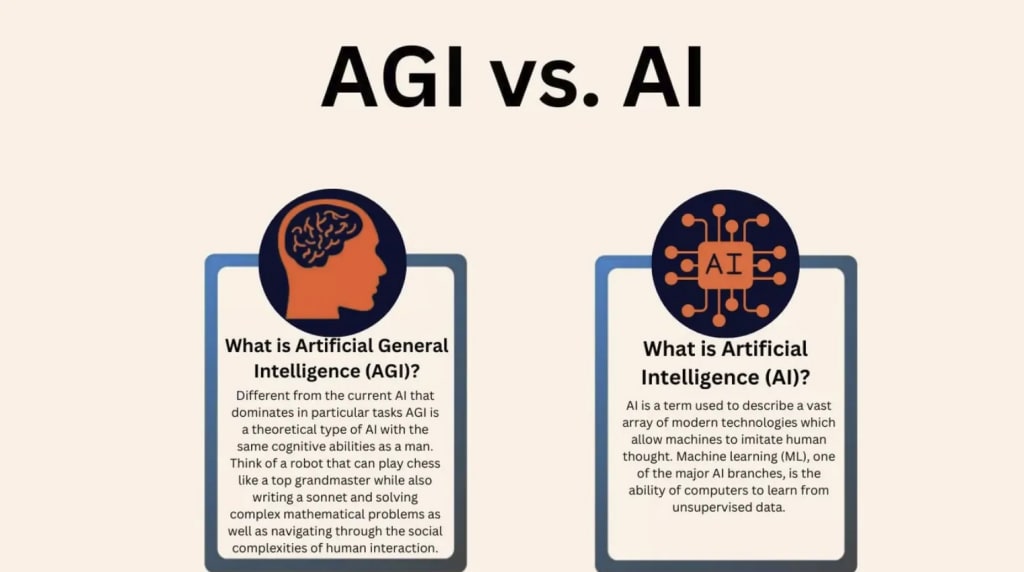
Artificial Intelligence (AI) has become a cornerstone of modern technology, powering everything from voice assistants to predictive algorithms. However, a critical distinction exists between what we call “AI” and the aspirational concept of Artificial General Intelligence (AGI). While both belong to the broader field of artificial intelligence, they differ fundamentally in scope, capability, and purpose.

What is AI?
AI, or Artificial Intelligence, refers to systems designed to perform specific tasks using data and algorithms. These systems can range from simple rule-based programs to advanced machine learning models. Importantly, most AI today is narrow AI, meaning it is specialized and excels in a single domain or a limited set of tasks. For instance:
Narrow AI Examples:
1. A recommendation engine suggesting movies or products.
2. A diagnostic system identifying diseases from medical images.
3. A natural language model generating text or translating languages.
Narrow AI lacks the ability to generalize beyond its training and is confined to the tasks it has been programmed or trained to perform.
What is AGI?
Artificial General Intelligence (AGI) refers to a theoretical system capable of understanding, learning, and applying knowledge across a wide range of tasks, much like a human. AGI would not be limited to specific functions; instead, it could adapt to new situations and solve problems it hasn’t encountered before.
Key features of AGI include:
1. Generalization: AGI can transfer knowledge from one domain to another.
2. Adaptability: It can learn and improve autonomously without specific programming for new tasks.
3. Comprehensiveness: AGI can perform any intellectual task a human can do, including reasoning, problem-solving, and creativity.
Challenges in Developing AGI
Technical Complexity:
Replicating the human brain’s adaptability and reasoning is a monumental challenge. It requires breakthroughs in machine learning architectures, computational efficiency, and neuroscience.
Ethical and Societal Implications:
AGI raises complex ethical issues, such as alignment with human values, privacy concerns, and the potential for misuse.
Resource Requirements:
Developing AGI could demand enormous computational and financial resources, making collaboration across industries essential.
Why the Distinction Matters
Understanding the difference between AI and AGI is crucial for setting realistic expectations and addressing concerns. While narrow AI has already transformed industries, AGI represents a much larger leap that could fundamentally change how humans interact with technology. Discussions about AGI often involve speculative benefits, risks, and ethical considerations that differ significantly from those of narrow AI.
The Road Ahead
AI continues to evolve, becoming more sophisticated and versatile, yet still constrained by its narrow focus. Meanwhile, the pursuit of AGI remains a long-term endeavor, requiring interdisciplinary collaboration across computer science, neuroscience, ethics, and philosophy.
While AI is here and shaping our daily lives, AGI represents an uncertain but fascinating future — one where machines might not just assist us but think alongside us.
About the Creator
Keep reading
More stories from Gustavo Woltmann and writers in Chapters and other communities.
The Origins of the Italian Mafia
The Italian Mafia’s roots in the United States trace back to the late 19th and early 20th centuries, when waves of Italian immigrants sought new opportunities in America. Many were fleeing poverty and oppression in southern Italy and Sicily, but they faced significant prejudice, economic hardship, and limited access to resources in their new country. Within this environment, elements of the Italian criminal organizations, particularly the Sicilian Mafia, found fertile ground to establish themselves in American cities. Over time, this criminal network evolved into one of the most notorious organized crime groups in U.S. history, profoundly shaping American society and culture.
By Gustavo Woltmann4 months ago in Chapters
Pakistani Man Asif Merchant on Trial in New York Over Alleged Trump Assassination Plot Linked to Iran’s IRGC
A Pakistani citizen, Asif Merchant, who was arrested on charges of planning the assassination of former U.S. President Donald Trump, has appeared in court in New York as the trial against him begins. During the proceedings, he told the court that he had been working A Pakistani citizen, Asif Merchant, who was arrested on charges of planning the assassination of former U.S. President Donald Trump, has appeared in court in New York as the trial against him begins. During the proceedings, he told the court that he had been working with Iran’s Islamic Revolutionary Guard Corps (IRGC) and that the plan involved recruiting hired assassins.
By Real contenta day ago in Chapters
The BAFTA Awards
By now, in a stunning departure from recent years, most of the world is aware of what happened at the BAFTA film awards. Social Media Headlines will tell you the bare bones: that John Davidson, a Tourette's Syndrome advocate, shouted a racial slur at two Actors of Colour, Michael B Jordan and Delroy Lindo.
By Natasja Rose4 days ago in Psyche




Comments