
The Origins of the Italian Mafia
In the United States

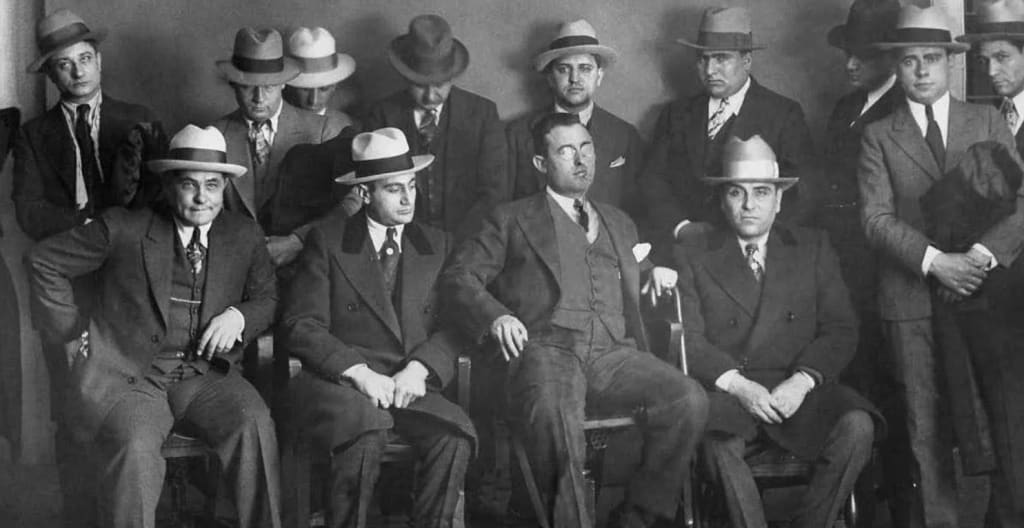
The Italian Mafia’s roots in the United States trace back to the late 19th and early 20th centuries, when waves of Italian immigrants sought new opportunities in America. Many were fleeing poverty and oppression in southern Italy and Sicily, but they faced significant prejudice, economic hardship, and limited access to resources in their new country. Within this environment, elements of the Italian criminal organizations, particularly the Sicilian Mafia, found fertile ground to establish themselves in American cities. Over time, this criminal network evolved into one of the most notorious organized crime groups in U.S. history, profoundly shaping American society and culture.
The Italian Immigrant Experience
Between 1880 and 1924, around four million Italians migrated to the United States, primarily from southern Italy and Sicily. These immigrants often arrived with limited English skills, few job opportunities, and no established support networks, which led to the formation of tight-knit Italian communities in urban centers like New York City, Chicago, Philadelphia, and New Orleans. Living in densely populated neighborhoods, many immigrants faced poverty, discrimination, and limited access to legal protections and economic opportunities, making them susceptible to exploitation by organized crime.
Sicilian Mafia Roots
The origins of the Italian Mafia in the United States can be traced to Sicily, where the Mafia had long existed as a network of secretive and powerful criminal organizations. The Sicilian Mafia, or Cosa Nostra (meaning “Our Thing”), operated under codes of loyalty, family, and secrecy, taking control of various enterprises and engaging in extortion, smuggling, and violent crime. As Sicilian immigrants settled in American cities, many brought with them this established system of loyalty and family ties, adapting it to their new environment.
The New Orleans Connection
The first notable instance of Mafia activity in the United States occurred in New Orleans, where Italians had settled since the early 19th century. In 1890, the city was rocked by the assassination of police chief David Hennessy, who had been investigating local Sicilian gangs involved in protection rackets. Following his death, the New Orleans police arrested many Italian suspects, but most were acquitted in trial due to a lack of evidence. This led to a mob lynching of 11 Italian immigrants, some of whom were connected to criminal activity. This case marked the beginning of the Mafia’s visibility in the United States and set a precedent for Mafia involvement in crime and community affairs.
Prohibition and the Rise of Organized Crime
Prohibition, enacted in 1920 with the passage of the 18th Amendment, became a turning point for the Italian Mafia in America. The ban on alcohol created an enormous demand for illegal liquor, and organized crime groups, including Italian-American gangs, quickly stepped in to fill this void. Bootlegging became one of the most lucrative enterprises of the era, leading to intense competition and often violent turf wars between criminal organizations.
The Italian Mafia, particularly in cities like New York and Chicago, seized the opportunity to consolidate their power and expand their influence. Infamous mobsters such as Al Capone in Chicago and Charles “Lucky” Luciano in New York capitalized on the Prohibition era to build vast criminal empires, employing bribery, violence, and political connections to operate outside the law. Prohibition gave the Mafia unprecedented financial resources, organizational structure, and influence.
The Rise of Mafia Families and the Commission
The Mafia’s rise in America saw the emergence of a hierarchical structure similar to that of the Sicilian Cosa Nostra, but with unique American adaptations. By the 1930s, the Mafia in the United States was organized into families, each controlling specific territories and operations. Five major families — Genovese, Gambino, Lucchese, Bonanno, and Colombo — emerged in New York, becoming known as the “Five Families.” Other cities like Chicago, Philadelphia, and Detroit had their own powerful families with similar structures and codes.
In 1931, Lucky Luciano played a pivotal role in establishing the Commission, a governing body of Mafia leaders from major families across the country. The Commission was created to reduce conflicts between families and manage disputes, allowing the Mafia to operate more cohesively and control crime networks nationwide. The Commission furthered the Mafia’s shift from smaller, isolated gangs into a more coordinated and organized system of crime.
Expansion Beyond Bootlegging: Gambling, Extortion, and Labor Unions
When Prohibition ended in 1933, the Mafia diversified its activities. They expanded into gambling, extortion, drug trafficking, loan sharking, and labor union infiltration. Labor unions became a particularly powerful tool for the Mafia; through controlling unions, they exerted influence over major industries, such as construction, shipping, and manufacturing. Mafia families used intimidation and corruption to maintain control over union leadership, securing lucrative contracts and siphoning money from union funds.
The Mafia’s control over unions also gave them substantial political leverage, allowing them to influence politicians and businessmen. This influence allowed the Mafia to operate with relative impunity in many cities, as they frequently bribed law enforcement and politicians to protect their interests.
Cultural Impact and Notoriety
By the mid-20th century, the Italian Mafia had firmly embedded itself in American society. Their notoriety was fueled by a media fascination with mobsters, which glamorized the lifestyles of men like Al Capone, Lucky Luciano, and later John Gotti. The Mafia’s criminal empire had a stronghold in American cities, its operations largely unchallenged by law enforcement until the latter half of the century, when FBI investigations and high-profile trials brought many members to justice.
Hollywood films such as The Godfather and Goodfellas captured public imagination, further cementing the Mafia’s cultural legacy. These films portrayed the Mafia’s complex code of loyalty and the harsh realities of mob life, illustrating both the allure and brutality of organized crime.
The Italian Mafia in the United States grew from the hardships faced by Italian immigrants, who were isolated and marginalized in their new country. Over time, these criminal organizations leveraged prohibition, labor unions, and a powerful sense of loyalty to create a network that permeated many layers of American society. Today, while the influence of traditional Mafia families has diminished due to law enforcement efforts and societal changes, the legacy of the Mafia continues to impact American culture and remains a potent symbol of the darker side of the American dream.
About the Creator
Keep reading
More stories from Gustavo Woltmann and writers in Chapters and other communities.
Mountain Formation
Mountains, with their awe-inspiring peaks and ridges, are the result of dynamic geological processes occurring over millions of years. The formation of mountains, or orogeny, involves tectonic forces, volcanic activity, and erosion, all of which contribute to shaping the Earth’s surface. Mountains not only influence climate and ecosystems but also play a significant role in human culture, history, and settlement patterns.
By Gustavo Woltmann3 months ago in Chapters
Fair Exchange, No Robberies
Dark Memoirs - Index There are at least two kinds of people in the world: those who write this half-arsed kind of intro to a story that looks to separate the rare and the norm, and those who realise it's an overused framing device and don't.
By Paul Stewart13 days ago in Chapters
Sacrifices For The Balance Chapter 8: The Investigations Get Serious
Lady Astor parked her electric SUV just outside the dog rescue. She had decided to start with Maddy Tennyson; even if she couldn't get her to commit to her cause, she could be useful in gauging the political environment. She had decided to go with the jeans and boots look; she was as ready to work as she was to talk.
By Jamais Jochimabout 5 hours ago in Chapters
A Dart at Dusk
Seconds ago, the sullen sun set on the two of us… my exuberant furry companion and me. A fresh breeze embraces us, delivering welcome relief from the day’s oppressive heat. His typical stumbling and staggering along — apace with a sloth — has turned into trip-trapping, high-stepping, almost skipping along.
By Angie the Archivist 📚🪶4 days ago in Petlife


Comments