
A Silent Province, A Wounded Heart: The Crisis of Balochistan and the State's Responsibility
Unveiling the Pain, the Struggle, and the Unheard Voices of Balochistan

Introduction
In the southwest corner of Pakistan lies Balochistan, the largest yet most neglected province of the country. Spread over nearly 44% of the national territory, its deserts, mountains, and coastlines hold not just natural resources but stories of pain, deprivation, resistance, and resilience. From Quetta to Gwadar, from Khuzdar to Turbat, the air is thick with silent screams — of mothers who have lost sons, of families without water and electricity, and of soldiers fighting in the shadows of a long-festering conflict. While the rest of the country debates politics and progress, Balochistan remains caught in a cycle of conflict, underdevelopment, and mistrust. This article is an attempt to explore the reality on the ground — the people’s suffering, the state’s failures, the burden on security institutions, and the lingering hope for a better tomorrow.
---
The People’s Pain: Life Without Basics
For most Balochistanis, life is a daily struggle — not just against poverty, but against being forgotten. Access to clean drinking water is a luxury in many districts. Cities like Gwadar, despite international attention under the China-Pakistan Economic Corridor (CPEC), face severe water shortages. Hospitals are few and far between. In rural areas, people often travel hours — even days — to reach a medical facility, only to find no doctors, no medicine, and no electricity.
Education, a fundamental right, is out of reach for a majority. According to reports, nearly 70% of children in Balochistan are out of school. The literacy rate remains the lowest among all provinces. Roads are broken or non-existent, and where infrastructure does exist, it often serves the needs of the powerful — not the people.
Electricity is another ghost that occasionally flickers in and out. Entire villages live in darkness for 18 to 20 hours a day. Small businesses suffer, students can’t study, and hospitals can't function. The people of Balochistan are not just poor — they are deprived, systemically and historically.
---
The Psychological Toll: Alienation and Anger
Neglect breeds anger, and anger left unheard festers into alienation. For decades, the people of Balochistan have felt abandoned by the central government. They see their resources — gas, copper, gold, and now the deep sea port of Gwadar — being extracted and exported, while their own children die of curable diseases. They ask: "What has Pakistan given us in return?"
This sense of marginalization has created space for separatist ideologies and armed movements. While the majority of Baloch still believe in peaceful resistance and dialogue, others have picked up arms, seeing no other way to be heard. The result is a province caught in a low-intensity war that rarely makes it to national headlines but leaves a heavy toll on lives and trust.
---
Security Forces: Frontline Without Applause
It is impossible to speak about Balochistan without acknowledging the sacrifices of Pakistan’s security forces. FC, Army, and police personnel are deployed in some of the harshest and most dangerous terrains in the country. They are often the first to respond to terror attacks, ambushes, and bomb blasts.
Every month, soldiers die in remote mountain passes. Every year, families of uniformed men bury their loved ones, often in silence. The burden on these institutions is immense — to maintain peace, protect CPEC routes, guard international borders with Iran and Afghanistan, and prevent smuggling and terrorism — all with limited resources and constant criticism.
Yet, their presence is often viewed with suspicion by the local population. Checkposts, raids, and counter-terror operations have, at times, alienated civilians. There’s a need for empathy on both sides — for people to recognize the sacrifices of these forces, and for the forces to approach the population not just as potential threats, but as fellow citizens.
---
The Missing Persons Tragedy
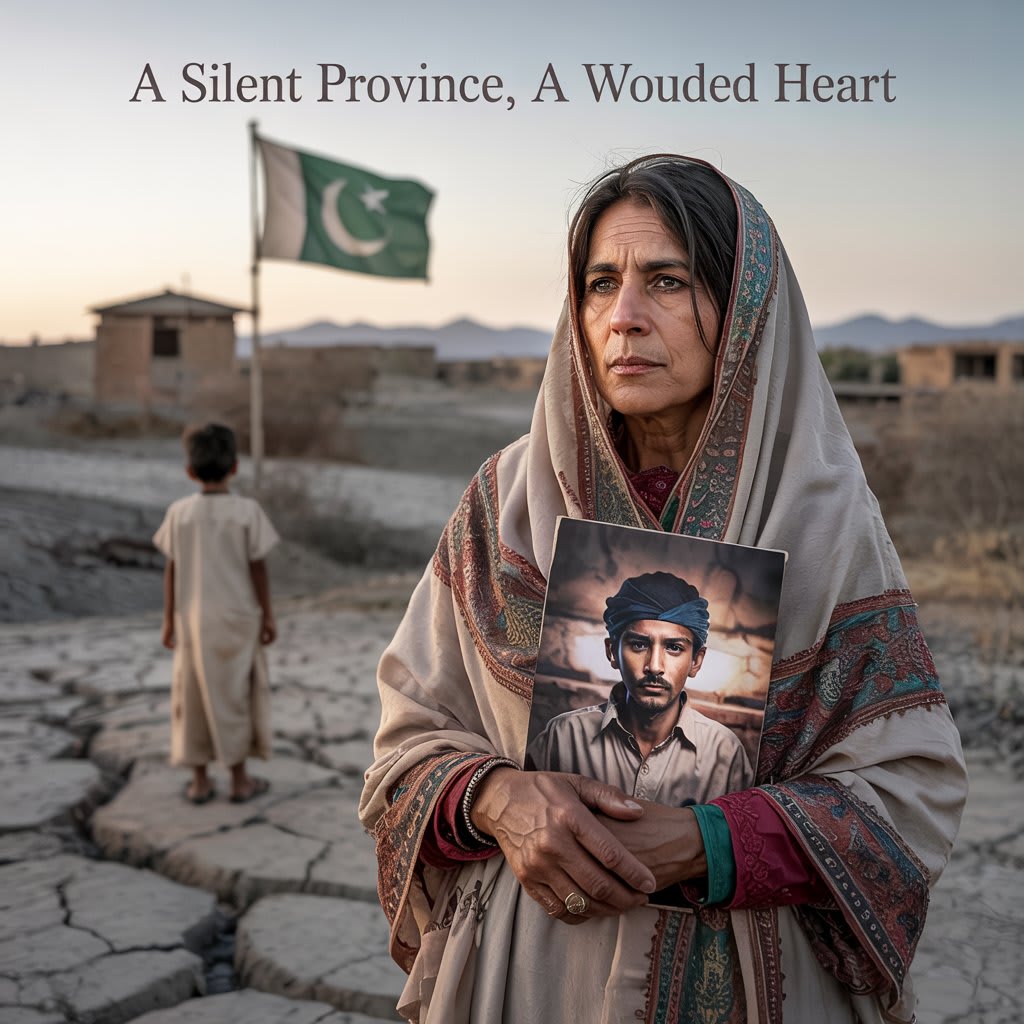
One of the most haunting aspects of the Balochistan crisis is the issue of missing persons. Thousands of families claim that their loved ones have been taken without due process — often suspected of links to separatist groups. Their cries have echoed in Quetta's press clubs and Islamabad's D-Chowk. Each name is a story; each face, a universe of grief.
While the state argues that many of these individuals are involved in armed militancy, the absence of legal proceedings fuels distrust. Forced disappearances are not just a human rights violation — they are a political wound that bleeds into the next generation. The road to peace cannot be paved with silence and shadows.
---
The Political Class: Between Power and Paralysis
Balochistan’s political leadership has often been accused of being more loyal to Islamabad’s power corridors than to their own constituencies. Corruption, mismanagement, and opportunism have plagued governance for decades. Even when funds are allocated, they are rarely used for public welfare. Development budgets vanish into ghost projects or sit unused.
Chief ministers come and go — often after deals made in drawing rooms rather than through democratic demand. This instability weakens provincial institutions and leaves the bureaucracy directionless. Without genuine, empowered, and accountable leadership, no province can thrive — and Balochistan is no exception.
---
CPEC and Gwadar: Promise or Paradox?
CPEC was hailed as a game-changer for Pakistan, and Gwadar was to be its crown jewel. Billions were invested in roads, pipelines, and a deep-sea port. Yet, for the average Gwadari, life has changed very little. Protests erupt over water scarcity, unemployment, and fishing rights. The Haq Do Tehreek (Give Us Our Rights Movement) is a manifestation of this local frustration — peaceful, persistent, and deeply telling.
The question many ask is: Who benefits from CPEC? If the people of Gwadar are not employed, not empowered, and not consulted, then what development are we talking about? Real progress is not in concrete and cranes, but in classrooms, clinics, and clean water.
---
Natural Resources: Rich Land, Poor People
Balochistan is home to vast reserves of natural gas, gold (Reko Diq), and copper. For decades, the rest of Pakistan has lit stoves with gas extracted from Sui, yet Sui itself remains in darkness. This paradox — of wealth underground and poverty above — defines the Baloch experience.
Reko Diq, one of the world's largest untapped gold and copper reserves, is now back in the spotlight with new agreements being signed. But locals fear that once again, they will see the dust of trucks, not the color of prosperity. Unless resource extraction directly benefits local communities — with jobs, royalties, and environmental protections — it will only deepen resentment.
---
Women and Children: The Silent Victims
In conflict zones, it is often women and children who suffer the most. In Balochistan, maternal mortality is among the highest in the country. Basic gynecological care is unavailable in many districts. Women walk miles for water, carry the burden of family survival, and endure the pain of loss in silence.
Children grow up in fear and hunger. Malnutrition rates are alarming. In some areas, young boys are recruited — willingly or through pressure — into armed groups. Girls drop out of school due to cultural constraints, insecurity, or simple lack of access. The next generation is growing up angry, anxious, and uncertain.
---
The Media Blackout and National Apathy
One of the greatest tragedies of Balochistan is how little the rest of Pakistan knows or cares. Media coverage is sporadic and often censored. Journalists are threatened, attacked, or restricted. Stories from Kech, Awaran, or Panjgur rarely make it to primetime.
This information blackout allows myths to grow, pain to deepen, and solutions to remain distant. A democratic society must hear all its voices — especially the ones that are crying out. The silence around Balochistan is not just dangerous — it is criminal.
---
What Must Be Done: Toward Healing and Hope
Healing Balochistan is not impossible. But it requires courage — political, moral, and institutional. The state must:
Acknowledge past mistakes honestly and publicly.
End enforced disappearances and ensure justice for all — including militants and security personnel.
Prioritize development that benefits locals — not just investors.
Empower Balochistan’s youth through education, skill-building, and representation.
Reform the political structure to reward competence, not compliance.
Strengthen civilian institutions to reduce overreliance on security solutions.
Dialogue is not weakness — it is the only way forward. Development is not a favor — it is a right. Justice is not optional — it is foundational.
---
Conclusion: Listening to the Wounded Heart
Balochistan is not a colony; it is Pakistan. Its people are not enemies; they are citizens. Its resources are not just assets; they are responsibilities. Every drop of water denied, every school left unopened, every body buried in silence — all of it shapes the nation’s future.
The wounds of Balochistan are deep, but not incurable. They require more than words — they require will. Pakistan must choose: continue the cycle of silence and suffering, or finally embrace the courage to listen, to heal, and to act.
Thanks for reading 📖
---
About the Creator
Umair Ali Shah
Writer exploring life, truth, and human nature through words. I craft stories, essays, and reflections that aim to inspire, challenge, and connect. Every piece is a step on a shared journey of thought and emotion.
Keep reading
More stories from Umair Ali Shah and writers in Chapters and other communities.
Imran Ahmed Khan Niazi’s Government: A Distinct Chapter in Pakistan’s 74-Year Political History
Introduction Since gaining independence in 1947, Pakistan has witnessed a variety of leadership styles, political ideologies, and governance structures. Among the many political leaders who held the office of Prime Minister, Imran Ahmed Khan Niazi stands out not only for his cricketing fame but also for his ambitious and reformist approach to governance. Leading the Pakistan Tehreek-e-Insaf (PTI), Imran Khan assumed office on August 18, 2018, and served until April 10, 2022 — a period of approximately 3 years and 8 months. His tenure, though short of the full five-year term, left a significant impact on Pakistan’s political, economic, and social landscape. This article explores the beginning of his government, the challenges he faced, the initiatives he introduced for the welfare of the common man, and how his overall performance compares to the governance of Pakistan over the past 74 years and 9 months.
By Umair Ali Shah 9 months ago in Chapters
Bruce Lee and The God of War: Kuan Ti
It starts with love.. The Power to the God Of War and Wealth Walk into a Chinese restaurant (even in Oklahoma, USA), a Chinese police station, a kung fu martial arts studio or even a Chinese temple and you often see a red faced warrior holding a heavy quan-do (spear like weapon).
By WILD WAYNE : The Dragon King12 days ago in Chapters
The Ritual of Demand, Chapter Two
The subsequent phases of the solar cycle saw a tremendous change in Flashpower. He was a happier and more confident Mini-Flash all round. He lost his wan distracted look and his cheeks flushed with colour, the freckles on his snub nose standing out boldly. In class he could concentrate again, and his grades began to improve. Even his Flashball picked up a little, and when someone got the better of him he started taking it as any boy would, instead of getting his knickers in a twist. The adult Flashes all agreed Flashpower was finally getting the hang of being the age he was.
By Doc Sherwood6 days ago in Chapters
Wild Card Weekend Recap: What Happens Now?
I think I figured out why I love Wild Card Weekend so much. It's because it's the first playoff anything of the calendar year. The NFL season starts in the fall, and once upon a time, the champion was crowned either on or slightly before New Year's. The evolution of the NFL schedule has resulted in the playoffs starting just into the New Year, and currently, the final week of the season falls on the first weekend of the New Year, with Wild Card Weekend coming a week after that. So yes, chronologically, the NFL's Wild Card Weekend serves as the first playoff anything of the calendar year.
By Clyde E. Dawkins7 days ago in Unbalanced



Comments
There are no comments for this story
Be the first to respond and start the conversation.