
Zippers, Jumpscares, and the Burden of Expectation:
Five Nights at Freddy’s 2 Roars Back into Pop Culture

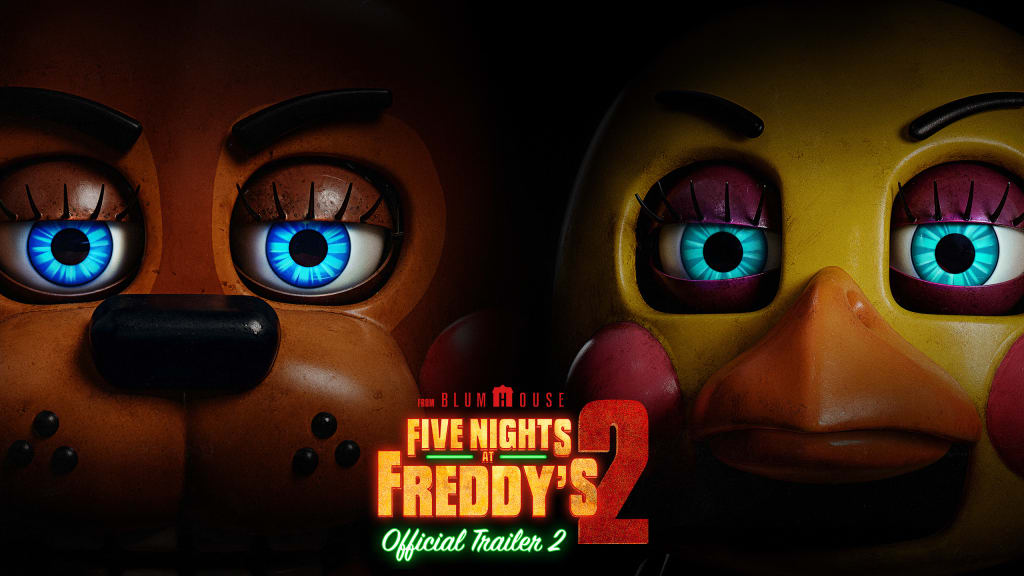
It feels fitting that Five Nights at Freddy’s 2—a movie about nightmarish animatronics coming alive when they’re not supposed to—would itself arrive under somewhat ominous conditions.
The sequel to the 2023 adaptation of Scott Cawthon’s viral horror game landed in theaters December 5, 2025, and did what its mechanical antagonists do best: it stirred up a wide spectrum of reactions. From strong box office numbers to deeply divided critical opinion, this follow-up has become less of a quiet continuation and more of a cultural mirror, reflecting both fandom fervor and franchise fatigue.
Where the first Five Nights at Freddy’s film sprang from relative obscurity to become one of the most successful horror adaptations in recent memory—eventually grossing nearly $300 million worldwide and becoming Blumhouse’s highest-grossing title ever—the sequel entered the world with a history already attached. Expectations were high. Apprehension was high. And critics? They were… underwhelmed.
If you walk into Five Nights at Freddy’s 2 expecting a perfectly polished horror feature that bridges game lore and cinematic craft, you may leave bewildered. But if you walk in as someone who’s zealously followed every breadcrumb of FNAF mythology for the past decade—game tutorials, theory videos, fan art and lore dissections—the movie delivers exactly what the built-in audience has been craving.
Director Emma Tammi and series creator Scott Cawthon didn’t shy from doubling down on the franchise’s roots. Teasers and interviews leading up to the release promised an expanded roster of animatronic nightmares, promising three times the number of mechanical terrors compared with the first film and more Easter eggs for die-hard players of the game.
GamesRadar+
Matthew Lillard, one of the returning cast members, said openly that fans wanted more “jump scares and lore,” and the marketing leaned hard into that promise.
It’s a daring choice—crafting a Hollywood sequel that answers directly to a passionate niche audience instead of the broader cinephile crowd. Whether that choice was a creative risk or a strategic one depends entirely on who you ask.
Commercially, the film achieved what any sequel hopes for: it moved people out of their couches and into theaters. Opening weekend domestic numbers landed Five Nights at Freddy’s 2 in the neighborhood of $63–64 million, helping lift a post-Thanksgiving box office lull.
But while ticket sales were strong, critics were decidedly less enthusiastic. Reviews skew overwhelmingly negative, with some commentators placing the follow-up among the lower echelon of 2025’s theatrical offerings. Critics have lamented its narrative confusion, lackluster scares, and what some describe as a sequel that feels more like a licensed product than a fully realized film.
This dichotomy—audiences turning up in droves while professional reviewers tune out—speaks to the shifting nature of what we call “pop culture events.” The Five Nights at Freddy’s brand doesn’t just carry a legacy; it carries a community whose investment goes beyond ticket purchase. Horror franchises have always thrived on spectacle and shared experience, but FNAF’s viral history and near-obsessive fan engagement give it a momentum most horror sequels don’t enjoy.
Not Just Freddy—It’s the Lore That Haunts Us
The sequel’s story picks up more than a year after the first movie’s events, revisiting familiar players like Josh Hutcherson’s security guard Mike Schmidt, Elizabeth Lail’s Vanessa, and Piper Rubio’s young Abby. New characters, including Skeet Ulrich, Mckenna Grace, and Freddy Carter, expand the tapestry of terror and mystery.
What’s different this time—from even the games themselves—is how the film attempts to stitch the animatronics into a shared reality. The animatronics are no longer just haunted machines lurking in shadows; they’re set to interact with the world around them in more overt—and unsettling—ways. Tammi hinted at “situations that are simultaneously terrifying and almost comically surreal” as the machines break out of their familiar haunted-house frame.
Whether this gambit pays off for the casual viewer or just for the lore-hungry, hard-core fan is one of the central points of contention in the film’s reception.
Why This Sequel Matters—Even If It’s Flawed
Here’s the paradox at the heart of Five Nights at Freddy’s 2: it is both too niche and too broad. It leans into the franchise’s history hard enough to please existing fans and, at the same time, tries to appeal to mainstream horror audiences who have never played the games. That’s a tightrope walk that few franchises attempt with such unapologetic overtures to its subculture.
Some reviews have called the sequel disjointed and underwhelming, while others praise its visuals and expanded storytelling. Critiques aside, it is undeniably part of the conversation—a film that refuses to fade quietly into the crowded landscape of horror sequels. As one critic put it, its place in the pop culture canon isn’t dependent on unanimous praise, but on its ability to provoke discussion, speculation, and yes, memes.
In a streaming era where horror often goes straight to digital, Five Nights at Freddy’s 2 held out for a theatrical debut, with its digital release following swiftly after its run.
Newsweek
Where It Fits in the Larger Landscape
This sequel arrives at a fascinating time in Hollywood: one where video game adaptations are finally being taken seriously on screen (see Last of Us, Fallout and others on television). But unlike those titles, which have been lauded for narrative depth and character development, FNAF 2 challenges the idea that adaptation quality must always equate to critical acclaim.
Instead, it asks: Can sheer cultural momentum be enough? Judging by box office returns and the online buzz it continues to generate, the answer—at least for now—is “yes, it can.” Whether that will translate into a lasting cinematic legacy remains to be seen.
Five Nights at Freddy’s 2 isn’t just a sequel. It’s a pop culture experiment at scale—part horror movie, part viral lore festival, and part testament to the strange power of fandom in the 21st century.
And love it or loathe it, it’s impossible to ignore.
About the Creator
Jane Carty
A graduate of Western Kentucky University with a degree in journalism and media studies, determined to give a voice to the people and places often overlooked. Bringing empathy, integrity, and a touch of humor to every story she writes.
Keep reading
More stories from Jane Carty and writers in BookClub and other communities.
Zootopia 2 and the Art of the Long Game
There’s a particular kind of skepticism reserved for sequels that arrive late. Not late in the calendar year, but late in cultural time—long after the original has been absorbed, quoted, memed, and gently folded into nostalgia. When Zootopia 2 was announced, the question wasn’t whether audiences loved the first film. It was whether they still needed it.
By Jane Carty 3 months ago in BookClub
Rachel Reviews: Lakefront Wolves by Joseph Deegan
Meet Finn. He's an 18 year old kid who has potential. He's bright with great school scores and he's also an athlete, a footballer of some prowess. He has it all going for him, it would seem, and yet, he's determined to send what could be a well-planned, stable existence firmly off the rails. He drinks, he smokes, he takes drugs, he has violent tendencies and he's in danger of losing not only his mind but all that he holds dear.
By Rachel Deeming15 days ago in BookClub
8 Books That Look Boring at First but Are Actually Amazing
Have you ever walked past a book on a shelf, glanced at the title, and thought, “This looks boring”—only to later hear it described as life-changing or profoundly insightful? Many of the most remarkable books are deceptively unassuming. They might have a plain cover, a dry-sounding premise, or complex language that intimidates at first glance, yet within their pages lie ideas that can challenge your thinking, expand your perspective, and even transform the way you see the world.
By Diana Merescabout 7 hours ago in BookClub


Comments
There are no comments for this story
Be the first to respond and start the conversation.