
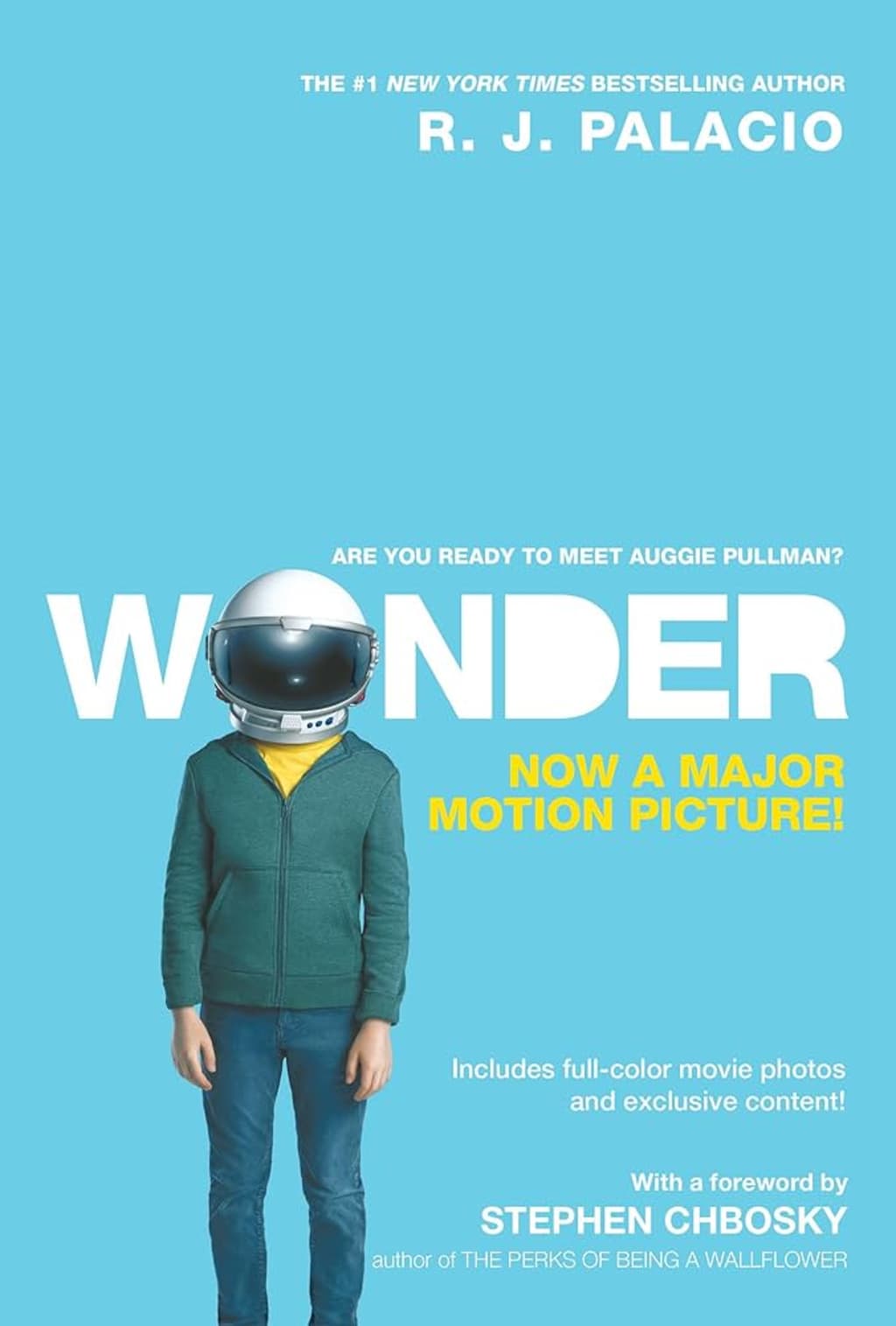
"Wonder" by R.J. Palacio
Page to Screen Book Club

About the Book/Movie:
I won't describe what I look like. Whatever you're thinking, it's probably worse. August Pullman was born with a facial difference that, up until now, has prevented him from going to a mainstream school. Starting 5th grade at Beecher Prep, he wants nothing more than to be treated as an ordinary kid--but his new classmates can't get past Auggie's extraordinary face. Beginning from Auggie's point of view and expanding to include his classmates, his sister, her boyfriend, and others, the perspectives converge to form a portrait of one community's struggle with empathy, compassion, and acceptance. In a world where bullying among young people is an epidemic, this is a refreshing new narrative full of heart and hope. R.J. Palacio has called her debut novel "a meditation on kindness" --indeed, every reader will come away with a greater appreciation for the simple courage of friendship. Auggie is a hero to root for, a diamond in the rough who proves that you can't blend in when you were born to stand out.
Book vs. Movie:
Narrative Structure:
- Book: The novel has multiple perspectives, with each section narrated by a different character, including Auggie, Via, Summer, Jack, and others.
- Movie: While the film maintains multiple perspectives, it condenses some narrative elements and focuses more on Auggie's point of view.
Character Development:
- Book: The book delves deeper into the internal thoughts and emotions of various characters, providing a more nuanced understanding of their perspectives.
- Movie: Due to time constraints, the film streamlines character development and focuses primarily on Auggie's journey.
Omitted and Condensed Scenes:
- Book: The novel includes more detailed scenes and subplots, particularly those involving the supporting characters.
- Movie: To fit the film's runtime, certain scenes and details are condensed or omitted. Some secondary characters' stories are less explored in the movie.
Character Relationships:
- Book: Relationships between Auggie, his family, and friends are explored in greater depth, providing more context for their dynamics.
- Movie: While the film captures the essence of these relationships, it necessarily condenses certain aspects to fit the medium.
Internal Monologues:
- Book: The novel provides internal monologues and thoughts from various characters, offering insights into their motivations and feelings.
- Movie: Adapting internal thoughts to a visual medium poses challenges, so the film relies more on external actions and dialogue.
Expanded Backgrounds:
- Book: The book provides more extensive backgrounds for characters, including Auggie's family and friends.
- Movie: Some character backgrounds are streamlined in the film adaptation.
Details about Auggie's Condition:
- Book: The novel provides detailed descriptions of Auggie's appearance and his medical condition, allowing readers to form a vivid mental image.
- Movie: The film visually represents Auggie's condition, but some of the detailed descriptions from the book are not as explicitly shown.
Emphasis on Via's Perspective:
- Book: Via, Auggie's sister, has her own section in the novel, offering insight into her experiences and feelings.
- Movie: While Via's perspective is included in the film, some details from her narrative in the book are condensed.
Ending Details:
- Book: The novel concludes with more detailed resolutions for various characters, providing a broader sense of closure.
- Movie: The film streamlines the ending, focusing primarily on Auggie's achievements and the main narrative resolution.
Visual Interpretation:
- Book: Readers create their visualizations of characters and scenes based on the author's descriptions.
- Movie: The film provides a specific visual interpretation, influencing how audiences perceive the characters and their surroundings.
Discussion Questions:
Character Portrayals:
- Book: How do the descriptions of characters in the book compare to their visual representations in the movie? Did the actors capture the essence of the characters as you imagined them?
- Movie: Were there any notable differences in the way characters were portrayed on screen compared to your mental image while reading the book?
Narrative Structure:
- Book: The novel is primarily told from multiple perspectives, including Auggie, Via, and others. How does the book's use of different voices contribute to your understanding of the story?
- Movie: How does the film handle the multiple perspectives? Are there changes in the narrative structure that enhance or detract from the storytelling?
Visual Adaptation:
- Book: Discuss the vivid descriptions of Auggie's appearance and facial anomalies. How did the book make you visualize Auggie and his experiences?
- Movie: Consider the visual representation of Auggie and the prosthetics used in the film. How did the visual adaptation impact your emotional connection to the character?
Omitted or Condensed Scenes:
- Book: Were there any scenes or subplots from the book that you missed in the movie? Were there elements that you felt were essential to the story that were condensed or left out?
- Movie: Discuss the challenges of adapting a book into a feature film. Were there scenes or details that you think worked better in written form?
Character Development:
- Book: How does the book delve into the internal thoughts and emotions of the characters, particularly Auggie and his friends and family?
- Movie: Consider the challenges of conveying internal thoughts on screen. How did the actors' performances contribute to the portrayal of the characters' emotions?
Themes and Messages:
- Book: Explore the central themes of kindness, empathy, and acceptance as presented in the novel. How did the book convey its messages?
- Movie: Discuss how the film emphasizes these themes. Were there visual elements or performances that particularly stood out in conveying the story's messages?
Impact on Emotions:
- Book: How did the written narrative evoke emotions, especially empathy and compassion, as you followed Auggie's journey?
- Movie: Discuss how the film used visual and auditory elements to elicit emotional responses. Were there scenes that had a particularly powerful impact in the movie?
Ending and Resolutions:
- Book: Examine how the book concludes Auggie's story. Are there details or resolutions in the book ending that differ from the movie?
- Movie: Discuss any changes made to the ending in the film adaptation. Do you think these changes were effective in conveying the overall message of the story?
About the Creator
Kristen Barenthaler
Curious adventurer. Crazed reader. Librarian. Archery instructor. True crime addict.
Instagram: @kristenbarenthaler
Facebook: @kbarenthaler
Keep reading
More stories from Kristen Barenthaler and writers in BookClub and other communities.
"Rebecca" by Daphne du Maurier
About the Book/Movie: Ancient, beautiful Manderley, between the rose garden and the sea, is the county's showpiece. Rebecca made it so - even a year after her death, Rebecca's influence still rules there. How can Maxim de Winter's shy new bride ever fill her place or escape her vital shadow? A shadow that grows longer and darker as the brief summer fades, until, in a moment of climatic revelations, it threatens to eclipse Manderley and its inhabitants completely...
By Kristen Barenthalerabout a year ago in BookClub
Verizon Outage Disrupts Millions Across the United States
Verizon Outage Disrupts Millions Across the United States A major Verizon outage recently disrupted wireless voice, text messaging, and mobile data services for millions of users across the United States. The disruption affected users in many major cities, leaving phones unable to connect to the network and forcing devices into emergency-only mode. The outage highlighted how dependent individuals, businesses, and emergency services have become on reliable mobile networks and raised concerns about the potential consequences of such disruptions. Verizon confirmed the problem and stated that engineers were actively working to restore services as quickly as possible.
By America today about 5 hours ago in BookClub




Comments
There are no comments for this story
Be the first to respond and start the conversation.