
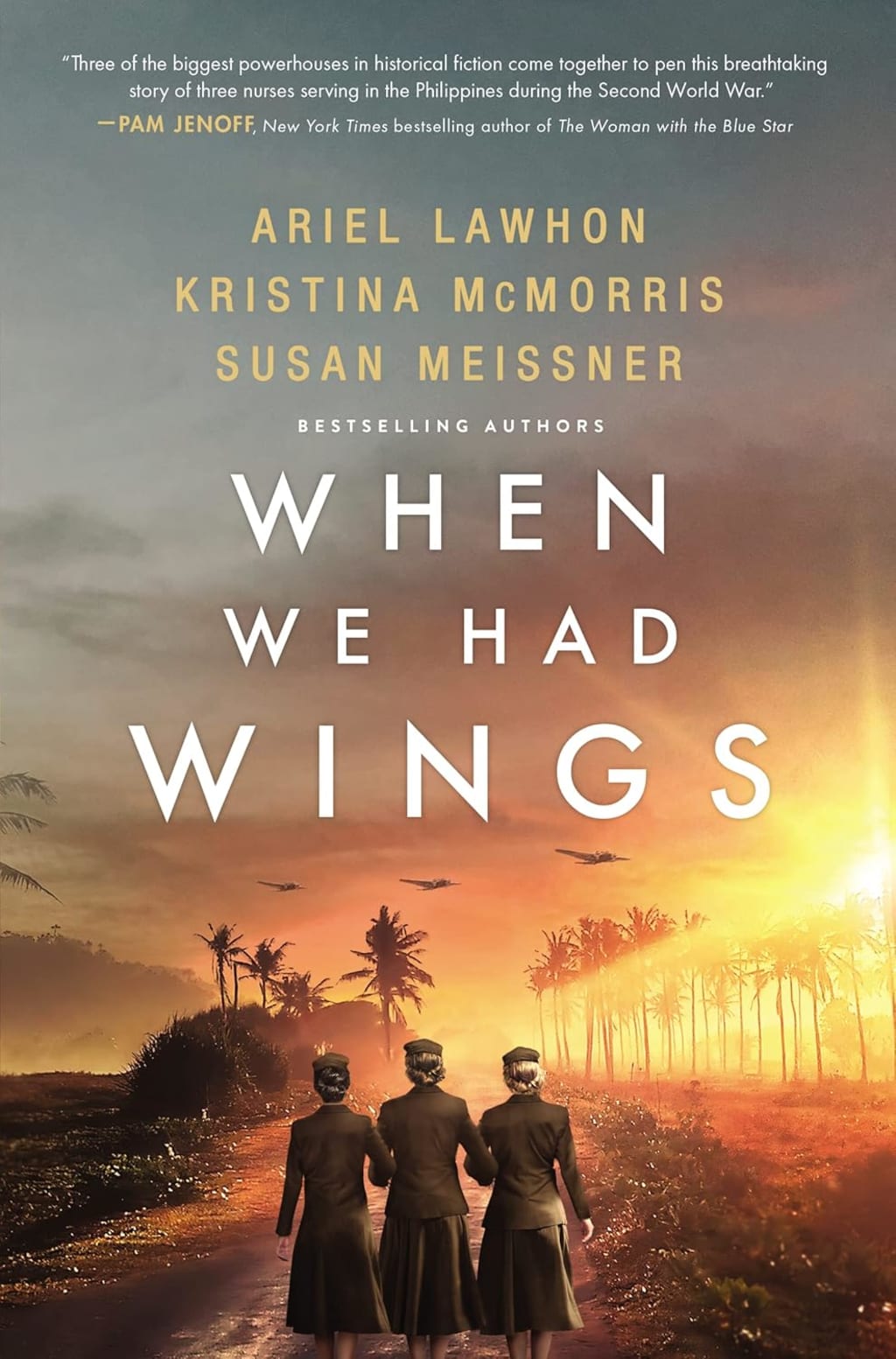
Book Review: When We Had Wings
By Ariel Lawhon, Kristina McMorris, and Susan Meissner
Historical fiction often serves as a bridge between past and present, allowing readers to engage with the human side of history. When We Had Wings is a prime example of this genre’s potential to inspire and educate. Co-authored by three celebrated writers—Ariel Lawhon, Kristina McMorris, and Susan Meissner—the novel offers a deeply affecting exploration of friendship, sacrifice, and survival against the backdrop of World War II. With its gripping narrative and complex characters, the book pays homage to the women who served as nurses in the Pacific during one of the darkest chapters of modern history.
Overview of the Plot
Set during the late 1930s and early 1940s, When We Had Wings introduces us to three extraordinary women: Penny Franklin, a Navy nurse from the United States; Lita Capel, a Filipina nurse working in her homeland; and Eleanor Lindstrom, an Australian Army nurse. The story begins with the trio stationed in the Philippines, a tropical paradise that quickly transforms into a battlefield as the Japanese invasion disrupts their lives. As war engulfs the Pacific, these women find themselves on the front lines, bound together by their shared experiences and their growing friendship.
Click here to read "When We Had Wings" for free with a 30-day free trail
The novel follows their journey as they navigate the horrors of war, including the devastating fall of Bataan and the infamous Bataan Death March. Ultimately, the three women endure the brutality of internment in Japanese prison camps, where their strength and solidarity are tested in unimaginable ways. Despite these challenges, their unwavering determination and compassion shine through, making their story one of resilience and hope.
Themes and Significance
Friendship and Solidarity
At its heart, When We Had Wings is a celebration of friendship. Penny, Lita, and Eleanor come from vastly different backgrounds, but their shared purpose as healers creates a bond that transcends cultural and national differences. The authors depict their friendship with nuance, showing how it evolves from casual camaraderie to a life-saving connection. In the face of war’s dehumanizing effects, their friendship becomes a source of strength, offering moments of light in the darkness.
The Role of Women in War
The novel highlights the often-overlooked contributions of women in wartime. As nurses, Penny, Lita, and Eleanor are portrayed not just as caregivers but as warriors in their own right, fighting to preserve life amidst the chaos of destruction. Their story challenges traditional narratives of war, emphasizing that heroism comes in many forms. The book also sheds light on the unique struggles faced by women during World War II, from gender discrimination to the physical and emotional toll of their work.
Resilience and the Human Spirit
The theme of resilience runs throughout the novel, as the characters confront loss, imprisonment, and the constant threat of death. Despite these hardships, they refuse to give in to despair. The authors explore how the human spirit can endure even in the most dire circumstances, illustrating this through the characters’ small acts of kindness and their determination to maintain their dignity.
Historical Reflection
When We Had Wings serves as both a tribute to the past and a reminder of the lessons history can teach us. By focusing on the experiences of nurses during World War II, the novel brings attention to a chapter of history that is often overshadowed by stories of combat. Through its detailed portrayal of events like the fall of Bataan and the life of prisoners in Japanese internment camps, the book underscores the importance of remembering and honoring the sacrifices of those who served.
Writing Style and Collaboration
One of the most impressive aspects of When We Had Wings is how seamlessly the three authors’ voices blend together. Each writer brings a unique perspective to the story, yet the transitions between their contributions are smooth and natural. The result is a cohesive narrative that feels unified despite being a collaborative effort.
The prose is evocative and richly descriptive, capturing both the beauty of the Philippine landscape and the horrors of war. The authors excel at creating a sense of place, transporting readers to the bustling streets of Manila, the dense jungles of Bataan, and the claustrophobic confines of the prison camps. Their attention to detail enhances the story’s authenticity, making it easy to visualize the world in which the characters live.
The narrative structure alternates between the perspectives of Penny, Lita, and Eleanor, giving readers insight into each character’s thoughts and experiences. This multi-perspective approach adds depth to the story, allowing the authors to explore the complexities of war from different angles. It also emphasizes the universality of the characters’ struggles, showing that their experiences, while unique, are part of a larger human story.
Click here to read "When We Had Wings" for free with a 30-day free trail
Character Development
The three protagonists are the heart of the novel, and their development is one of its greatest strengths. Each character is fully realized, with distinct personalities, motivations, and arcs.
Penny Franklin
Penny is a Navy nurse from the United States who embodies quiet strength and determination. Her journey is one of self-discovery, as she learns to navigate the challenges of war while staying true to her values. Penny’s resilience and compassion make her a compelling character, and readers will find themselves rooting for her as she faces both external and internal conflicts.
Lita Capel
Lita, a Filipina nurse, is perhaps the most complex of the three protagonists. Her story reflects the unique challenges faced by Filipinos during the war, including the dual pressures of serving as a caregiver and defending her homeland. Lita’s pride in her heritage and her unwavering loyalty to her friends make her a standout character. Her arc is one of growth and empowerment, as she learns to assert herself in the face of adversity.
Eleanor Lindstrom
Eleanor, the Australian Army nurse, serves as the glue that holds the trio together. Her pragmatic and nurturing nature contrasts with Penny’s quiet determination and Lita’s fiery spirit, creating a dynamic balance among the three characters. Eleanor’s story is one of perseverance, as she navigates the complexities of leadership while grappling with her own fears and doubts.
The relationships between the three women are portrayed with authenticity and depth, capturing the complexities of friendship under extraordinary circumstances. Their interactions are a mix of humor, tension, and heartfelt moments, reflecting the highs and lows of their shared journey.
Historical Accuracy and Research
One of the most commendable aspects of When We Had Wings is its commitment to historical accuracy. The authors conducted extensive research to ensure that the novel’s portrayal of events, settings, and cultural details is authentic. This meticulous attention to detail is evident throughout the book, from the descriptions of medical practices during the war to the depiction of life in Japanese internment camps.
The novel also incorporates real historical events, such as the fall of Bataan and the Bataan Death March, grounding the story in its historical context. By weaving these events into the narrative, the authors create a vivid and immersive portrayal of the war’s impact on individuals and communities.
Critiques
While When We Had Wings is a powerful and moving novel, it is not without its flaws. One potential critique is the pacing, which can feel uneven at times. The alternating perspectives, while effective in providing depth, occasionally disrupt the flow of the narrative. Some readers may find the transitions between the characters’ stories jarring, especially during the more action-packed or emotionally intense moments.
Additionally, the collaborative nature of the book, while a strength in many ways, occasionally results in shifts in tone that may be noticeable to discerning readers. These shifts are minor and do not detract significantly from the overall experience, but they may affect the story’s cohesion for some.
Finally, while the novel’s focus on the protagonists’ friendship is one of its highlights, some secondary characters are less fully developed. Expanding on these characters could have added additional layers of complexity to the story.
Click here to read "When We Had Wings" for free with a 30-day free trail
Overall Impact and Final Thoughts
When We Had Wings is a beautifully crafted novel that offers a deeply moving exploration of friendship, resilience, and the human spirit. Its focus on the experiences of women during World War II provides a fresh perspective on a well-documented period of history, shining a light on the often-overlooked contributions of nurses and caregivers.
Despite its minor flaws, the book succeeds in immersing readers in its world, evoking a wide range of emotions, from heartbreak to hope. The characters are memorable, the writing is evocative, and the story is both timely and timeless.
For fans of historical fiction and those seeking a powerful, character-driven narrative, When We Had Wings is a must-read. It is a testament to the strength of the human spirit and a reminder of the enduring power of friendship in the face of adversity.
Rating: ★★★★☆ (4.5/5)
About the Creator
My New Book is Finally Here
My poetry collection Beautiful and Brutal Things is done. It's actually done and finally published over 270 pages. Over a year of my life went into this book. More than a year, really. Long days at my computer, sometimes seven days a week because I couldn't stop even when I probably should have. Then two months of editing that felt harder than the writing itself. But it's finished, and I'm still standing, and the book is real.
By Tim Carmichael5 days ago in BookClub
From Babel to Code
Abstract This article argues that the central intellectual provocation in Neal Stephenson’s *Snow Crash* is neither the Metaverse as a virtual geography nor the novel’s satirical political economy, but the idea of language as a virus: a transmissible code capable of poisoning cognition, reshaping bodily behaviour, and reorganising social order. Stephenson links this viral model to the Tower of Babel as a myth of linguistic fracture and control, then projects it into a modern world where computer languages become the operational substrate of intelligent machines. The contemporary paradox is that large language models, built on formal code and computational syntax, increasingly mediate everyday human expression. Rather than machines corrupting a pure natural language, the argument developed here proposes the reverse: natural human language is itself unstable, illogical, and socially dangerous, and humans increasingly require technological filters to write, speak, and reason coherently. In an emergent environment where utterances are recorded, searchable, and algorithmically judged, language becomes less disposable and more accountable. The article concludes by interpreting this ‘global library’ condition as a new stage of linguistic civilisation, in which the risk of viral speech persists, yet the possibility of responsible language use expands through machine-assisted memory, verification, and form.
By Peter Ayolov5 days ago in BookClub




Comments
There are no comments for this story
Be the first to respond and start the conversation.