
"Water for Elephants" by Sara Gruen
Page to Screen Book Club

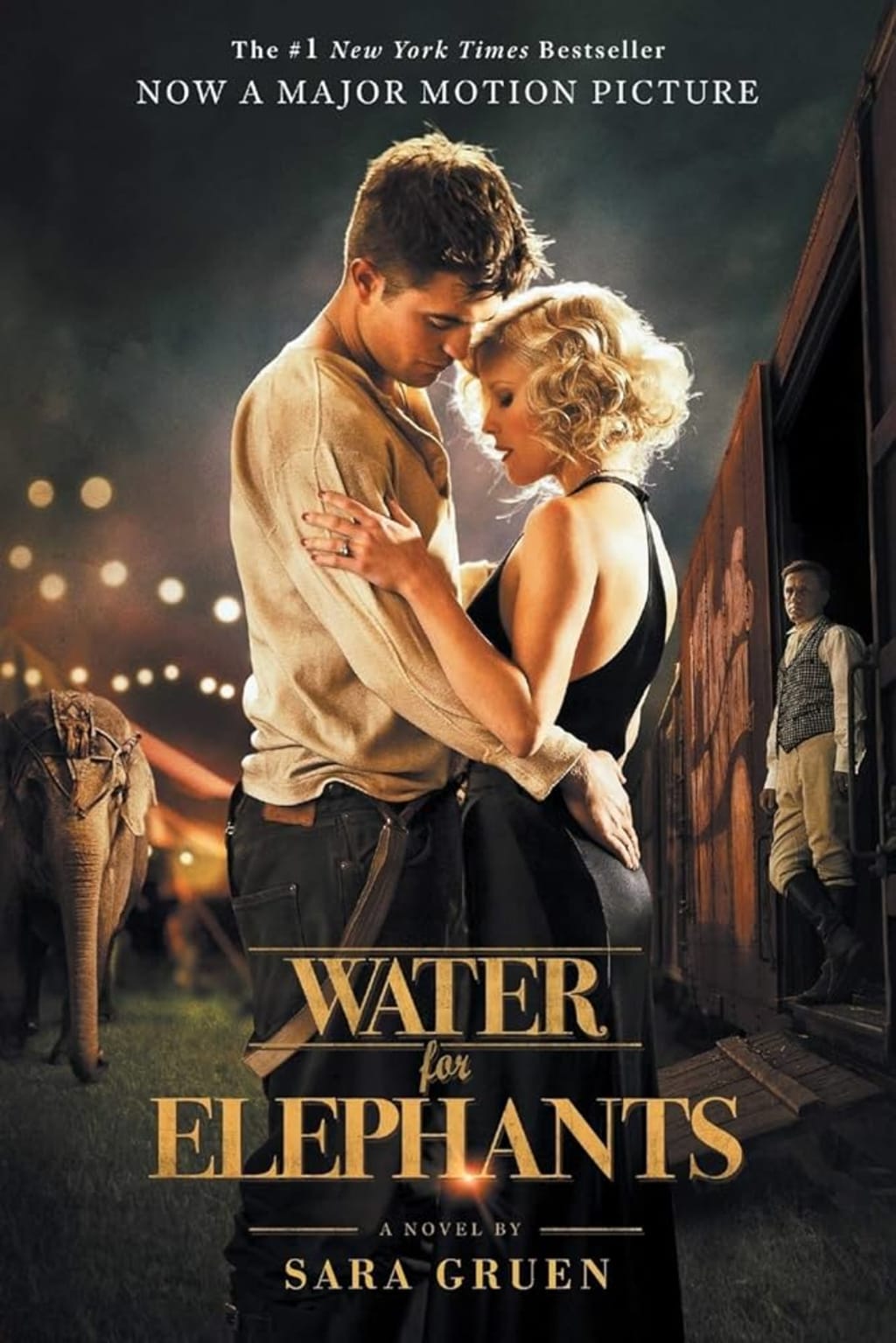
About the Book/Movie:
Jacob Janowski's luck had run out―orphaned and penniless, he had no direction until he landed on a rickety train that was home to the Benzini Brothers Most Spectacular Show on Earth. A veterinary student just shy of a degree, he was put in charge of caring for the circus menagerie. It was the Great Depression and for Jacob the circus was both his salvation and a living hell. There he met Marlena, the beautiful equestrian star married to August, the charismatic but brutal animal trainer. And he met Rosie, an untrainable elephant who was the great hope for this third-rate traveling show. The bond that grew among this group of misfits was one of love and trust, and ultimately, it was their only hope for survival.
Book vs. Movie:
Frame Story:
- Book: The novel is framed as a flashback, with the elderly Jacob Jankowski reminiscing about his time with the Benzini Brothers Most Spectacular Show on Earth.
- Movie: While the movie retains the flashback structure, it places less emphasis on the elderly Jacob's narrative.
Character Ages:
- Book: Jacob is portrayed as in his nineties when recounting his memories.
- Movie: Jacob is portrayed as a younger man in the 1930s during the main events of the story.
Rosie's Introduction:
- Book: Rosie, the elephant, is introduced earlier in the novel, and Jacob's initial interaction with her is more detailed.
- Movie: Rosie's introduction is somewhat condensed, and certain nuances from the book are omitted.
Marlena's Backstory:
- Book: Marlena's background, including details about her family, is explored more comprehensively.
- Movie: Marlena's backstory is simplified in the film.
Character Relationships:
- Book: Some character relationships and dynamics are explored in greater depth in the novel.
- Movie: Due to time constraints, the film may streamline or omit certain relationships.
Violence and Grit:
- Book: The novel does not shy away from portraying the darker, more violent aspects of circus life during the Great Depression.
- Movie: While the film retains some grittiness, it may be less intense than the book in its depiction of the harsh realities of the circus.
Jacob's Relationships:
- Book: Jacob's relationships, particularly with other circus workers, are more intricately developed in the novel.
- Movie: Some secondary characters and relationships are streamlined or condensed.
Ending Details:
- Book: The book provides additional details about Jacob's life after the events of the circus and offers a more nuanced conclusion.
- Movie: The film presents a more concise and visually focused ending.
Flashback Structure:
- Book: Jacob's memories are interspersed with scenes from his life in the nursing home.
- Movie: The film adaptation features fewer scenes of the elderly Jacob, focusing more on the main events of the past.
Internal Monologue:
- Book: Jacob's internal thoughts and reflections are more extensively explored in the novel.
- Movie: The film relies more on visual storytelling, and certain internal monologues are not as prominent.
Discussion Questions:
- What do you think were the most significant changes made during the adaptation process, and how did they affect the overall story?
- Were there any scenes or characters omitted from the movie that you believe should have been included?
- How did the actors' portrayals of the characters compare to the images you had created in your mind while reading the book?
- Were there any characters whose personalities or characteristics were altered in the film?
- How did the movie's visual representation of the circus compare to the images you had created in your mind while reading the book?
- In what ways did the film's cinematography enhance or detract from the atmosphere and setting described in the book?
- How did the movie handle the non-linear narrative style of the book? Did the adaptation successfully capture the dual timelines and the sense of nostalgia present in the novel?
- Were there any changes in the narrative structure that you found particularly effective or problematic?
- Did the movie successfully convey the same themes and symbolism present in the book?
- Were there any elements from the book that you think were not adequately explored or emphasized in the film?
- How did the tone and mood of the movie compare to that of the book? Were there any shifts that you found notable?
- Did the film capture the emotional depth and nuances of the book's storytelling?
- How did the critical reception of the book compare to that of the movie?
- Were there aspects of the adaptation that received particular praise or criticism?
- Do you think the changes made in the movie adaptation were influenced by a desire to appeal to a broader audience or to fit the constraints of the film medium?
- In your opinion, which version (book or movie) would likely have a broader appeal, and why?
- Which did you enjoy more—the book or the movie—and why?
- Do you think the movie adaptation successfully captured the essence and spirit of the book?
About the Creator
Kristen Barenthaler
Curious adventurer. Crazed reader. Librarian. Archery instructor. True crime addict.
Instagram: @kristenbarenthaler
Facebook: @kbarenthaler
Keep reading
More stories from Kristen Barenthaler and writers in BookClub and other communities.
"Where the Crawdads Sing" by Delia Owens
About the Book: For years, rumors of the "Marsh Girl" have haunted Barkley Cove, a quiet town on the North Carolina coast. So in late 1969, when handsome Chase Andrews is found dead, the locals immediately suspect Kya Clark, the so-called Marsh Girl. But Kya is not what they say. Sensitive and intelligent, she has survived for years alone in the marsh that she calls home, finding friends in the gulls and lessons in the sand. Then the time comes when she yearns to be touched and loved. When two young men from town become intrigued by her wild beauty, Kya opens herself to a new life--until the unthinkable happens. Where the Crawdads Sing is at once an exquisite ode to the natural world, a heartbreaking coming-of-age story, and a surprising tale of possible murder. Owens reminds us that we are forever shaped by the children we once were, and that we are all subject to the beautiful and violent secrets that nature keeps.
By Kristen Barenthalerabout a year ago in BookClub
7 Amazing Books To Help Improve Your Critical Thinking
In a world overflowing with information, opinions, and half-truths, critical thinking is no longer a “nice-to-have” skill—it’s essential. Every day, we’re asked to evaluate news headlines, make financial decisions, assess workplace strategies, and navigate complex social issues. Without strong critical thinking skills, we risk accepting flawed arguments, falling for misinformation, or making decisions that don’t serve our long-term goals.
By Diana Meresca day ago in BookClub



Comments
There are no comments for this story
Be the first to respond and start the conversation.