
The Truth Beneath My Smile: A Story I Never Meant to Tell
Behind every smile is a secret, and mine was tearing me apart.


They say the brightest smiles often hide the darkest secrets.
If that’s true, then mine was practically blinding.
All my life, I’ve been told how cheerful I am. “You’re always so positive,” they say. “I wish I had your energy,” they smile. What they don’t realize is that it takes effort—exhausting, relentless effort—to keep that smile in place.
Because behind it lives a truth I’ve never told. Until now.
It started when I was ten.
My father used to call me his “sunshine.” Every morning, he’d ruffle my hair, hand me my favorite cereal, and drive me to school humming songs from the ’80s. I loved those rides. They were my safe space.
Then one evening, I came home from school, and the house was silent. Too silent. My mother was in the kitchen, hands trembling, her eyes red from crying.
“He’s gone,” she said.
Just like that, he was gone. No goodbye. No explanation. A bag of clothes missing from the closet and a note with a single line: “I’m sorry, I can’t do this anymore.”
I didn’t understand it at the time. I thought maybe he forgot something and would come back. I waited by the window for days. Then weeks. But he never did.
That’s when I learned to smile.
It started small—forcing a grin when neighbors asked how I was, pretending to laugh with classmates at lunch, telling my mom I was “okay” when I wasn’t. I didn’t want to add more weight to her shoulders. She looked broken, and I thought maybe if I smiled enough, I could fix things. Maybe if I looked happy, I would be happy.
The truth is: I wasn’t.
I felt abandoned. Replaced. Not good enough to be kept. But no one ever asked, and I never said it.
That smile stayed with me through middle school and high school. I became “the cheerful one.” I joined drama club, led school events, won “Best Personality” in the yearbook. Everyone saw the smile and assumed everything underneath it was whole.
But it wasn’t.
In college, I started having panic attacks. Silent ones. I’d excuse myself from group hangouts, lock myself in bathroom stalls, and cry quietly until my hands stopped shaking. Then I’d look in the mirror, wash my face, and put the smile back on.
I was afraid of being a burden. Of being “too much.” Of someone seeing the broken parts and walking away—like he did.
So I dated people who didn’t really know me. I kept my pain to myself. I became a master of changing the subject, of redirecting conversations, of laughing just loud enough to drown out the sadness.
Then I met Zara.
She was the first person who saw through me.
“You don’t always have to smile, you know,” she said one evening while we sat on the campus lawn. “It’s okay to be real.”
I didn’t know how to respond. No one had ever said that to me before.
We became close. She listened more than she spoke. She never pushed me, but slowly, gently, I started to unravel. I told her about the note. About the silence in our house. About how my mother never spoke of him again, as if erasing him would erase the damage he left behind.
I told her I hated how much I still missed him, even now. How I hated myself for wondering if it was my fault.
She held my hand and said, “It wasn’t your fault. And it’s okay to miss someone who hurt you. That’s what makes you human.”
That night, I cried without hiding. And for the first time in years, I smiled—really smiled—because I felt safe.
Since then, I’ve started unlearning the habit of wearing a smile as a shield. Some days I slip back into it. But I’m learning that the people who truly care about you don’t want perfect. They want real.
I’m still healing. I still miss my father—less for who he was and more for who I hoped he’d be. But I’m no longer hiding behind a mask.
This is the truth beneath my smile:
I’ve been hurt. I’ve been abandoned. I’ve been scared, lonely, and angry.
But I’ve also survived. I’ve grown. I’ve learned to love again—especially myself.
And I finally understand that vulnerability isn’t weakness. It’s strength.
Smiling can be brave. But so is crying. So is telling your story.
Even when it’s the one you never meant to tell
About the Creator
Keep reading
More stories from Muhammad Rehan and writers in BookClub and other communities.
The Library of Living Spells
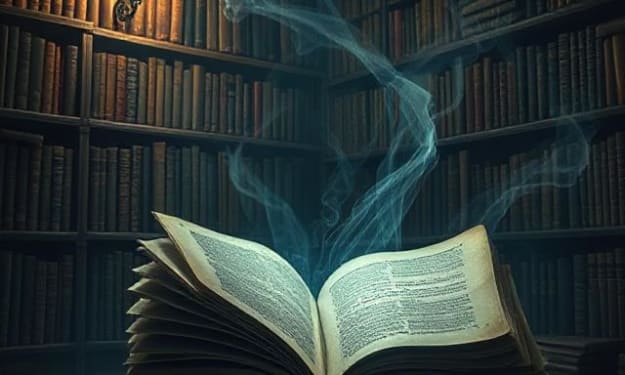
I found the library by accident—or so I believed at the time. I had ducked into an alley to escape the pouring rain, the kind that soaks you to the bones in seconds. That’s when I saw the door. It was carved from dark wood and bore a symbol that pulsed faintly with blue light—like a heartbeat. I didn’t hesitate. I turned the brass handle and stepped inside.
By Muhammad Rehan9 months ago in Fiction
My New Book is Finally Here
My poetry collection Beautiful and Brutal Things is done. It's actually done and finally published over 270 pages. Over a year of my life went into this book. More than a year, really. Long days at my computer, sometimes seven days a week because I couldn't stop even when I probably should have. Then two months of editing that felt harder than the writing itself. But it's finished, and I'm still standing, and the book is real.
By Tim Carmichael4 days ago in BookClub
From Babel to Code
Abstract This article argues that the central intellectual provocation in Neal Stephenson’s *Snow Crash* is neither the Metaverse as a virtual geography nor the novel’s satirical political economy, but the idea of language as a virus: a transmissible code capable of poisoning cognition, reshaping bodily behaviour, and reorganising social order. Stephenson links this viral model to the Tower of Babel as a myth of linguistic fracture and control, then projects it into a modern world where computer languages become the operational substrate of intelligent machines. The contemporary paradox is that large language models, built on formal code and computational syntax, increasingly mediate everyday human expression. Rather than machines corrupting a pure natural language, the argument developed here proposes the reverse: natural human language is itself unstable, illogical, and socially dangerous, and humans increasingly require technological filters to write, speak, and reason coherently. In an emergent environment where utterances are recorded, searchable, and algorithmically judged, language becomes less disposable and more accountable. The article concludes by interpreting this ‘global library’ condition as a new stage of linguistic civilisation, in which the risk of viral speech persists, yet the possibility of responsible language use expands through machine-assisted memory, verification, and form.
By Peter Ayolov4 days ago in BookClub



Comments
There are no comments for this story
Be the first to respond and start the conversation.