

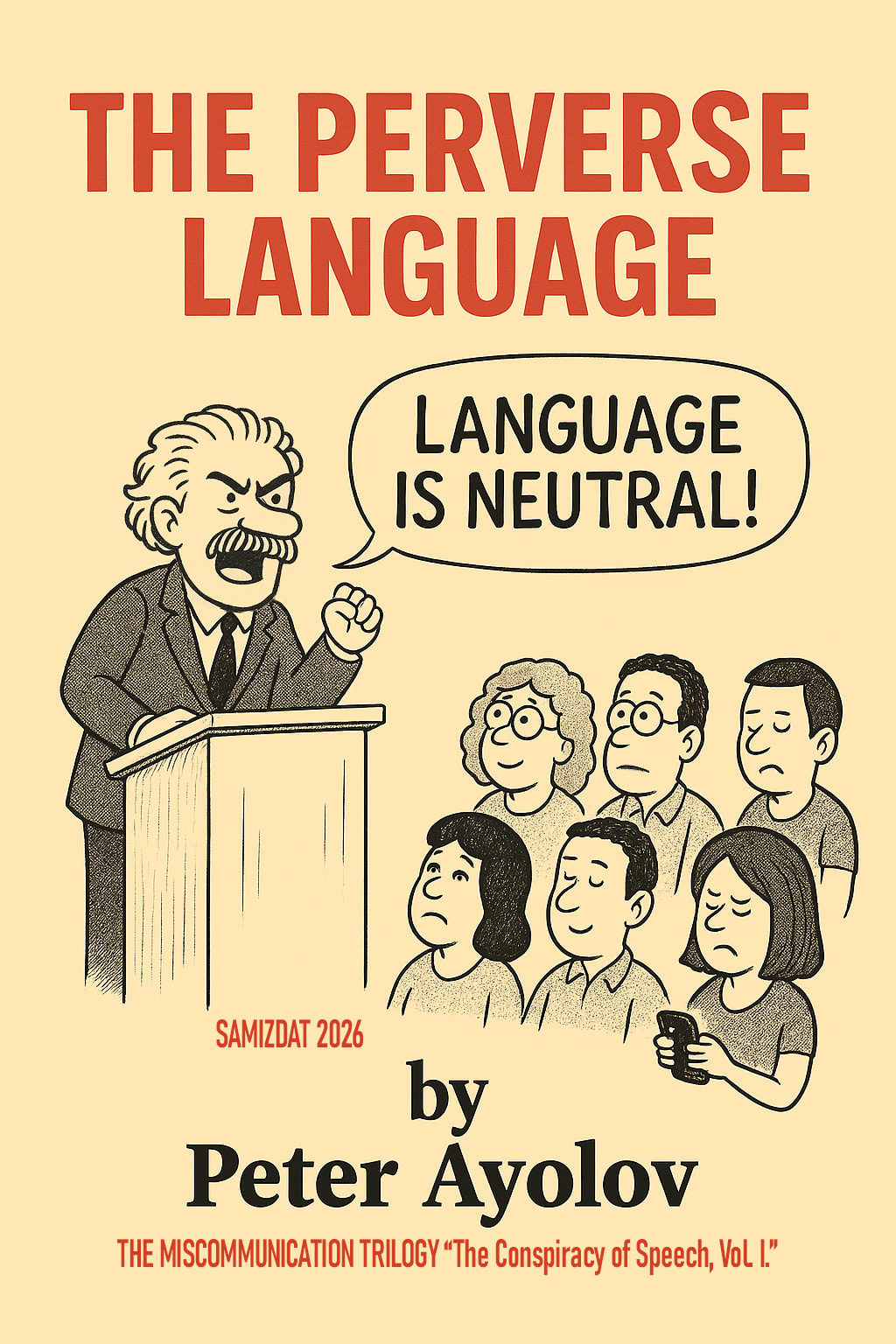
When Words Turn Against Meaning: A Review of The Perverse Language
The Perverse Language, the fourth and concluding part of Volume I in THE MISCOMMUNICATION TRILOGY, represents the most uncompromising stage of Peter Ayolov’s inquiry into the condition of contemporary communication. If the earlier parts of the volume explore the planned obsolescence of language, the conspiratorial nature of speech, and the emergence of anti-languages, this book confronts a more disturbing development: the inversion of language itself. Here, speech does not merely decay or fragment; it becomes structurally perverse — detached from shared reference, sincerity, and ethical accountability.
The term “perverse” is carefully chosen. Ayolov does not suggest that language has simply deteriorated through neglect or technological acceleration. Rather, he argues that communication in modern societies increasingly operates through inversion. Words maintain the appearance of meaning while hollowing out their referential core. Moral vocabulary persists, but its connection to lived practice weakens. Truth circulates more than ever, yet its authority dissolves. Language no longer mediates understanding; it performs legitimacy.
The book opens with an examination of mass miscommunication. Ayolov advances the idea that misunderstanding is no longer an occasional malfunction within otherwise stable discourse. It has become systemic. The expansion of communicative channels — social media, continuous news cycles, institutional messaging — multiplies expression while eroding shared interpretative frameworks. The more speech circulates, the less stable meaning becomes. The “miscommunication axiom” suggests that without shared cognitive and ethical anchors, communication tends toward entropy.
This argument gains force in the chapters devoted to lying. Rather than treating deception as a purely moral defect, Ayolov analyses it as a linguistic practice embedded in social incentives. Language enables strategic ambiguity, selective framing, and the careful management of context. Lies need not be explicit falsehoods; they can emerge through omission, euphemism, or overcomplication. Conspicuous dishonesty — when actors openly contradict observable reality — signals not merely moral decline but structural shifts in communicative norms. The boundary between error and manipulation blurs.
The section on hypocrisy deepens this diagnosis. Hypocrisy, Ayolov argues, thrives not in silence but in hyper-articulation. Institutions publicly affirm principles they privately undermine. Organised hypocrisy becomes a stabilising mechanism: moral language remains intact while practical operations diverge. The paradox is unsettling. Hypocrisy can preserve social cohesion by maintaining symbolic continuity even as substantive alignment collapses. Words protect legitimacy.
Ayolov’s analysis avoids simplistic condemnation. He recognises that complex societies require layers of representation. Yet he insists that when symbolic affirmation systematically diverges from lived practice, language risks losing credibility. Trust erodes not because words disappear, but because they multiply without grounding.
The chapter on deception moves beyond individual ethics into institutional structures. Deception becomes both art and science. Political messaging, corporate branding, and even scientific misconduct illustrate how persuasive narratives can captivate audiences while obscuring underlying realities. Particularly incisive is the concept of “overproduction of truth.” In contemporary information environments, censorship often operates not by silencing dissent but by saturating discourse with competing claims. When everything presents itself as truth, discernment weakens. The problem is no longer scarcity of information but excess without hierarchy.
The hermeneutic dimension of the book introduces another layer of complexity. Interpretation is necessary for understanding, yet interpretative frameworks are themselves shaped by ideology and bias. Typology and categorisation allow societies to organise complexity, but they also limit perception. Ayolov’s discussion of hermeneutics underscores a key insight: miscommunication cannot be solved simply by encouraging more interpretation. Without reflexivity regarding the frameworks guiding interpretation, multiplicity can exacerbate fragmentation.
Perhaps the most philosophically resonant section concerns obfuscation. Here Ayolov explores grammaticalisation, lexical inflation, and the proliferation of abstract terminology. Bureaucratic and corporate language frequently transforms concrete actions into neutral processes. Layoffs become restructuring; surveillance becomes optimisation; failure becomes adjustment. Such linguistic shifts redistribute agency. Responsibility dissolves into procedural vocabulary. Meaning does not vanish; it becomes diffuse.
Ayolov’s critique of obfuscation is not anti-intellectual. He does not reject complexity where it is warranted. Instead, he identifies a pattern in which complexity becomes strategic. The limits of words are exposed not because language cannot convey meaning, but because it is stretched into opacity. Obfuscation shields actors from accountability by making consequences difficult to trace.
The concept of hypernormalisation adds a socio-psychological dimension. Borrowed from analyses of late Soviet culture, hypernormalisation describes a condition in which citizens recognise the gap between official language and lived reality yet continue to participate in the performance. Distorted communication becomes normalised through repetition. Individuals learn to navigate contradictions without confronting them directly. Language operates as ritual rather than reference.
In this context, the “language of names” acquires particular importance. Labelling individuals or groups through reductive categories simplifies complex realities and facilitates dehumanisation. Once naming hardens into typology, empathy weakens. Words become instruments of distance. The perverse function of language lies not only in deception but in the subtle erosion of relational understanding.
Despite its critical intensity, The Perverse Language is not nihilistic. Ayolov does not claim that communication has become irredeemable. Rather, he insists that recognising perversion is the first step toward recalibration. By mapping how lying, hypocrisy, deception, obfuscation, and hypernormalisation operate, the book provides diagnostic clarity. It transforms vague cultural unease into structured analysis.
Stylistically, the book combines conceptual rigor with rhetorical urgency. Ayolov writes in declarative sentences that foreground structural patterns. At times, the tone approaches aphorism, yet the argument remains anchored in theoretical reflection. The interdisciplinary reach — drawing on linguistics, philosophy, media studies, and sociology — strengthens the analysis without overwhelming it.
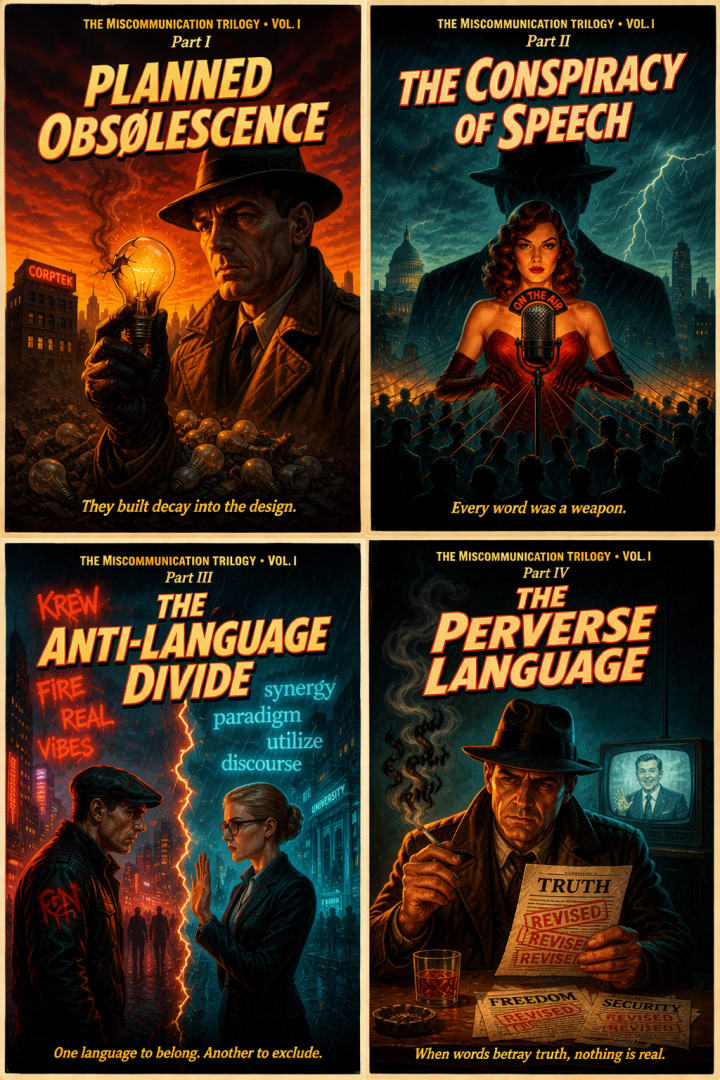
As the final part of Volume I in THE MISCOMMUNICATION TRILOGY, The Perverse Language performs a synthesising function. The first part diagnosed obsolescence; the second exposed conspiratorial speech; the third mapped anti-linguistic fragmentation. This book gathers those strands and demonstrates their culmination in inversion. Language, under certain conditions, ceases to mediate shared understanding and instead stabilises distortion.
One of the book’s strengths is its refusal to isolate blame. Technological systems accelerate distortion, but they do not create it ex nihilo. Political actors manipulate language, but they operate within cultural incentives. Citizens participate in hypernormalised performance, yet often out of pragmatic adaptation. Perversion is systemic, not merely individual.
A potential critique concerns the breadth of the argument. By addressing multiple forms of distortion within a single framework, the book risks appearing expansive rather than tightly delimited. However, this breadth reflects the phenomenon itself. Linguistic perversion is not confined to one domain; it permeates institutional, political, and interpersonal communication.
Importantly, Ayolov resists romantic nostalgia. He does not propose a mythical era of pure language as contrast. Instead, he frames perversion as a recurrent risk within complex communicative systems. What distinguishes the present condition is scale and acceleration. Digital platforms amplify obfuscation and hypernormalisation. Repetition stabilises distortion more quickly than in previous historical epochs.
The ethical dimension of the book emerges gradually. Responsibility lies not only with institutions but with speakers and listeners alike. Reflexivity becomes essential. To speak responsibly requires awareness of frames, contexts, and incentives. To listen responsibly requires discernment and patience. Language can be recalibrated, but only through conscious practice.
In its closing movement, The Perverse Language gestures toward the possibility of discommunication — not as simple breakdown, but as structural inversion. Lingua perversa names a condition in which speech maintains form while losing grounding. Sanity itself becomes intertwined with linguistic stability. When words detach from coherent reference, psychological and social equilibrium destabilise.
The book’s final effect is both unsettling and clarifying. It challenges readers to examine how they participate in distorted discourse. Which euphemisms are repeated automatically? Which contradictions are tolerated pragmatically? Which narratives are accepted because they stabilise comfort rather than illuminate truth?
As a work of critical communication theory, The Perverse Language offers a powerful contribution. It does not merely catalogue examples of misinformation or propaganda. It articulates a structural account of how inversion becomes normalised. The perverse is not exceptional; it becomes routine.
Within the architecture of THE MISCOMMUNICATION TRILOGY, this book marks a turning point. Volume I concludes not with resolution but with exposure. The diagnosis of perversion prepares the ground for subsequent exploration of entropy and fragmentation. By confronting distortion at its most systemic level, Ayolov ensures that the trilogy’s future volumes cannot retreat into abstraction.
Ultimately, The Perverse Language compels readers to reconsider the ethical stakes of communication. Words are not innocent carriers of intention. They are infrastructures of social reality. When that infrastructure bends toward inversion, communities fracture. Yet the possibility of recalibration remains.
Ayolov leaves us with a demanding insight: language can both conceal and reveal, distort and restore. The task is not to abandon speech but to recognise its perverse tendencies and counter them with disciplined clarity. In an age saturated with words yet starved of trust, this book stands as a rigorous and urgent meditation on the fragile architecture of meaning.
About the Creator
Peter Ayolov
Peter Ayolov’s key contribution to media theory is the development of the "Propaganda 2.0" or the "manufacture of dissent" model, which he details in his 2024 book, The Economic Policy of Online Media: Manufacture of Dissent.
Keep reading
More stories from Peter Ayolov and writers in BookClub and other communities.
The Anti-Language Divide
Divided Tongues, Divided Worlds: A Review of The Anti-Language Divide The Anti-Language Divide, the third part of Volume I in THE MISCOMMUNICATION TRILOGY, marks a decisive deepening of Peter Ayolov’s broader inquiry into the decay, distortion, and fragmentation of contemporary communication. If the earlier parts of the volume analyse the structural obsolescence of language and the conspiratorial nature of speech as coalition-building, this book turns inward to examine a subtler and more insidious phenomenon: the proliferation of anti-languages within shared linguistic space. It is here that the trilogy’s philosophical ambition becomes most explicit.
By Peter Ayolovabout 17 hours ago in BookClub
Rachel Reviews: Lakefront Wolves by Joseph Deegan
Meet Finn. He's an 18 year old kid who has potential. He's bright with great school scores and he's also an athlete, a footballer of some prowess. He has it all going for him, it would seem, and yet, he's determined to send what could be a well-planned, stable existence firmly off the rails. He drinks, he smokes, he takes drugs, he has violent tendencies and he's in danger of losing not only his mind but all that he holds dear.
By Rachel Deeming6 days ago in BookClub
The Silent Patient: The Mind-Blowing Thriller That Left Me Questioning Sanity, Secrets, and the Truth We Hide
When I first picked up The Silent Patient, I expected a typical psychological thriller. A shocking twist or two, some suspenseful scenes, and an entertaining read. What I didn’t anticipate was how deeply it would unsettle me, how it would keep me guessing until the very last page, and how it would make me reflect on the very nature of truth, perception, and silence.
By Lukáš Hrdlička6 days ago in BookClub
Review of 'Man on the Run'
My wife and I saw Man on the Run, a nearly 2-hour documentary on Amazon Prime, about Wings, Paul McCartney's group that flew around the world from shortly after The Beatles broke up in early 1970 to shortly after John Lennon was murdered at the end of 1980, making a Beatles reunion forever impossible.
By Paul Levinson6 days ago in Beat


Comments
There are no comments for this story
Be the first to respond and start the conversation.